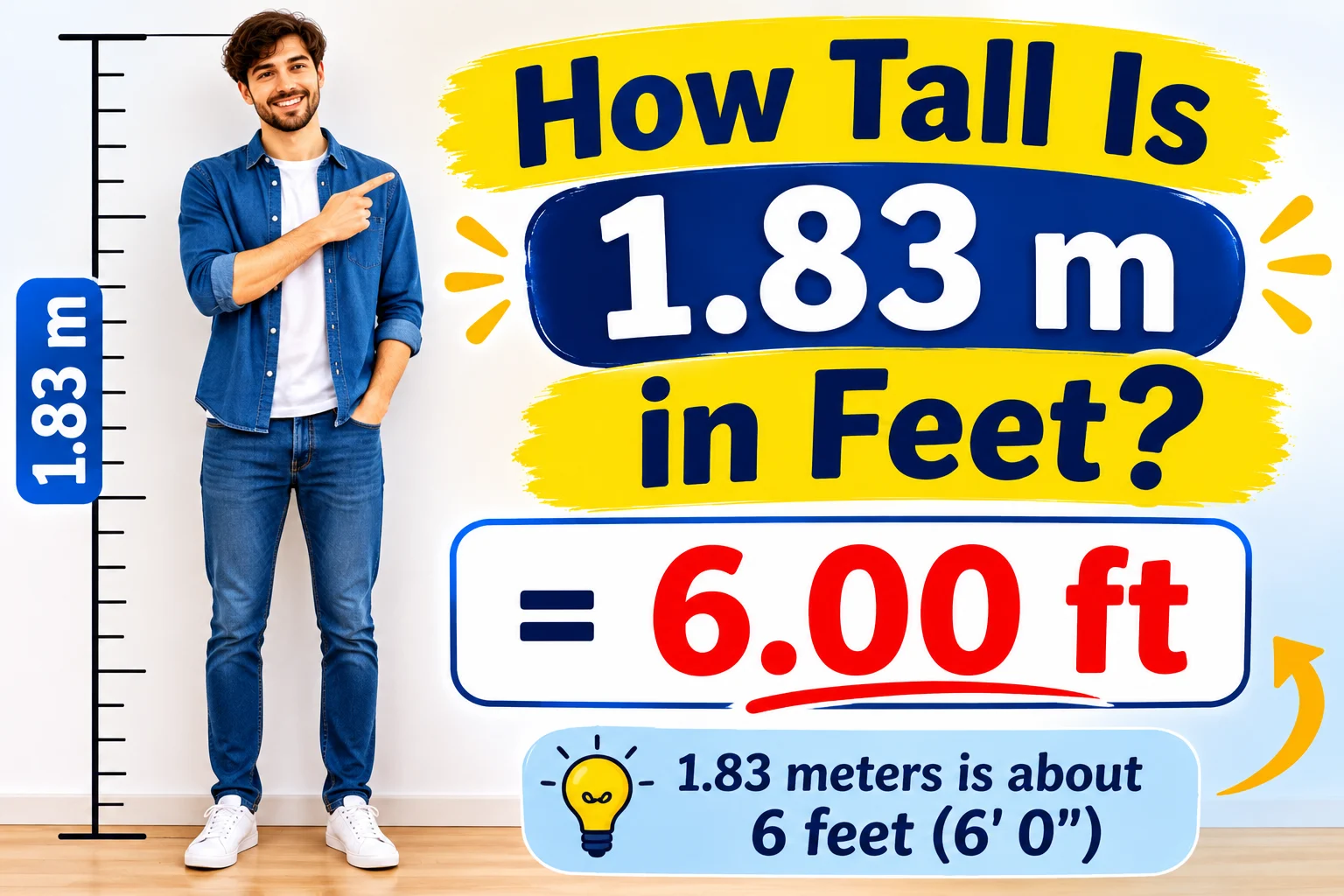
If you see someone’s height listed as 1.83 meters, you may immediately wonder how that translates into the feet-and-inches format commonly used in the United States. So, how tall is 1.83 m in feet?
The quick answer is 1.83 meters = 6.00394 feet, which is approximately 6 feet 0.05 inches. For everyday use, that rounds to exactly 6 feet (6’0″).
That tiny decimal difference matters when precision is important, but for describing a person’s height, 1.83 m is essentially 6 feet tall.
This measurement conversion comes up frequently when comparing international height records, reading medical or sports information, buying products with metric dimensions, or converting specifications between metric and U.S. customary units. The calculation itself is simple, but there is one common source of confusion: decimal feet are not the same thing as feet and inches.
This guide explains exactly how the conversion works, shows the calculation step by step, provides useful comparison tables, and gives practical examples so you can confidently convert 1.83 meters into feet and inches.
1. How Tall Is 1.83 m in Feet? Quick Answer
1.83 meters = 6.00394 feet.
In feet and inches:
1.83 meters ≈ 6 feet 0.05 inches, or approximately 6 feet 0 inches.
For most everyday situations, the best answer is simply:
1.83 m = 6 feet tall
The standard conversion formula is:
Feet = meters × 3.28084
Therefore:
1.83 × 3.28084 = 6.0039372 feet
Rounded to five decimal places:
1.83 m = 6.00394 ft
Because there are 12 inches in one foot, the tiny decimal portion can be converted into inches:
0.00394 × 12 ≈ 0.047 inches
So the full measurement is approximately:
6 feet 0.05 inches
Quick conversion table
| Measurement | Equivalent |
|---|---|
| 1.83 meters | 6.00394 feet |
| 1.83 meters | 21.6 dm |
| 1.83 meters | 183 centimeters |
| 1.83 meters | 72.0472 inches |
| 1.83 meters | 6 ft 0.05 in |
| Rounded everyday height | 6 ft 0 in |
2. Understanding the Units
Before doing any unit conversion, it helps to understand what you’re converting.
A meter (m) is the fundamental unit of length in the International System of Units (SI). It is widely used around the world for measuring distance, height, dimensions, and other forms of length.
A foot (ft) is a U.S. customary unit of length. One foot contains exactly 12 inches.
The internationally standardized relationship is:
1 meter = 3.280839895 feet
For most everyday calculations, this is commonly rounded to:
1 meter ≈ 3.28084 feet
Therefore, 1.83 meters is just slightly more than 6 feet.
Metric and U.S. customary units
| Unit | System | Relationship | Common Uses |
|---|---|---|---|
| Meter (m) | Metric/SI | 1 m = 100 cm | Height, distance, science |
| Centimeter (cm) | Metric/SI | 100 cm = 1 m | Body measurements |
| Foot (ft) | U.S. customary | 12 in = 1 ft | Height, construction |
| Inch (in) | U.S. customary | 1/12 of a foot | Small dimensions |
| Yard (yd) | U.S. customary | 3 ft = 1 yd | Sports, fabric, distances |
This is a length conversion, so measurements such as square feet, cubic feet, pounds, gallons, and other area, weight, or volume units require different conversion formulas.
3. How Tall Is 1.83 m in Feet? Conversion Formula
The basic conversion formula is:
Feet = meters × 3.28084
For 1.83 meters:
1.83 × 3.28084
= 6.0039372 feet
Therefore:
1.83 meters ≈ 6.00394 feet
Converting the answer into feet and inches
The result is:
6.00394 feet
The whole-number portion is 6 feet.
The decimal portion is:
0.00394 feet
To turn that fraction of a foot into inches, multiply by 12:
0.00394 × 12 ≈ 0.047 inches
So:
1.83 m ≈ 6 ft 0.05 in
When rounded to the nearest whole inch:
1.83 m = 6 ft 0 in
Why does 1.83 m come out almost exactly to 6 feet?
This is a useful relationship to remember:
6 feet = 1.8288 meters
Compare that with:
1.83 meters
The difference is only:
1.83 − 1.8288 = 0.0012 meters
That’s just 1.2 millimeters.
So 1.83 meters is only about 0.05 inch taller than 6 feet.
Expert insight: If a height is listed as 1.83 m, describing it as 6 feet tall is appropriate for ordinary conversation. Keep the more precise value when you’re performing technical calculations.
4. 1.83 Meter Conversion Table
A conversion chart makes it easier to see how 1.83 meters relates to nearby heights.
| Meters | Feet | Feet & Inches, Approx. |
|---|---|---|
| 1.70 m | 5.57743 ft | 5 ft 6.93 in |
| 1.75 m | 5.74147 ft | 5 ft 8.90 in |
| 1.78 m | 5.83990 ft | 5 ft 10.08 in |
| 1.80 m | 5.90551 ft | 5 ft 10.87 in |
| 1.81 m | 5.93832 ft | 5 ft 11.26 in |
| 1.82 m | 5.97113 ft | 5 ft 11.65 in |
| 1.83 m | 6.00394 ft | 6 ft 0.05 in |
| 1.84 m | 6.03675 ft | 6 ft 0.44 in |
| 1.85 m | 6.06955 ft | 6 ft 0.83 in |
| 1.90 m | 6.23360 ft | 6 ft 2.80 in |
| 2.00 m | 6.56168 ft | 6 ft 6.74 in |
The table also shows something interesting: moving from 1.82 m to 1.83 m crosses the six-foot mark.
5. Practical Examples of 1.83 m in Feet
The conversion becomes more useful when you see where it appears in everyday situations.
Example 1: Converting a person’s height
Suppose someone’s height is recorded as 1.83 meters.
Use the formula:
1.83 × 3.28084 = 6.00394 feet
So the person is approximately:
6 feet tall
This is the most common reason someone searches for this conversion.
Example 2: Converting 1.83 m to inches
Since:
1 meter = 39.3700787 inches
Calculate:
1.83 × 39.3700787 = 72.047244 inches
Therefore:
1.83 m ≈ 72.05 inches
Since 72 inches equals 6 feet:
72.05 inches ≈ 6 feet
Example 3: A piece of furniture
Imagine a bookcase is listed as 1.83 meters tall.
Converting it gives approximately:
6 feet 0 inches
That makes it easier for someone familiar with U.S. customary units to visualize its height.
Example 4: Sports
Athletes’ heights are often published in both metric and U.S. customary units. A player listed at 1.83 m would generally be described in the United States as 6 feet tall.
This conversion is particularly useful when comparing international player profiles.
Example 5: Reverse conversion
Suppose you start with 6 feet and want to convert it into meters.
Use:
Meters = feet × 0.3048
So:
6 × 0.3048 = 1.8288 meters
This demonstrates why 1.83 m and 6 feet are effectively the same for normal height descriptions, while technically differing by only 0.0012 meter.
Example 6: A construction measurement
A contractor working from metric plans encounters a vertical dimension of 1.83 meters.
The exact conversion is approximately:
6.00394 feet
For a rough discussion, 6 feet may be sufficient. For installation or engineering work, however, the original metric specification should generally be preserved rather than casually rounded.
6. Common Conversion Mistakes
Metric-to-feet conversion is straightforward, but several mistakes can produce confusing answers.
Mistake 1: Reading 6.00394 feet as 6 feet 0.00394 inches
That’s incorrect.
The decimal is a fraction of a foot. To convert it to inches, multiply by 12.
0.00394 × 12 ≈ 0.047 inches
Mistake 2: Assuming 1 meter equals exactly 3 feet
For rough mental estimates, 3 feet may seem convenient. But the actual relationship is:
1 meter ≈ 3.28084 feet
Using 3 instead of 3.28084 creates increasing errors as the measurement gets larger.
Mistake 3: Confusing decimal feet with feet-and-inches
For example:
5.5 feet = 5 feet 6 inches
It does not mean 5 feet 5 inches.
The decimal portion must always be multiplied by 12 to obtain inches.
Mistake 4: Rounding too early
If you immediately round 1.83 meters to 6 feet and then use that rounded number in another technical calculation, you may introduce unnecessary error.
Keep the original measurement until the final result whenever precision matters.
Mistake 5: Mixing metric and U.S. customary units
If a drawing contains measurements in meters and feet, convert them into a common unit before calculating dimensions or comparing values.
Expert tip: For professional work, distinguish between a display value and a calculation value. A person can be described as 6 feet tall while a technical calculation still uses 1.83 meters.
7. Quick Mental Conversion Tips
You can estimate 1.83 meters without a calculator.
A useful approximation is:
1 meter ≈ 3.28 feet
Then:
1.83 × 3.28 ≈ 6.00 feet
So you can quickly remember:
1.83 meters is essentially 6 feet.
A useful benchmark
Another excellent reference point is:
6 feet = 1.8288 meters
Therefore, whenever you see a measurement close to 1.83 meters, you can immediately recognize it as approximately 6 feet.
Common height conversions
| Metric Height | Approximate U.S. Height |
|---|---|
| 1.60 m | 5 ft 3 in |
| 1.65 m | 5 ft 5 in |
| 1.70 m | 5 ft 7 in |
| 1.75 m | 5 ft 9 in |
| 1.80 m | 5 ft 11 in |
| 1.83 m | 6 ft 0 in |
| 1.85 m | 6 ft 1 in |
| 1.90 m | 6 ft 3 in |
| 1.95 m | 6 ft 5 in |
| 2.00 m | 6 ft 7 in |
For fast estimates, memorizing a few benchmark heights is often more useful than memorizing every conversion factor.
8. Comparing 1.83 Meters With Feet and Inches
Different formats can represent essentially the same physical height.
| Measurement Format | Value |
|---|---|
| Meters | 1.83 m |
| Centimeters | 183 cm |
| Decimal feet | 6.00394 ft |
| Decimal feet, rounded | 6.00 ft |
| Inches | 72.0472 in |
| Feet and inches | 6 ft 0.05 in |
| Nearest whole inch | 6 ft 0 in |
Which format should you use?
It depends on your purpose.
- Everyday conversation: 6 feet
- Height listings: 6’0″
- General measurement: 6.00 feet
- Technical calculations: 6.00394 feet
- Metric documentation: 1.83 meters
- Detailed inch measurement: 72.0472 inches
There is no single “best” format for every situation. Good measurement practice means choosing the format that communicates the required precision clearly.
9. Why Accurate Measurement Matters
A small difference in a height measurement can be irrelevant in casual conversation but important in a technical setting.
Construction
Contractors may need to convert metric architectural plans into U.S. customary units. Accurate conversions help prevent problems with clearances, framing, fixtures, doors, and equipment.
Engineering
Engineers often work across international standards. Preserving precision during unit conversion helps prevent accumulated measurement errors.
Manufacturing
A component designed using metric dimensions may need to fit equipment specified in inches or feet. Even small discrepancies can matter when parts must fit precisely.
Home renovation
Suppose you have a doorway that is exactly 6 feet high and want to install an object measuring 1.83 meters.
The conversion tells you:
1.83 m ≈ 6 ft 0.05 in
The object is actually about 0.05 inch taller than a 6-foot opening.
That is tiny, but it could matter in a real installation.
Education
This example also demonstrates an important mathematical lesson: rounding can hide a difference that still exists in the original measurement.
A student might correctly say that 1.83 m is about 6 feet, but a more precise calculation reveals that it is very slightly taller.
A practical case study
Imagine a homeowner orders a 1.83-meter-tall cabinet for a room with a measured vertical clearance of exactly 6 feet.
At first glance, both measurements appear identical.
But:
1.83 m = 6.00394 ft
while:
6 ft = 6.00000 ft
The cabinet is therefore approximately 0.00394 foot, or 0.047 inch, taller.
In practice, the manufacturer may have dimensional tolerances, and the floor or ceiling may not be perfectly level. The lesson is simple: when physical fit matters, don’t rely on rounded conversions alone.
10. How Tall Is 1.83 m in Feet? Final Thoughts
So, how tall is 1.83 m in feet?
The exact conversion is:
1.83 meters = 6.00394 feet
In feet and inches, that is approximately:
1.83 meters = 6 feet 0.05 inches
For everyday use, you can confidently round it to:
1.83 m ≈ 6 feet (6’0″)
The conversion formula to remember is:
Feet = meters × 3.28084
For 1.83 meters:
1.83 × 3.28084 = 6.00394 feet
Key takeaways
- 1.83 m = 183 cm
- 1.83 m = 6.00394 ft
- 1.83 m ≈ 6 ft 0.05 in
- Rounded to the nearest inch, 1.83 m = 6 ft 0 in
- 6 feet = 1.8288 meters
- 1.83 meters is only about 0.05 inch taller than 6 feet
- Keep extra decimal places when precision matters
Whether you’re converting a person’s height, checking furniture dimensions, reading international specifications, or solving a measurement problem, this conversion is quick once you know the relationship between meters and feet.
Ready to convert another measurement? Explore more length-conversion guides for meters, centimeters, feet, inches, yards, and miles—and learn how to move confidently between metric and U.S. customary units.
FAQs About How Tall Is 1.83 m in Feet
How tall is 1.83 m in feet?
1.83 meters is 6.00394 feet, which is approximately 6 feet 0.05 inches. Rounded to the nearest whole inch, that is 6 feet 0 inches. In everyday conversation, you would normally describe someone who is 1.83 meters tall as 6 feet tall. The slight difference exists because 6 feet is exactly 1.8288 meters, making 1.83 meters just 1.2 millimeters taller.
Is 1.83 meters exactly 6 feet?
No, but it is extremely close. 6 feet equals exactly 1.8288 meters, while 1.83 meters is 0.0012 meter taller. That difference is approximately 1.2 millimeters, or about 0.047 inch. For normal height descriptions, 1.83 meters can be rounded to 6 feet. For technical calculations, however, it is better to retain the original 1.83-meter measurement.
What is 1.83 m in feet and inches?
1.83 meters is approximately 6 feet 0.05 inches. To calculate this, first convert meters to decimal feet: 1.83 × 3.28084 = 6.00394 feet. Then convert the decimal portion into inches: 0.00394 × 12 ≈ 0.047 inches. Rounded to the nearest inch, the result is 6 feet 0 inches.
What is 1.83 meters in inches?
1.83 meters equals approximately 72.0472 inches. The calculation uses the conversion factor 1 meter = 39.3700787 inches. Therefore, 1.83 × 39.3700787 = 72.0472 inches. Since 72 inches equals 6 feet, this confirms that 1.83 meters is just slightly taller than 6 feet.
What is the easiest way to convert 1.83 meters to feet?
The easiest method is to multiply the meter measurement by 3.28084. For 1.83 meters, calculate 1.83 × 3.28084 = 6.00394 feet. If you only need an everyday estimate, remember that 1.83 meters is essentially 6 feet. For technical work, use the full conversion rather than relying on the rounded value.
Can I convert 1.83 meters to feet without a calculator?
Yes. For a quick mental calculation, use 1 meter ≈ 3.28 feet. Then 1.83 × 3.28 gives approximately 6.00 feet. Another useful shortcut is remembering that 6 feet equals 1.8288 meters. Because 1.83 meters is extremely close to 1.8288 meters, you can immediately recognize 1.83 meters as approximately 6 feet.
Why is accurate conversion important?
Accurate unit conversion matters when measurements affect physical fit, manufacturing, construction, engineering, or safety. In casual conversation, rounding 1.83 meters to 6 feet is perfectly reasonable. But if you’re checking whether a 1.83-meter object will fit inside a 6-foot opening, the small difference could matter. Technical calculations should therefore retain sufficient precision until the final result.
What formula should I remember for meters to feet?
Remember this simple conversion formula:
Feet = meters × 3.28084
For the reverse conversion:
Meters = feet × 0.3048
These formulas work for length measurements. They should not be used directly for square feet, cubic feet, pounds, gallons, or other units because area, volume, weight, and length require different conversion factors.
How Many Square Feet in a Roof Square?