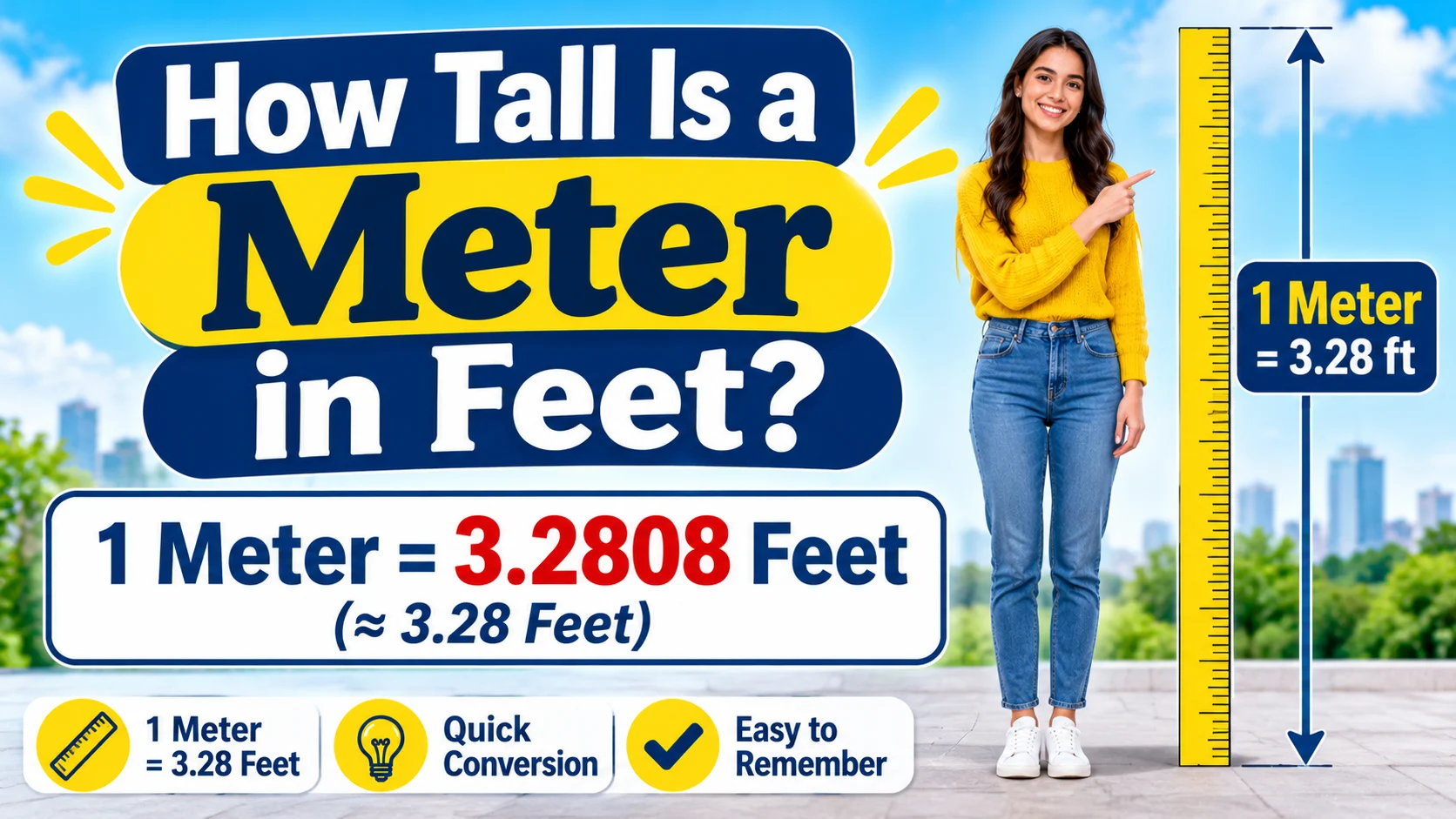
Imagine you are shopping for a 1-meter-long shelf, checking the height of a piece of furniture, or trying to understand a metric measurement on a product label. If you normally think in feet and inches, the number 1 meter may not mean much at first.
So, how tall is a meter in feet?
The quick answer is that 1 meter equals approximately 3.28 feet. More precisely, one meter is 3.28084 feet, or about 3 feet 3.37 inches.
That small decimal difference can matter when you are working on a construction project, measuring a room, converting engineering specifications, or simply trying to visualize a metric length.
The good news is that the conversion is straightforward. Once you know that 1 meter = 3.28084 feet, you can convert almost any measurement from meters to feet with a simple multiplication.
This guide explains the conversion formula, shows exactly how the calculation works, provides useful conversion charts, and gives real-world examples so you can confidently calculate measurements without guessing.
1. Quick Answer: How Tall Is a Meter in Feet?
1 meter = 3.28084 feet.
For everyday measurements, you can round this to:
1 meter ≈ 3.28 feet
In feet and inches, that is approximately:
1 meter = 3 feet 3.37 inches
The conversion formula is:
Feet = Meters × 3.28084
For example:
1 × 3.28084 = 3.28084 feet
So, a meter is a little more than 3¼ feet.
Quick reference
| Metric measurement | Feet | Approx. feet & inches |
|---|---|---|
| 0.5 meter | 1.64042 ft | 1 ft 7.68 in |
| 1 meter | 3.28084 ft | 3 ft 3.37 in |
| 1.5 meters | 4.92126 ft | 4 ft 11.06 in |
| 2 meters | 6.56168 ft | 6 ft 6.74 in |
| 3 meters | 9.84252 ft | 9 ft 10.11 in |
| 5 meters | 16.4042 ft | 16 ft 4.85 in |
| 10 meters | 32.8084 ft | 32 ft 9.70 in |
2. Understanding the Units
A meter is the fundamental unit of length in the International System of Units (SI), commonly called the metric system. It is used throughout most of the world for everyday measurements, science, engineering, manufacturing, and international trade.
A foot is a unit of length used primarily in the United States and is part of the U.S. customary measurement system. It is also used in some other countries and industries, particularly for height, construction, and aviation.
One foot is exactly:
1 foot = 0.3048 meter
Because that relationship is exact, the meter-to-foot conversion can also be expressed exactly:
1 meter = 3.280839895… feet
For practical work, 3.28084 feet is usually sufficient.
Meter vs. foot at a glance
| Feature | Meter | Foot |
|---|---|---|
| Measurement system | Metric/SI | U.S. customary |
| Exact relationship | 1 m | 0.3048 m |
| Common abbreviation | m | ft or ′ |
| Common uses | Science, international measurements, engineering | U.S. height, construction, real estate |
| Smaller than 1 meter? | — | Yes |
| Inches per unit | 39.3701 in | 12 in |
An important point: the U.S. customary foot and the international foot are the same length today. One foot is exactly 12 inches, and one inch is exactly 2.54 centimeters.
3. Conversion Formula: How Tall Is a Meter in Feet?
The standard conversion formula is simple:
Feet = Meters × 3.28084
Why multiply?
Because one meter contains approximately 3.28084 feet. Therefore, multiplying the number of meters by 3.28084 tells you how many feet occupy that same distance.
Example 1: Convert 1 meter to feet
Start with:
1 meter
Multiply by the conversion factor:
1 × 3.28084 = 3.28084 feet
Answer:
1 meter = 3.28084 feet
Example 2: Convert 2 meters to feet
2 × 3.28084 = 6.56168 feet
Therefore:
2 meters = 6.56168 feet
Rounded:
2 meters ≈ 6.56 feet
Example 3: Convert 1.75 meters to feet
1.75 × 3.28084 = 5.74147 feet
So:
1.75 meters ≈ 5.74 feet
To express the decimal portion as inches:
0.74147 × 12 ≈ 8.90 inches
Therefore:
1.75 meters ≈ 5 feet 8.9 inches
This is particularly useful when converting a person’s height from metric to the feet-and-inches format commonly used in the United States.
4. Meter-to-Foot Conversion Table
A reliable conversion chart saves time when you need to convert common measurements repeatedly.
| Meters | Feet | Approx. feet & inches |
|---|---|---|
| 0.1 m | 0.32808 ft | 3.94 in |
| 0.25 m | 0.82021 ft | 9.84 in |
| 0.5 m | 1.64042 ft | 1 ft 7.68 in |
| 0.75 m | 2.46063 ft | 2 ft 5.53 in |
| 1 m | 3.28084 ft | 3 ft 3.37 in |
| 1.25 m | 4.10105 ft | 4 ft 1.21 in |
| 1.5 m | 4.92126 ft | 4 ft 11.06 in |
| 1.75 m | 5.74147 ft | 5 ft 8.90 in |
| 2 m | 6.56168 ft | 6 ft 6.74 in |
| 2.5 m | 8.20210 ft | 8 ft 2.43 in |
| 3 m | 9.84252 ft | 9 ft 10.11 in |
| 4 m | 13.12336 ft | 13 ft 1.48 in |
| 5 m | 16.40420 ft | 16 ft 4.85 in |
| 10 m | 32.80840 ft | 32 ft 9.70 in |
Tip: For most everyday projects, rounding to two decimal places is more than adequate. For engineering or precision manufacturing, retain more digits according to the required tolerance.
5. Practical Examples of a Meter in Everyday Life
Knowing the number 3.28 feet is useful, but being able to visualize a meter is even more helpful.
Construction and home improvement
Suppose a product specification says a countertop is 2 meters long.
Calculate:
2 × 3.28084 = 6.56168 feet
So the countertop is approximately 6.56 feet long, or about 6 feet 6.7 inches.
Interior design
A curtain rod listed as 1 meter long measures about 3 feet 3 inches.
That can make it easier to determine whether the rod will span a particular window.
Human height
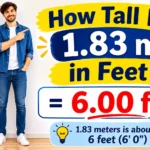
If someone’s height is 1.8 meters:
1.8 × 3.28084 = 5.90551 feet
The decimal portion can be converted into inches:
0.90551 × 12 ≈ 10.87 inches
So:
1.8 meters ≈ 5 feet 10.9 inches
Sports
A 10-meter platform or diving-related measurement can be converted quickly:
10 × 3.28084 = 32.8084 feet
That is approximately 32 feet 9.7 inches.
Education
Students often encounter meters in science and feet in everyday U.S. measurements. Practicing both directions helps reinforce how metric and U.S. customary units relate.
Shopping and product specifications
Imported furniture, exercise equipment, appliances, and outdoor products may list dimensions in centimeters or meters. Converting those dimensions to feet and inches helps U.S. shoppers determine whether an item will fit.
6. Common Conversion Mistakes
A basic unit conversion can still go wrong if you use the wrong operation or round too aggressively.
1. Dividing instead of multiplying
To convert meters to feet, multiply by 3.28084.
Correct:
2 × 3.28084 = 6.56168 ft
Do not divide meters by 3.28084 when going from meters to feet.
2. Confusing meters and centimeters
Remember:
1 meter = 100 centimeters
A measurement of 150 centimeters is 1.5 meters, not 150 meters.
3. Treating decimal feet as feet and inches
This is a very common mistake.
For example, 5.5 feet does not mean 5 feet 5 inches.
Instead:
0.5 × 12 = 6 inches
Therefore:
5.5 feet = 5 feet 6 inches
4. Rounding too early
If you repeatedly convert and round intermediate results, small errors can accumulate. Keep several decimal places during the calculation and round the final answer.
5. Mixing measurement systems
A project may list one dimension in meters and another in feet. Convert all measurements into the same unit before comparing them.
Expert tip: In construction, manufacturing, and engineering, always check the required precision before rounding. A difference that seems insignificant in a rough estimate can matter when measurements must fit together exactly.
7. Quick Mental Conversion Tips
You do not always need a conversion calculator.
For a quick estimate, remember:
1 meter ≈ 3.28 feet
A useful mental shortcut is:
Meters × 3.3 ≈ Feet
For example:
5 meters × 3.3 = 16.5 feet
The precise answer is:
5 × 3.28084 = 16.4042 feet
The shortcut is close enough for many casual estimates.
Easy numbers to memorize
| Remember this | Approximate equivalent |
|---|---|
| 1 meter | 3.28 feet |
| 2 meters | 6.56 feet |
| 3 meters | 9.84 feet |
| 5 meters | 16.40 feet |
| 10 meters | 32.81 feet |
For reverse conversion, remember:
1 foot = 0.3048 meter
So:
Feet × 0.3048 = Meters
Mental-math strategy
For a rough estimate:
- Multiply meters by 3.
- Add roughly one-quarter to one-third of the original meter value.
- Adjust if greater precision is needed.
For example, 4 meters is roughly:
4 × 3.25 ≈ 13 feet
The exact answer is 13.12336 feet.
8. Comparison: Meter vs. Foot
Understanding the relative size of the units makes length conversion easier to visualize.
| Category | Meter | Foot |
|---|---|---|
| Basic size | 1 meter | 0.3048 meter |
| Inches | 39.3701 inches | 12 inches |
| Measurement system | Metric/SI | U.S. customary |
| Typical precision | Metric decimal measurements | Feet/inches or decimal feet |
| Common applications | Science, global commerce, engineering | U.S. construction, height, real estate |
| Main advantage | Easy decimal scaling | Familiar for many U.S. measurements |
| Conversion to the other | 1 m = 3.28084 ft | 1 ft = 0.3048 m |
Common values worth remembering
| Measurement | Equivalent in feet |
|---|---|
| 50 cm | 1.64042 ft |
| 75 cm | 2.46063 ft |
| 100 cm | 3.28084 ft |
| 150 cm | 4.92126 ft |
| 180 cm | 5.90551 ft |
| 200 cm | 6.56168 ft |
| 250 cm | 8.20210 ft |
These values are especially useful when reading furniture dimensions, clothing or height information, sports specifications, and imported product measurements.
9. Why Accurate Measurement Matters
Accurate unit conversion is more than a classroom exercise. A wrong conversion can cause real-world problems.
Construction
A contractor ordering materials needs dimensions to match the plans. A conversion error can lead to materials being cut too short or too long.
Engineering
Engineers may work with international specifications that use metric units while equipment or existing structures use feet and inches. Consistent unit conversion is essential.
Manufacturing
Manufacturers often work with tight tolerances. Rounding a measurement unnecessarily can introduce errors that prevent components from fitting correctly.
Home renovation
Imagine ordering a 3-meter countertop while assuming it is only about 9 feet long. In reality:
3 meters = 9.84252 feet
That is nearly 9 feet 10 inches. A seemingly small misunderstanding could affect whether the countertop fits the intended space.
Education
Students who understand both systems are better prepared for science, technology, engineering, and mathematics subjects where different measurement systems may appear side by side.
A realistic case study
Suppose a homeowner measures a wall at approximately 4 meters and wants to purchase a U.S.-listed shelving system.
Using the conversion:
4 × 3.28084 = 13.12336 feet
The wall is about 13 feet 1.5 inches long.
If the homeowner mistakenly treats 4 meters as 12 feet, the error is more than a foot—large enough to affect the planned layout.
Measurement lesson: Convert first, then compare dimensions. Never rely on a rough visual estimate when a precise fit matters.
10. How Tall Is a Meter in Feet? Common Questions
How tall is a meter in feet exactly?
One meter equals 3.280839895 feet exactly when expressed using the defined relationship between the meter and international foot. For normal measurements, it is commonly rounded to 3.28084 feet, or simply 3.28 feet. In feet and inches, one meter is approximately 3 feet 3.37 inches.
Is 1 meter equal to 3 feet?
No. 1 meter is slightly longer than 3 feet. Three feet equals 0.9144 meters, while one meter equals 3.28084 feet. The difference is about 0.28084 foot, or approximately 3.37 inches. For rough estimating, someone might say a meter is about 3 feet, but that approximation should not be used for precise construction or engineering work.
What is the easiest way to convert meters to feet?
The easiest method is to multiply the meter measurement by 3.28084. For example, 2 meters × 3.28084 = 6.56168 feet. If you only need a rough estimate, multiply meters by 3.3. For accurate work, use the full conversion factor or a reliable measurement calculator.
Can I convert meters to feet without a calculator?
Yes. Memorize 1 meter ≈ 3.28 feet for quick mental calculations. For instance, 5 meters is roughly 16.4 feet. Another useful fact is that 1 meter is approximately 39.37 inches. Mental conversion is suitable for estimates, but use precise calculations when measurements affect construction, manufacturing, engineering, or other applications where accuracy matters.
Is the meter-to-foot conversion exact?
Yes. The relationship between the meter and the international foot is exact. One foot is exactly 0.3048 meter, so one meter is exactly 3.280839895… feet. The decimal continues, which is why practical answers are usually rounded to 3.28 or 3.28084 feet. The appropriate number of decimal places depends on the required measurement precision.
What formula should I remember for meter-to-foot conversion?
Remember this simple conversion formula:
Feet = Meters × 3.28084
For the reverse calculation:
Meters = Feet × 0.3048
These two formulas cover most everyday meter-to-foot and foot-to-meter conversions. If you frequently work with both systems, keeping these conversion factors handy can save time.
Why is knowing how tall a meter is in feet useful?
The conversion is useful whenever metric and U.S. customary measurements meet. Homeowners may need it when buying imported furniture, contractors may encounter metric specifications, students may convert science measurements, and travelers may need to understand distances or heights. Converting everything to the same unit also prevents mistakes when comparing dimensions.
How many feet are in 2 meters?
There are 6.56168 feet in 2 meters.
The calculation is:
2 × 3.28084 = 6.56168 feet
Rounded to two decimal places, that is 6.56 feet. In feet and inches, it is approximately 6 feet 6.74 inches.
How do I convert feet back to meters?
Multiply the number of feet by 0.3048.
For example:
10 feet × 0.3048 = 3.048 meters
Therefore, 10 feet equals 3.048 meters. This reverse conversion is useful when a U.S. measurement needs to be entered into a metric specification, engineering calculation, or international product document.
Final Thoughts
So, how tall is a meter in feet?
The answer is simple:
1 meter = 3.28084 feet, or approximately 3 feet 3.37 inches.
The key formula to remember is:
Feet = Meters × 3.28084
For reverse conversion:
Meters = Feet × 0.3048
The most important lesson is not just memorizing one number. It is understanding how the units relate, knowing when to round, and choosing the right level of precision for the job.
Whether you are measuring furniture, planning a renovation, studying mathematics, reading engineering specifications, or comparing international product dimensions, a reliable measurement conversion method can prevent costly mistakes.
Ready to convert another measurement? Explore more conversion guides for length, weight, volume, and other everyday units to make unit conversion quick and effortless.