Imagine you’re planning a four-mile walking route, measuring a stretch of land, or helping your child with a math assignment. The distance is given in miles, but you need the answer in feet. How do you convert it quickly and accurately?
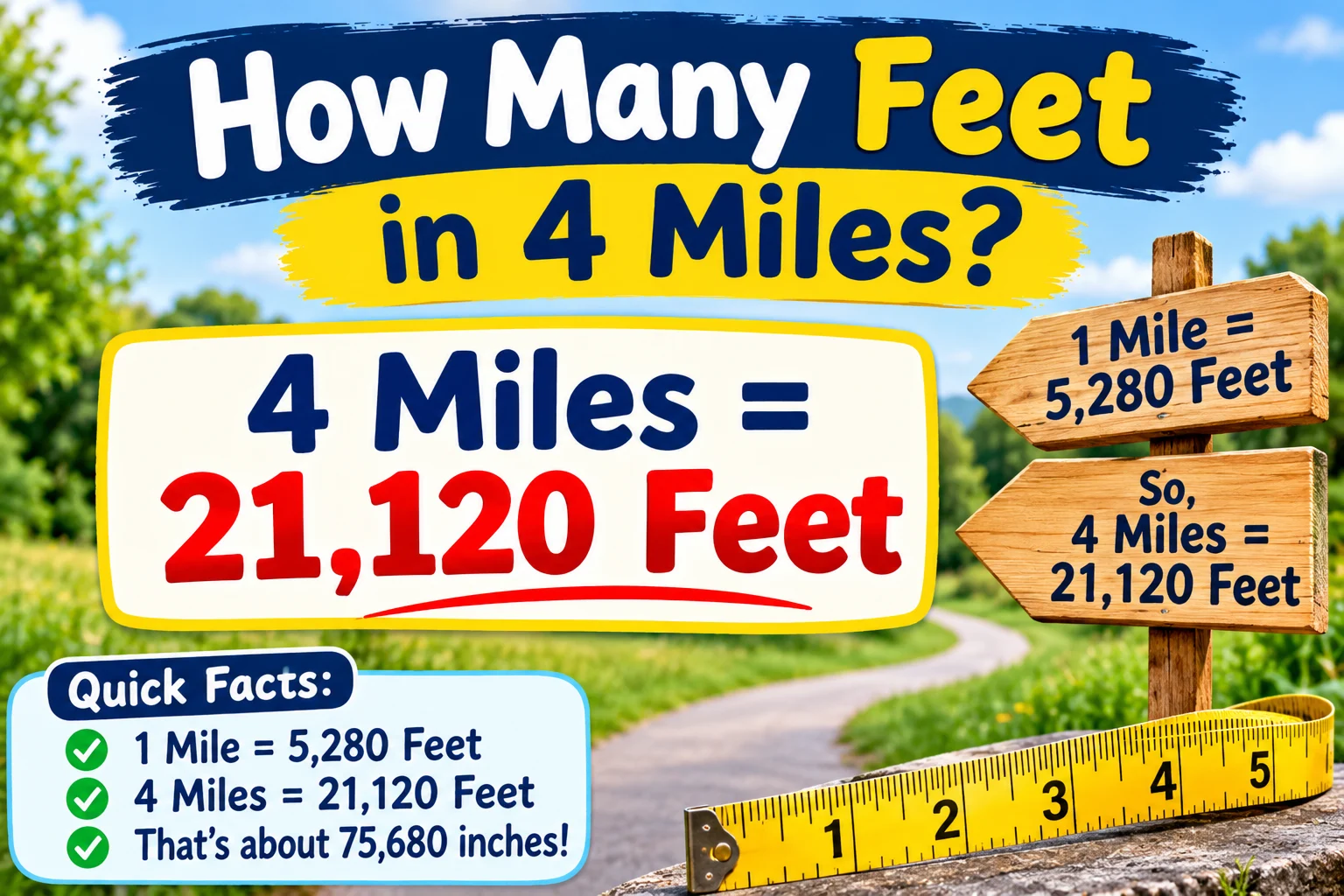
The answer is straightforward: there are 21,120 feet in 4 miles.
To calculate this measurement, multiply the number of miles by 5,280 because one standard statute mile equals exactly 5,280 feet.
Understanding this conversion is useful for students, homeowners, contractors, engineers, athletes, and anyone who works with distance measurements. It can help you interpret property dimensions, estimate walking distances, understand road measurements, and solve everyday math problems.
In this guide, you’ll learn the conversion formula, see a practical conversion chart, explore real-world examples, and discover easy mental math techniques. We’ll also cover common mistakes and answer frequently asked questions so you can convert miles to feet confidently, with or without a calculator.
1. Quick Answer: How Many Feet in 4 Miles?
Four miles equals exactly 21,120 feet.
The U.S. customary measurement system defines one statute mile as 5,280 feet. Therefore, converting four miles into feet requires multiplying four by 5,280.
- 1 mile = 5,280 feet
- 2 miles = 10,560 feet
- 3 miles = 15,840 feet
- 4 miles = 21,120 feet
The formula is:
This conversion is exact for standard statute miles, so you don’t need to round the result.
2. Understanding Miles and Feet
Before exploring the calculation, it helps to understand what these two units measure and when each is useful.
What Is a Mile?
A mile is a unit of length commonly used in the United States to measure longer distances.
Miles are frequently used for:
- Road distances between cities and towns.
- Driving directions and navigation.
- Running, walking, and cycling routes.
- Property boundaries and geographic distances.
One statute mile contains exactly 5,280 feet, 1,760 yards, or 63,360 inches.
What Is a Foot?
A foot is a smaller unit of length in the U.S. customary system. The plural form is feet.
Feet are commonly used to measure:
- Room dimensions and ceiling heights.
- Building materials and construction layouts.
- Furniture, landscaping, and property features.
- Sports fields and other physical spaces.
One foot contains 12 inches, and three feet make one yard.
How Do Miles Compare With Metric Units?
The metric system uses meters and kilometers instead of miles and feet.
| Measurement | Equivalent |
|---|---|
| 1 foot | 0.3048 meters |
| 1 mile | 1.609344 kilometers |
| 1 mile | 1,609.344 meters |
| 4 miles | 6.437376 kilometers |
| 4 miles | 6,437.376 meters |
| 4 miles | 21,120 feet |
These relationships help you convert between U.S. customary and metric units when working with maps, engineering plans, or international measurements.
3. Conversion Formula: How to Calculate Feet in 4 Miles
The miles-to-feet conversion formula is simple and consistent.
The number 5,280 is the conversion factor because every standard statute mile contains exactly 5,280 feet.
Step-by-Step Calculation
Let’s calculate how many feet are in four miles.
Step 1: Identify the distance.
You have 4 miles.
Step 2: Write the conversion factor.
Step 3: Multiply the distance by the conversion factor.
Step 4: Include the correct unit.
The result is exact.
Example 1: Convert 2.5 Miles to Feet
Suppose you want to measure a walking route of 2.5 miles.
Answer: 2.5 miles = 13,200 feet.
Example 2: Convert 0.75 Miles to Feet
A trail is 0.75 miles long.
Answer: 0.75 miles = 3,960 feet.
Example 3: Convert Feet Back to Miles
The reverse formula is:
If a road segment measures 26,400 feet:
Answer: 26,400 feet = 5 miles.
The key is to multiply when converting miles to feet and divide when converting feet to miles.
4. Miles-to-Feet Conversion Table
Use this conversion table to find common distances without repeating the calculation.
| Miles | Feet |
|---|---|
| 0.25 | 1,320 |
| 0.5 | 2,640 |
| 0.75 | 3,960 |
| 1 | 5,280 |
| 1.5 | 7,920 |
| 2 | 10,560 |
| 2.5 | 13,200 |
| 3 | 15,840 |
| 4 | 21,120 |
| 5 | 26,400 |
| 6 | 31,680 |
| 8 | 42,240 |
| 10 | 52,800 |
Common Distance Conversions
The following reference table includes other useful units for understanding distance.
| Distance | Feet | Yards |
|---|---|---|
| 1 mile | 5,280 | 1,760 |
| 2 miles | 10,560 | 3,520 |
| 3 miles | 15,840 | 5,280 |
| 4 miles | 21,120 | 7,040 |
| 5 miles | 26,400 | 8,800 |
Expert tip: Save this conversion chart if you frequently work with road distances, property measurements, or school assignments. Every additional mile adds another 5,280 feet.
5. Practical Examples: Where Is This Conversion Useful?
Knowing how many feet are in four miles is more than a math exercise. It can help you interpret distances in several real-world situations.
Walking and Running
Suppose you plan a four-mile walk for exercise. Converting the distance gives you 21,120 feet.
This can be useful when comparing route distances or working with tracking tools that display measurements in different units.
Remember that the conversion tells you the distance, not how long the walk will take. Travel time depends on your pace, terrain, and stops.
Construction and Land Measurement
Imagine a preliminary site plan describes a straight boundary as four miles long.
The equivalent distance is 21,120 feet. This value can help when reviewing plans that use feet instead of miles.
However, actual construction measurements should be verified against surveyed boundaries and project specifications. A unit conversion cannot replace a professional land survey.
Road Planning and Transportation
Transportation professionals often work with distances expressed in miles, while detailed engineering plans may use feet.
For example, a four-mile road segment corresponds to 21,120 feet. Converting between these units makes it easier to compare documents that use different measurement formats.
School Mathematics
Students may encounter miles-to-feet questions in arithmetic, measurement, and unit-conversion lessons.
The calculation reinforces multiplication, conversion factors, and dimensional reasoning.
A useful practice question is: How many feet are in 6 miles?
The same formula works regardless of the number of miles.
Travel and Navigation
A map may show a four-mile route, while a measurement tool reports the distance in feet.
Converting the route gives 21,120 feet. This may help you compare measurements, although the actual route can be longer than the straight-line distance between two locations.
6. Common Miles-to-Feet Conversion Mistakes
Even a simple conversion can lead to incorrect answers if you use the wrong operation or unit.
Mistake 1: Dividing Instead of Multiplying
Incorrect:
Correct:
Why it matters: Feet are smaller units than miles, so the numerical value must increase when you convert miles into feet.
Mistake 2: Using the Wrong Conversion Factor
A mile contains 5,280 feet, not 5,000 feet or 6,280 feet.
Using an approximate factor can produce an incorrect result when exact measurements are required.
Mistake 3: Confusing Feet With Yards
One mile equals 1,760 yards, but 5,280 feet.
If you accidentally use 1,760 as the number of feet per mile, your answer will be three times too small.
Mistake 4: Making Decimal Errors
For 2.5 miles:
A misplaced decimal can change the answer significantly. Estimate the result before finalizing it: 2.5 miles must be more than the 5,280 feet in one mile.
Mistake 5: Mixing Metric and U.S. Customary Units
Meters and feet are different units. If a project uses metric measurements, convert the distance consistently instead of mixing meters, feet, miles, and kilometers without checking the units.
Expert tip: Always write the unit beside your answer. Writing “21,120” alone is less clear than writing “21,120 feet.”
7. Quick Mental Conversion Tips
You can calculate many miles-to-feet conversions without a calculator.
Memorize the Base Conversion
Remember this number:
1 mile = 5,280 feet.
Once you know this relationship, every whole-mile conversion becomes a multiplication problem.
Break the Calculation Into Smaller Parts
For four miles, calculate:
- 4 × 5,000 = 20,000
- 4 × 280 = 1,120
- 20,000 + 1,120 = 21,120
This method makes the arithmetic easier to check mentally.
Use Half-Mile and Quarter-Mile Values
A half-mile equals 2,640 feet, and a quarter-mile equals 1,320 feet.
These values are helpful when converting distances such as 1.25, 2.5, or 3.75 miles.
For example:
You can also calculate this as three miles plus three-quarters of a mile:
Use a Conversion Calculator When Precision Matters
A conversion calculator is useful when working with unusual decimals, large distances, or several measurements at once.
For routine calculations, however, knowing the conversion factor is often enough.
8. Comparison Between Miles and Feet
Miles and feet both measure length, but each is suited to different types of distances.
| Feature | Mile | Foot |
|---|---|---|
| Relative size | Larger unit | Smaller unit |
| Feet per unit | 5,280 feet | 1 foot |
| Common uses | Roads, routes, long distances | Rooms, buildings, short distances |
| Typical precision | Convenient for broad distances | Convenient for detailed measurements |
| Main advantage | Easy to communicate long travel distances | Practical for construction and everyday dimensions |
| Conversion direction | Multiply by 5,280 to get feet | Divide by 5,280 to get miles |
Neither unit is inherently more accurate than the other. Accuracy depends on the measuring method, instrument, and precision of the recorded value.
For example, a distance can be stated as 4 miles for convenience or 21,120 feet for a more detailed unit representation. The two values describe the same length when the original distance is exactly four miles.
9. Why Accurate Measurement Matters
Correct unit conversion is essential whenever measurements guide decisions, purchases, or physical work.
Construction and Engineering
A conversion error can affect project estimates, layout calculations, and the interpretation of engineering drawings.
Professionals should verify conversion factors and retain consistent units throughout calculations.
Home Renovation and DIY
If you’re measuring a property boundary, planning a long fence line, or reviewing a site plan, converting between miles and feet can make the dimensions easier to understand.
For material quantities, remember that length is only one part of the calculation. A fence estimate, for instance, also needs appropriate allowance for posts, gates, and site conditions.
Manufacturing
Manufacturers rely on consistent units when preparing specifications and communicating dimensions across teams.
Even when a conversion is mathematically correct, recording the wrong unit can lead to misunderstandings or costly errors.
Education
Learning unit conversion helps students develop number sense and understand how measurement systems relate to one another.
It also teaches dimensional reasoning: the answer should make sense in terms of both its numerical value and its unit.
A Practical Case Study
Imagine a contractor reviewing a preliminary site document that lists a proposed straight access route as four miles. A separate planning sheet requests the same length in feet.
The contractor calculates:
The converted value can then be recorded on the planning sheet.
Before construction, the contractor would still verify the route’s surveyed length, the measurement reference points, and the project’s approved drawings. The conversion handles the units; it does not establish the actual site dimensions.
10. Final Thoughts: Remember How Many Feet in 4 Miles
The answer to how many feet in 4 miles is 21,120 feet.
The calculation uses one essential conversion factor:
To convert miles to feet, multiply by 5,280. To convert feet to miles, divide by 5,280.
Keep these key points in mind:
- Four miles equals exactly 21,120 feet.
- The conversion is exact for standard statute miles.
- Smaller units produce larger numerical values for the same distance.
- Always include the correct unit and double-check your arithmetic.
- Use a conversion calculator or reference chart when handling multiple measurements.
Whether you’re completing homework, comparing route distances, reviewing construction plans, or improving your measurement skills, this simple formula makes unit conversion easier.
Ready to improve your measurement skills? Explore more miles-to-feet, feet-to-inches, yards-to-miles, and metric conversion guides to build confidence with everyday calculations.
Frequently Asked Questions (FAQs)
1. How many feet are in 4 miles?
There are exactly 21,120 feet in 4 miles. Multiply four by the conversion factor of 5,280 feet per mile: 4 × 5,280 = 21,120. This applies to standard statute miles, which are used for ordinary U.S. road distances and most everyday mileage measurements.
2. What is the easiest way to convert miles to feet?
The easiest method is to multiply the number of miles by 5,280. For example, 3 miles equals 3 × 5,280, or 15,840 feet. Memorizing that one mile contains 5,280 feet makes most basic conversions straightforward, even without a calculator.
3. Can I calculate how many feet are in 4 miles without a calculator?
Yes. Break the calculation into manageable parts. Multiply four by 5,000 to get 20,000, then multiply four by 280 to get 1,120. Add the results: 20,000 + 1,120 = 21,120 feet. This mental math technique works for other whole-mile conversions as well.
4. Is the conversion from 4 miles to feet exact?
Yes. One standard statute mile is defined as exactly 5,280 feet. Therefore, four miles equals exactly 21,120 feet without rounding. This is a defined unit relationship, not an approximation. Be aware that a measured real-world distance may still have measurement uncertainty even when its unit conversion is exact.
5. What formula should I use to convert miles into feet?
Use the formula Feet = Miles × 5,280. To convert in the opposite direction, use Miles = Feet ÷ 5,280. These formulas work for whole numbers and decimal values. Always check that your answer uses the correct unit and that your multiplication or division matches the direction of the conversion.
6. How many yards and kilometers are in 4 miles?
Four miles equals 7,040 yards and 6.437376 kilometers. The yard conversion uses 1,760 yards per mile, while the kilometer conversion uses 1.609344 kilometers per mile. These relationships help you compare U.S. customary units with metric measurements when interpreting maps, travel distances, or technical documents.
7. Why are there 5,280 feet in a mile?
The 5,280-foot mile developed through historical English measurement conventions that combined furlongs and other traditional units. The modern international statute mile is now standardized as exactly 5,280 feet. Although the number may seem unusual, memorizing this established conversion factor makes miles-to-feet calculations consistent and reliable.
8. Where is the miles-to-feet conversion commonly used?
Miles-to-feet conversions are useful in education, construction planning, transportation, surveying, sports, and general distance calculations. For example, a route described as four miles can be expressed as 21,120 feet when a document requires that unit. In professional applications, always verify the original measurement and follow the project’s specified units.