Imagine you’re told that a hiking trail marker, property boundary, construction setback, or running route is 500 feet away. Feet are easy to picture when you’re working with a building or yard, but the distance can feel less intuitive when you switch to miles.
So, how far is 500 feet in miles?
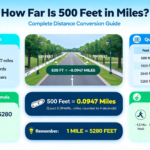
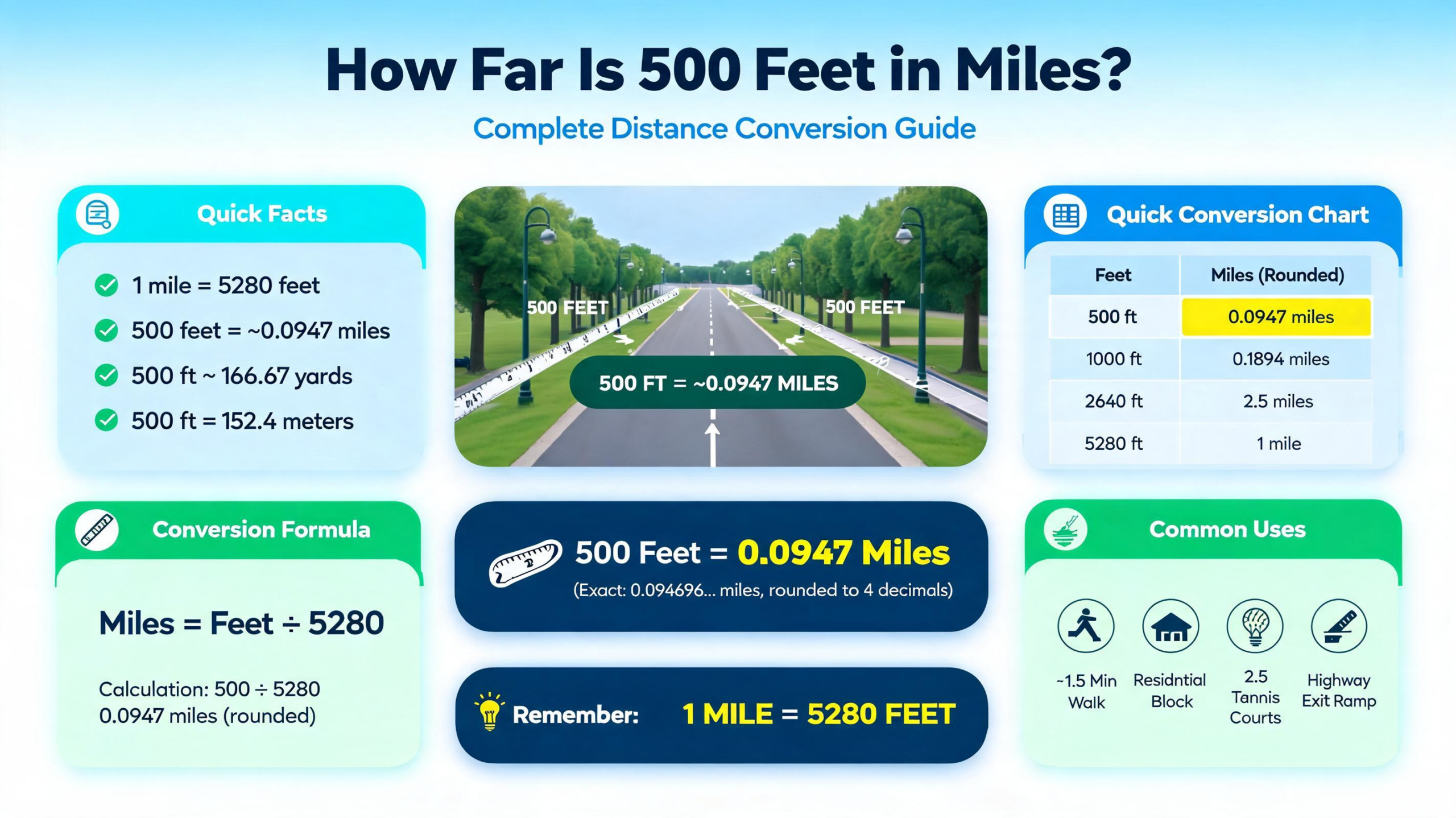
500 feet equals approximately 0.0947 miles. More precisely:
500 feet = 0.09469697 miles
That’s just under one-tenth of a mile.
The conversion is straightforward because a standard U.S. mile contains exactly 5,280 feet. Divide 500 by 5,280, and you have the distance in miles.
This measurement conversion is useful for everything from estimating walking distances and running routes to interpreting property plans, construction specifications, maps, and engineering measurements. Once you know the basic conversion formula, you can also convert other distances between feet and miles without relying entirely on a conversion calculator.
Quick Answer: How Far Is 500 Feet in Miles?
500 feet is approximately 0.0947 miles.
The conversion formula is:
Miles = Feet ÷ 5,280
For 500 feet:
500 ÷ 5,280 = 0.09469697 miles
For everyday use, you can round that to:
- 500 feet ≈ 0.095 miles
- 500 feet ≈ 9.47% of a mile
- 500 feet ≈ 1/10.56 of a mile
- 500 feet = 166.67 yards
- 500 feet = 6,000 inches
- 500 feet = 152.4 meters
If you’re looking for a quick answer, 0.0947 miles is the number to remember.
Understanding the Units: Feet and Miles
A foot (ft) is a unit of length used extensively in the United States. It is part of the U.S. customary system and is also historically related to the broader family of imperial measurements.
A mile (mi) is a much larger unit of distance. In the modern U.S. system:
1 mile = 5,280 feet
That relationship is exact, not an approximation.
Where feet are commonly used
Feet are practical for relatively short distances and dimensions, including:
- Room dimensions
- Building heights
- Property measurements
- Construction plans
- Furniture dimensions
- Ceiling heights
- Sports-field measurements
- Swimming pool lengths
Where miles are commonly used
Miles are more convenient for longer distances, such as:
- Road trips
- Highway distances
- Running and walking routes
- Travel directions
- Property-to-property distances
- Geographic distances
For comparison, the metric equivalent of 500 feet is 152.4 meters. While meters are standard in most countries, feet and miles remain common in everyday U.S. measurements.
Conversion Formula: How to Calculate 500 Feet in Miles
The key conversion formula is simple:
Miles = Feet ÷ 5,280
Why do we divide? Because one mile contains 5,280 feet. When converting a smaller unit into a larger unit, the numerical value becomes smaller.
Step-by-step calculation
To convert 500 feet:
- Start with the distance: 500 feet
- Use the conversion factor: 1 mile = 5,280 feet
- Divide 500 by 5,280.
- Round the result to the precision you need.
500 ÷ 5,280 = 0.094696969…
Therefore:
500 feet = 0.09469697 miles
For most practical situations, 0.0947 miles provides sufficient precision.
Example: Convert 1,000 feet
1,000 ÷ 5,280 = 0.1893939 miles
So:
1,000 feet ≈ 0.1894 miles
Example: Convert 250 feet
250 ÷ 5,280 = 0.0473485 miles
So:
250 feet ≈ 0.04735 miles
The same conversion formula works for virtually any number of feet.
500 Feet to Miles Conversion Table
A conversion chart can be more convenient than performing the calculation repeatedly.
| Distance in Feet | Distance in Miles |
|---|---|
| 100 ft | 0.01894 mi |
| 200 ft | 0.03788 mi |
| 300 ft | 0.05682 mi |
| 400 ft | 0.07576 mi |
| 500 ft | 0.09470 mi |
| 600 ft | 0.11364 mi |
| 700 ft | 0.13258 mi |
| 800 ft | 0.15152 mi |
| 900 ft | 0.17045 mi |
| 1,000 ft | 0.18939 mi |
| 2,000 ft | 0.37879 mi |
| 2,640 ft | 0.50000 mi |
| 5,280 ft | 1.00000 mi |
Notice that 2,640 feet is exactly half a mile, making it a useful reference point for mental estimates.
Practical Examples of 500 Feet in the Real World
Knowing the numerical conversion is helpful, but understanding what 500 feet actually looks like can make the measurement much more useful.
Construction and home improvement
A construction project may specify a setback, access route, utility run, or property feature in feet. If a plan calls for something to be 500 feet away, that is approximately 0.095 mile.
For longer site plans, converting feet to miles can make distances easier to communicate with people who think in road or travel distances.
Walking and running
A distance of 500 feet is relatively short compared with a mile.
For perspective:
5,280 ÷ 500 = 10.56
So it would take about 10.56 segments of 500 feet to make one mile.
A person’s actual walking time varies with pace, terrain, and conditions, but 500 feet is generally a short walk—roughly comparable to moving several city blocks in some locations.
Property and land measurements
Property professionals may work with feet when discussing boundaries, structures, easements, and setbacks. Converting a distance such as 500 feet to miles can make the measurement easier to understand in a broader geographic context.
Sports and education
Students can use 500 feet as a useful exercise for understanding scale. Teachers can demonstrate how a mile is divided into smaller distances by comparing 500-foot intervals.
The conversion also provides a practical lesson in unit conversion, division, decimals, and proportional reasoning.
More Worked Conversion Examples
The basic formula becomes easy once you see it applied to different numbers.
Example 1: Convert 750 feet to miles
750 ÷ 5,280 = 0.142045…
Therefore:
750 feet ≈ 0.1420 miles
Example 2: Convert 1,500 feet to miles
1,500 ÷ 5,280 = 0.2840909…
Therefore:
1,500 feet ≈ 0.2841 miles
Example 3: Convert 0.1 mile to feet
For a reverse conversion, multiply by 5,280:
0.1 × 5,280 = 528 feet
So:
0.1 mile = 528 feet
This is particularly useful because it shows that 500 feet is slightly less than 0.1 mile.
Example 4: A real-world route
Suppose a walking route contains three 500-foot sections.
500 + 500 + 500 = 1,500 feet
Then:
1,500 ÷ 5,280 ≈ 0.2841 miles
The route is therefore about 0.284 miles.
Common Conversion Mistakes to Avoid
Even a simple measurement conversion can produce errors if the units are handled incorrectly.
1. Multiplying instead of dividing
Because a mile is larger than a foot, converting feet to miles requires division:
Feet ÷ 5,280 = miles
Multiplying 500 by 5,280 would produce a vastly incorrect answer.
2. Forgetting the 5,280 conversion factor
Don’t confuse miles and yards. There are:
- 3 feet in 1 yard
- 1,760 yards in 1 mile
- 5,280 feet in 1 mile
Remembering the correct relationship prevents many unit-conversion errors.
3. Dropping decimal places too early
The exact result is:
0.094696969… miles
If you round too early, calculations involving several distances can accumulate small errors. Keep extra decimal places during intermediate calculations and round only at the end.
4. Mixing U.S. customary and metric units
Feet and miles are not metric units. If a measurement is given in meters or kilometers, use the appropriate metric conversion before switching systems.
5. Confusing distance with area
A measurement such as 500 feet describes length or distance. 500 square feet, however, describes area. They cannot be converted in the same way.
Expert tip: Always check the unit’s exponent. Feet (ft) measure length, while square feet (ft²) measure area.
Quick Mental Conversion Tips
You don’t always need a measurement calculator.
The most useful fact to memorize is:
1 mile = 5,280 feet
From there, you can make quick estimates.
Tip 1: Remember the one-tenth-mile benchmark
Since:
0.1 mile = 528 feet
500 feet must be just under 0.1 mile.
That lets you estimate the answer before calculating it.
Tip 2: Use half a mile
0.5 mile = 2,640 feet
So 500 feet is considerably less than half a mile—specifically about 19% of half a mile.
Tip 3: Use the approximate factor
For rough mental calculations:
1 foot ≈ 0.0001894 miles
Then:
500 × 0.0001894 ≈ 0.0947 miles
For everyday estimates, however, dividing by 5,280 is usually easier and more reliable.
Comparison Between Feet, Miles, Yards, and Meters
Each unit has situations where it is more convenient than the others.
| Unit | Relationship to 500 ft | Typical Uses | Precision/Convenience |
|---|---|---|---|
| Foot | 500 ft | Buildings, rooms, construction | Excellent for short distances |
| Yard | 166.67 yd | Landscaping, sports, fabric | Useful for medium distances |
| Mile | 0.0947 mi | Roads, travel, running | Useful for longer distances |
| Meter | 152.4 m | Science, international measurements | Standard metric length unit |
| Kilometer | 0.1524 km | International travel and geography | Useful for long distances |
Common reference values
| Feet | Yards | Miles | Meters |
|---|---|---|---|
| 100 ft | 33.33 yd | 0.01894 mi | 30.48 m |
| 250 ft | 83.33 yd | 0.04735 mi | 76.20 m |
| 500 ft | 166.67 yd | 0.09470 mi | 152.40 m |
| 1,000 ft | 333.33 yd | 0.18939 mi | 304.80 m |
| 2,640 ft | 880 yd | 0.50000 mi | 804.67 m |
| 5,280 ft | 1,760 yd | 1.00000 mi | 1,609.34 m |
Why Accurate Measurement Matters
Accurate unit conversion isn’t just a classroom exercise. A small misunderstanding can create expensive or inconvenient problems in the real world.
Construction
Contractors rely on accurate measurements for layouts, materials, setbacks, utilities, and structural components. A conversion error can affect an entire project.
Engineering and manufacturing
Engineers often move between different measurement units when interpreting specifications, drawings, and technical data. Precision matters because even small discrepancies can become significant at scale.
Home renovation and DIY
Suppose you’re planning a long fence, driveway, drainage line, or property improvement. Knowing whether a measurement is expressed in feet, yards, meters, or miles helps prevent ordering mistakes and inaccurate layouts.
Education
Measurement conversion teaches students more than arithmetic. It reinforces proportional reasoning, decimals, estimation, and dimensional analysis.
A practical case study
Imagine a homeowner is told that a community walking trail begins 500 feet from a property entrance. The homeowner wants to compare that distance with a route described elsewhere as 0.1 mile.
Using the conversion:
500 feet ≈ 0.0947 miles
And because:
0.1 mile = 528 feet
the two distances are very close, but not identical. The 500-foot distance is 28 feet shorter than one-tenth of a mile.
That distinction might be unimportant for a casual walk, but it matters when precise measurements are required.
FAQ: How Far Is 500 Feet in Miles?
How far is 500 feet in miles exactly?
500 feet equals 0.094696969… miles. For most everyday purposes, it can be rounded to 0.0947 miles or approximately 0.095 miles. The conversion is based on the exact relationship that one U.S. mile contains 5,280 feet. Because the decimal continues indefinitely, the rounded value is normally used in practical measurement work.
What is the easiest way to convert 500 feet to miles?
The easiest method is to divide the number of feet by 5,280. For 500 feet, calculate 500 ÷ 5,280 = 0.09469697 miles. If you only need an estimate, remember that one-tenth of a mile is 528 feet. Therefore, 500 feet is slightly less than 0.1 mile.
Can I convert 500 feet to miles without a calculator?
Yes. A useful mental shortcut is to remember that 0.1 mile equals 528 feet. Since 500 feet is 28 feet less than 528 feet, its mileage is slightly below 0.1 mile. For a precise answer, the standard conversion formula—feet divided by 5,280—is preferable.
Is the conversion from feet to miles exact?
Yes. The underlying conversion is exact because 1 mile = 5,280 feet. However, the decimal representation of 500 feet in miles is repeating, so it must be rounded when written as a finite decimal. 0.0947 miles is a rounded representation rather than the complete decimal value.
How many yards are in 500 feet?
Since there are 3 feet in 1 yard, divide 500 by 3. The result is 166.6667 yards, or approximately 166.67 yards. This can be useful when comparing distances to sports fields, landscaping measurements, or other situations where yards are commonly used.
How many meters is 500 feet?
500 feet equals exactly 152.4 meters. The conversion is based on the exact relationship that one foot equals 0.3048 meter. Unlike the feet-to-miles result, the metric conversion of 500 feet produces a terminating decimal: 152.4 meters.
Why is a mile 5,280 feet?
The 5,280-foot mile developed from historical English measurement systems rather than from a simple modern decimal relationship. The current international mile was standardized at exactly 5,280 feet. Today, this value is used for the U.S. customary mile and is also equivalent to the international statute mile.
What industries use feet-to-miles conversion?
Feet-to-miles conversion appears in construction, surveying, engineering, transportation, real estate, sports, education, manufacturing, and outdoor recreation. Professionals often use feet for precise local measurements and miles for broader distances. Being able to convert between them makes technical information easier to interpret and communicate.
Final Thoughts: How Far Is 500 Feet in Miles?
So, how far is 500 feet in miles?
The answer is:
500 feet = 0.09469697 miles ≈ 0.0947 miles
The formula is equally simple:
Miles = Feet ÷ 5,280
For a quick estimate, remember that 528 feet equals exactly 0.1 mile, so 500 feet is just under one-tenth of a mile.
The bigger lesson is that good measurement work isn’t simply about memorizing conversion factors. It’s about understanding which unit makes the most sense, checking your calculation, keeping enough precision, and translating the result into a distance people can visualize.
Whether you’re estimating a walking route, reading a construction plan, working on a DIY project, teaching a math lesson, or checking a property measurement, this simple length conversion can save time and prevent mistakes.
Ready to convert another measurement? Explore more measurement conversion guides to quickly convert feet, inches, yards, miles, meters, and other U.S. customary and metric units.