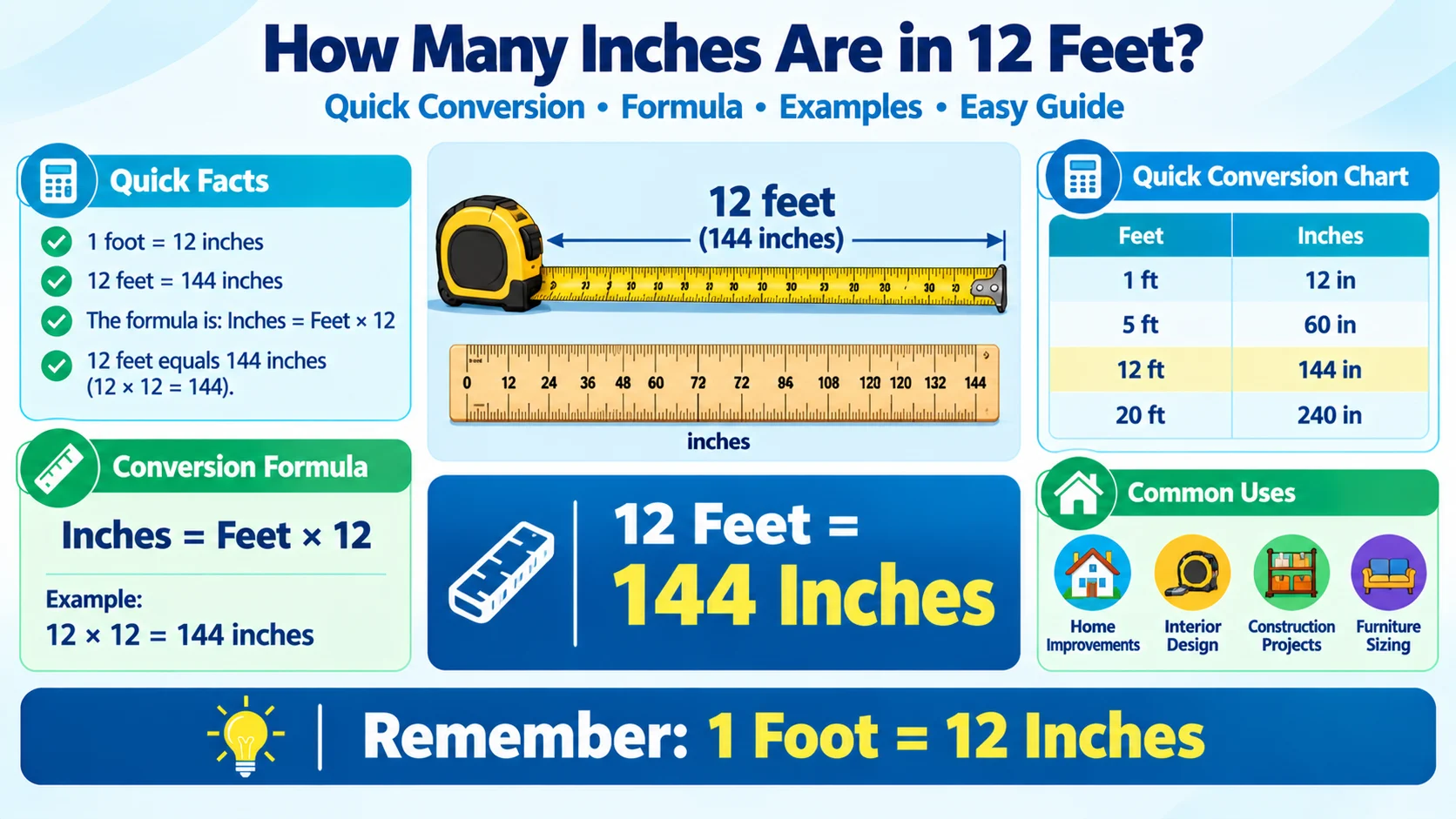
Need to measure a wall, check a furniture dimension, or convert a height from feet to inches? One of the most common U.S. customary unit conversions is turning feet into inches. If you’re wondering how many inches are in 12 feet?, the answer is straightforward: 12 feet equals 144 inches.
The reason is simple: 1 foot contains exactly 12 inches. So, to convert 12 feet to inches, multiply 12 by 12:
12 × 12 = 144 inches
That makes 12 feet the same length as 144 inches.
This conversion is useful in far more situations than a basic math exercise. Contractors use inches when taking precise measurements, homeowners use them for renovation projects, students encounter the conversion in math problems, and shoppers often need inches to understand product dimensions.
In this measurement guide, you’ll learn the conversion formula, see exactly how the calculation works, compare nearby values in a conversion chart, and explore practical examples. You’ll also learn a few mental-math shortcuts that make feet-to-inches conversions almost automatic.
1. Quick Answer: How Many Inches Are in 12 Feet?
12 feet = 144 inches.
The conversion formula is:
Inches = Feet × 12
For 12 feet:
12 × 12 = 144
Therefore:
There are exactly 144 inches in 12 feet.
Because both feet and inches are U.S. customary units, this is an exact conversion, not an estimate. There is no rounding involved.
Quick reference
| Feet | Inches |
|---|---|
| 1 ft | 12 in |
| 2 ft | 24 in |
| 3 ft | 36 in |
| 4 ft | 48 in |
| 5 ft | 60 in |
| 6 ft | 72 in |
| 8 ft | 96 in |
| 10 ft | 120 in |
| 12 ft | 144 in |
| 15 ft | 180 in |
| 20 ft | 240 in |
If you only need the answer for a homework problem or quick measurement, 144 inches is the number to remember.
2. Understanding Feet and Inches
A foot and an inch are both units of length in the U.S. customary system. The relationship between them is fixed:
1 foot = 12 inches
The plural of foot is feet, while the abbreviation is usually ft. The abbreviation for inch is in.
The foot has a long history as a measurement based loosely on human body dimensions. Over time, different regions used slightly different definitions. Today, however, the modern foot used in the United States is standardized.
The inch is the smaller unit. Since one foot contains 12 inches, inches are generally more convenient when greater detail is needed.
For example, a carpenter might describe a board as:
- 8 feet long for a broad measurement
- 8 feet 4 inches for a more specific measurement
- 100 inches when working entirely in inches
Feet and inches compared
| Unit | Equivalent | Common uses |
|---|---|---|
| 1 foot | 12 inches | Height, room dimensions, construction |
| 1 inch | 1/12 foot | Small dimensions, hardware, precise measurements |
| 12 feet | 144 inches | Large room dimensions, materials, distance |
Although feet and inches are imperial-style units, they are commonly grouped with U.S. customary units in everyday American measurement.
3. Conversion Formula: How Many Inches Are in 12 Feet?
The conversion formula is one of the easiest in measurement:
Inches = Feet × 12
Why multiply by 12?
Because every foot contains exactly 12 inches. If you have multiple feet, each foot contributes another 12 inches.
Step-by-step calculation
To convert 12 feet:
Step 1: Start with the measurement.
12 feet
Step 2: Use the conversion factor.
1 foot = 12 inches
Step 3: Multiply.
12 feet × 12 inches/foot = 144 inches
Step 4: Cancel the feet units.
144 inches
So:
12 feet = 144 inches
Example: Convert 7 feet
7 × 12 = 84 inches
Therefore:
7 feet = 84 inches
Example: Convert 9.5 feet
Decimal measurements work the same way:
9.5 × 12 = 114 inches
Therefore:
9.5 feet = 114 inches
This demonstrates why the conversion is so useful: whether the number is a whole number or decimal, the same formula works.
4. 12 Feet to Inches Conversion Table
A conversion chart can be faster than calculating every measurement individually.
| Feet | Exact inches |
|---|---|
| 0.5 ft | 6 in |
| 1 ft | 12 in |
| 1.5 ft | 18 in |
| 2 ft | 24 in |
| 3 ft | 36 in |
| 4 ft | 48 in |
| 5 ft | 60 in |
| 6 ft | 72 in |
| 7 ft | 84 in |
| 8 ft | 96 in |
| 9 ft | 108 in |
| 10 ft | 120 in |
| 11 ft | 132 in |
| 12 ft | 144 in |
| 13 ft | 156 in |
| 14 ft | 168 in |
| 15 ft | 180 in |
| 20 ft | 240 in |
Common values worth memorizing
| Feet | Inches | Typical reference |
|---|---|---|
| 3 ft | 36 in | 1 yard |
| 4 ft | 48 in | Common furniture dimension |
| 6 ft | 72 in | Approximate adult height range |
| 8 ft | 96 in | Common lumber length |
| 10 ft | 120 in | Room/material measurement |
| 12 ft | 144 in | One dozen feet |
| 16 ft | 192 in | Common construction material length |
The pattern is predictable: each additional foot adds 12 inches.
5. Practical Examples of 12 Feet in Inches
Knowing that 12 feet equals 144 inches becomes especially useful when measurements are given in different formats.
Construction
Suppose a contractor needs a piece of material that is 12 feet long but the supplier’s ordering system requires inches.
Convert it:
12 × 12 = 144 inches
The required length is 144 inches.
This avoids mixing feet and inches when calculating how much material is needed.
Home improvement
Imagine you’re planning shelving for a wall that is 12 feet wide.
Converting the width gives:
12 feet = 144 inches
If each shelf section is 36 inches wide:
144 ÷ 36 = 4
So four 36-inch sections would span the 12-foot width, assuming no space is needed between them.
Interior design
A room that is 12 feet wide has a width of 144 inches. This can be useful when comparing furniture dimensions listed in inches.
For example, if a sofa is 84 inches wide:
144 − 84 = 60 inches
That leaves 60 inches of horizontal space across the room, before accounting for other furniture or clearances.
Education
A math student may encounter:
Convert 12 feet to inches.
The solution is:
12 × 12 = 144 inches
The important concept is recognizing the correct conversion factor rather than relying on a calculator.
Shopping
Furniture, mattresses, curtains, rugs, and other products may have dimensions listed in inches. If your available space is measured in feet, converting both measurements to inches makes comparison easier.
Sports and recreation
Distances in recreational spaces can also be converted. A 12-foot measurement is exactly 144 inches, which can help when laying out equipment or marking a practice area.
6. Common Conversion Mistakes
The math is simple, but a few mistakes appear frequently.
Mistake 1: Multiplying by 10
Some people accidentally calculate:
12 × 10 = 120
That’s incorrect because a foot contains 12 inches, not 10.
The correct calculation is:
12 × 12 = 144
Mistake 2: Dividing instead of multiplying
When converting feet to inches, multiply by 12.
When converting inches to feet, divide by 12.
For example:
144 inches ÷ 12 = 12 feet
Mistake 3: Confusing inches with centimeters
An inch and a centimeter are different units. One inch equals exactly 2.54 centimeters.
Therefore, don’t use 2.54 as the conversion factor when converting feet to inches.
Mistake 4: Reading a measuring tape incorrectly
A tape measure may display feet, inches, and fractional inches simultaneously. The smaller marks between whole inches can represent fractions such as 1/2, 1/4, or 1/8 inch.
Always check what each marking represents before recording a measurement.
Mistake 5: Rounding an exact conversion
There is no need to round 12 feet to 144 inches.
Expert tip: Keep the units attached to your calculation. Writing “12 ft × 12 in/ft” makes the conversion factor visible and helps prevent unit mistakes.
7. Quick Mental Conversion Tips
You don’t need a conversion calculator to convert ordinary feet into inches.
The easiest mental rule is:
Double the number, then multiply by 6.
Why? Because multiplying by 12 is the same as multiplying by 2 and then by 6.
For 12 feet:
12 × 2 = 24
24 × 6 = 144
An even easier strategy is simply to memorize a few anchor values.
Handy mental references
- 1 foot = 12 inches
- 2 feet = 24 inches
- 5 feet = 60 inches
- 6 feet = 72 inches
- 10 feet = 120 inches
- 12 feet = 144 inches
You can also build unfamiliar conversions from a known value.
For example, to convert 13 feet:
12 feet = 144 inches
Add one more foot:
144 + 12 = 156 inches
Therefore:
13 feet = 156 inches
This method is useful when you are estimating measurements on a job site without immediately reaching for a measurement calculator.
8. Comparison Between Feet and Inches
Feet and inches measure the same physical quantity—length—but they serve different practical purposes.
| Feature | Feet | Inches |
|---|---|---|
| Relative size | Larger unit | Smaller unit |
| Conversion | 1 ft = 12 in | 1 in = 1/12 ft |
| Typical use | Room size, height, distance | Detailed dimensions |
| Precision | Good for general dimensions | Better for smaller measurements |
| Common U.S. applications | Construction, height, real estate | Furniture, hardware, manufacturing |
| Advantage | Easy to visualize larger distances | Convenient for precise dimensions |
A useful rule is:
Use feet for the big picture and inches for detail.
For example, saying a room is 12 feet wide is natural. When installing a 14-inch shelf, however, inches are more convenient.
Related length conversions
| Measurement | Equivalent |
|---|---|
| 1 foot | 12 inches |
| 1 foot | 0.3333 yard |
| 1 foot | 0.3048 meter |
| 1 inch | 2.54 centimeters |
| 12 feet | 4 yards |
| 12 feet | 3.6576 meters |
This also illustrates that 12 feet is exactly 4 yards, because one yard equals 3 feet.
9. Why Accurate Measurement Matters
A one-inch error might not seem serious when measuring a large space. In a real project, however, small mistakes can accumulate quickly.
Construction
Accurate dimensions are essential when cutting lumber, installing framing, positioning doors, or ordering materials.
Engineering and manufacturing
Manufactured components often need to fit together within specific tolerances. Converting units incorrectly can create parts that are too large or too small.
Home renovation
Imagine a homeowner has a 12-foot wall and wants to install four equal shelves.
The wall is:
12 × 12 = 144 inches
Divide by four:
144 ÷ 4 = 36 inches
So each section could be 36 inches wide if the entire wall is divided equally and no additional spacing is required.
If the homeowner mistakenly treated 12 feet as 120 inches, each section would be calculated as only 30 inches wide—a significant error.
Education
Learning basic unit conversion builds an important mathematical habit: always identify the relationship between units before calculating.
DIY projects
Whether you’re building a workbench, installing trim, planning a garden structure, or measuring flooring, consistent units reduce mistakes.
Professional measurement rule: Before calculating, convert all dimensions to the same unit. A calculation using feet and inches together is easy to misread.
10. Final Thoughts: How Many Inches Are in 12 Feet?
So, how many inches are in 12 feet?
The answer is:
12 feet = 144 inches
The formula is:
Inches = Feet × 12
For this specific conversion:
12 × 12 = 144 inches
The conversion is exact because every foot contains exactly 12 inches.
Key takeaways
- 1 foot = 12 inches
- 12 feet = 144 inches
- To convert feet to inches, multiply by 12
- To convert inches to feet, divide by 12
- No rounding is necessary for whole-foot conversions
- Converting measurements to one unit makes calculations easier and safer
Whether you’re solving a school problem, measuring a room, buying materials, or planning a DIY project, this simple relationship is one of the most useful facts in U.S. customary measurement.
Frequently Asked Questions
How many inches are in 12 feet?
There are 144 inches in 12 feet. The calculation is 12 feet × 12 inches per foot = 144 inches. Because one foot is exactly 12 inches, this is an exact conversion rather than an approximation. If you need to convert the measurement back, divide 144 inches by 12, which gives exactly 12 feet.
What is the easiest way to convert feet to inches?
The easiest method is to multiply the number of feet by 12. For example, to convert 8 feet, calculate 8 × 12 = 96 inches. The formula is inches = feet × 12. This works for whole numbers, decimals, and mixed measurements, making it the standard method for feet-to-inches conversion.
Can I convert 12 feet to inches without a calculator?
Yes. Since one foot contains 12 inches, simply multiply 12 by 12. You can think of it as twelve groups of twelve: 12 + 12 + 12 and so on, for a total of 144 inches. This is an easy conversion to perform mentally and is worth memorizing for everyday measurement work.
Why is 12 feet equal to 144 inches?
The relationship comes from the definition of the foot: 1 foot contains 12 inches. Therefore, twelve feet contain twelve groups of twelve inches. Mathematically, 12 × 12 = 144. This relationship is fixed, so the result does not depend on rounding, estimation, or the measuring tool being used.
What formula should I use to convert feet to inches?
Use the formula Inches = Feet × 12. If you have 12 feet, substitute the number into the formula: 12 × 12 = 144 inches. For the reverse conversion, use Feet = Inches ÷ 12. Keeping these two formulas in mind covers most everyday feet-and-inches measurement conversions.
Is 12 feet the same as 144 inches?
Yes. 12 feet and 144 inches describe exactly the same length. They simply use different units. Since one foot equals 12 inches, multiplying 12 feet by 12 gives 144 inches. You can use either measurement depending on which unit is more convenient for the project or calculation.
How many inches are in 12 feet for construction?
There are exactly 144 inches in 12 feet, which is useful when construction plans, materials, or cutting instructions require measurements entirely in inches. For example, a 12-foot board is 144 inches long. Converting the entire project into one unit can help prevent mistakes when adding dimensions or determining material requirements.
How do I convert 144 inches back to feet?
Divide the number of inches by 12 because there are 12 inches in every foot:
144 ÷ 12 = 12 feet
Therefore, 144 inches = 12 feet. The same conversion factor works in reverse: multiply feet by 12 to get inches, and divide inches by 12 to get feet.
Is the feet-to-inches conversion exact?
Yes. The conversion between feet and inches is exact: 1 foot equals exactly 12 inches. Unlike conversions between some metric and U.S. customary units that may involve decimal values, there is no rounding when converting a whole number of feet into inches. This makes feet-to-inches conversion particularly simple for precise measurements.
Which industries use feet-to-inches conversion?
Feet-to-inches conversion is common in construction, carpentry, architecture, interior design, manufacturing, engineering, furniture production, real estate, and education. It is especially useful when a large dimension is given in feet but detailed measurements, cutting dimensions, or product specifications are expressed in inches.
How Many Square Feet in a Roof Square?