Replacing a roof can feel like learning a new language. A contractor may tell you your home needs 18 squares, while a home-improvement estimate may list the roof area in square feet. If you’re trying to compare the two numbers, one question matters immediately: how many square feet in a roof square?
The answer is straightforward:
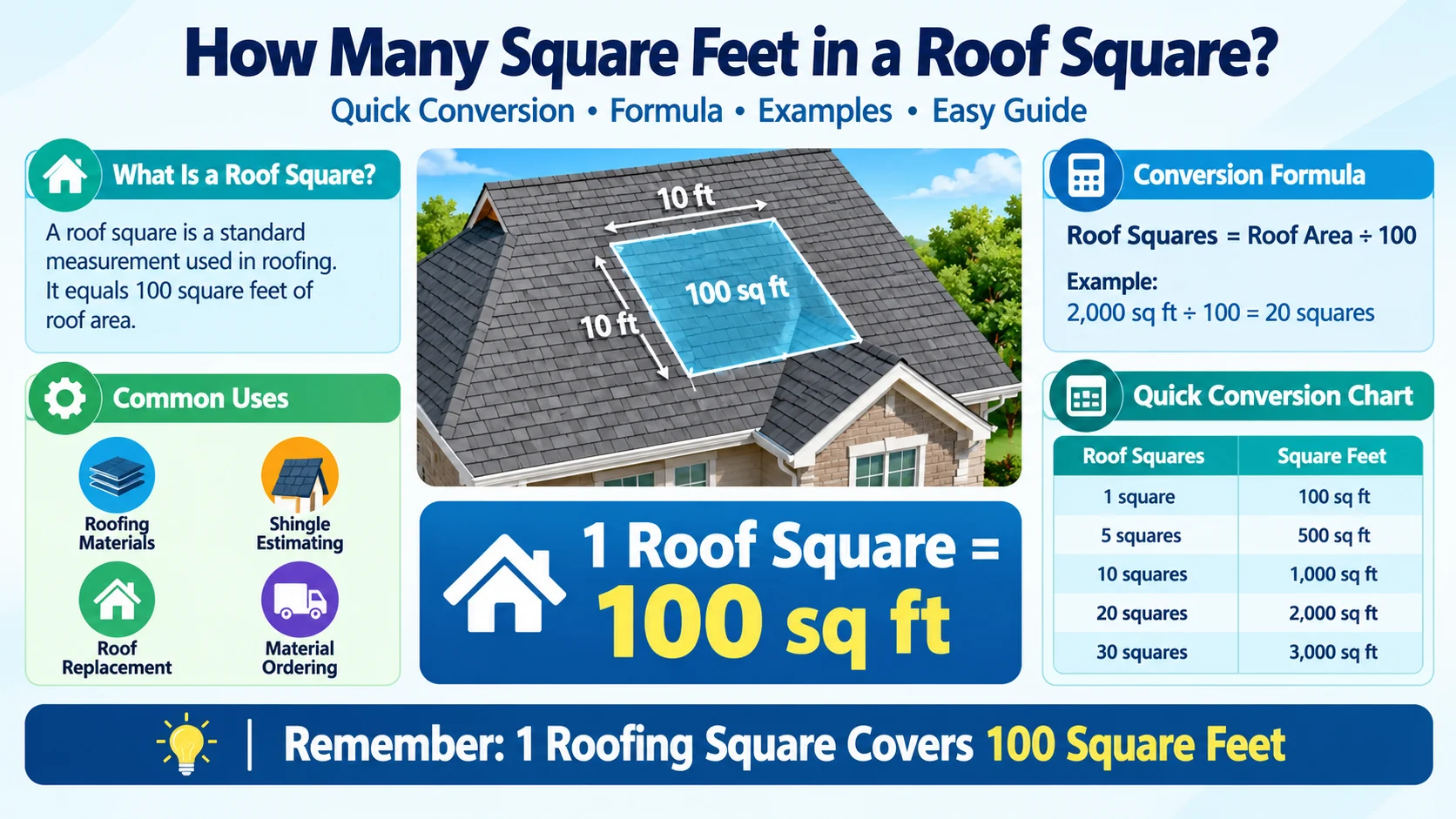
1 roofing square = 100 square feet.
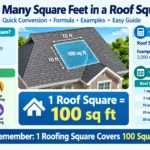
A roofing square is a standard industry unit used to describe roof area. One square represents a 10-foot-by-10-foot area, or 100 square feet.
So, if a roof measures 2,000 square feet, it contains 20 roofing squares. If a contractor says a project is 25 squares, that corresponds to 2,500 square feet of roof area before accounting for additional material allowances.
Understanding this simple measurement conversion can help homeowners check roofing estimates, contractors calculate material quantities, and DIYers avoid costly mistakes. The important part is knowing that a roofing square measures area, not the length of one side.
1. Quick Answer: How Many Square Feet in a Roof Square?
There are exactly 100 square feet in one roofing square.
The basic conversion is:
1 roofing square = 100 square feet
A roofing square can be visualized as a 10-foot × 10-foot area:
10 ft × 10 ft = 100 square feet
To convert roofing squares to square feet:
Square feet = Roofing squares × 100
To convert square feet to roofing squares:
Roofing squares = Square feet ÷ 100
Quick Conversion Chart
| Roofing Squares | Square Feet |
|---|---|
| 1 | 100 sq ft |
| 2 | 200 sq ft |
| 5 | 500 sq ft |
| 10 | 1,000 sq ft |
| 15 | 1,500 sq ft |
| 20 | 2,000 sq ft |
| 25 | 2,500 sq ft |
| 30 | 3,000 sq ft |
| 40 | 4,000 sq ft |
| 50 | 5,000 sq ft |
This is an exact unit conversion. The complication comes not from converting squares to square feet, but from accurately determining the actual surface area of a roof.
2. Understanding the Units
A square foot (sq ft) is a unit of area. It represents a space measuring 1 foot by 1 foot.
A roofing square, sometimes simply called a square in the roofing industry, is also a unit of area, but it is much larger:How Many Square Feet in a Roof Square?
Replacing a roof can feel like learning a new language. A contractor may tell you your home needs 18 squares, while a
The term is primarily associated with roofing and is commonly used when estimating shingles, roofing membranes, underlayment, and other materials.
U.S. Customary Units and Roofing
Roofing measurements in the United States commonly use feet, inches, square feet, and roofing squares. Metric measurements can also be used, particularly for technical specifications and products manufactured internationally.
For reference:
100 square feet ≈ 9.2903 square meters
That means one roofing square is approximately 9.29 m².
Important: A roofing square is not the same thing as the square footage of the home’s floor plan. A sloped roof can have considerably more surface area than the building’s footprint.
3. Conversion Formula: How Many Square Feet in a Roof Square?
The conversion formula is simple because one roofing square has a fixed area of 100 square feet.
From Roofing Squares to Square Feet
Use:
Square feet = Number of squares × 100
For example, suppose a contractor estimates 18 roofing squares.
- Start with 18 squares.
- Multiply by 100.
- 18 × 100 = 1,800 square feet
Therefore:
18 roofing squares = 1,800 sq ft
From Square Feet to Roofing Squares
Reverse the calculation:
Roofing squares = Square feet ÷ 100
Suppose your measured roof area is 2,750 square feet.
- Start with 2,750 sq ft.
- Divide by 100.
- 2,750 ÷ 100 = 27.5
Therefore:
2,750 square feet = 27.5 roofing squares
Notice that a roof does not have to contain a whole number of squares. Decimal values are perfectly valid measurements.
Why the Formula Works
A square measuring 10 feet on each side has an area of:
10 × 10 = 100 square feet
The roofing industry uses that 100-square-foot area as one standard roofing square. Once the definition is established, converting between the units is simply multiplication or division by 100.
4. Roof Square Conversion Table
The following conversion table makes common calculations easy to check without a calculator.
| Roof Area in Squares | Equivalent Square Feet | Approx. Square Meters |
|---|---|---|
| 0.5 | 50 sq ft | 4.65 m² |
| 1 | 100 sq ft | 9.29 m² |
| 2 | 200 sq ft | 18.58 m² |
| 3 | 300 sq ft | 27.87 m² |
| 5 | 500 sq ft | 46.45 m² |
| 10 | 1,000 sq ft | 92.90 m² |
| 15 | 1,500 sq ft | 139.35 m² |
| 20 | 2,000 sq ft | 185.81 m² |
| 25 | 2,500 sq ft | 232.26 m² |
| 30 | 3,000 sq ft | 278.71 m² |
| 40 | 4,000 sq ft | 371.61 m² |
| 50 | 5,000 sq ft | 464.52 m² |
Common Reverse Conversions
| Roof Area | Roofing Squares |
|---|---|
| 500 sq ft | 5 squares |
| 750 sq ft | 7.5 squares |
| 1,000 sq ft | 10 squares |
| 1,250 sq ft | 12.5 squares |
| 1,500 sq ft | 15 squares |
| 1,800 sq ft | 18 squares |
| 2,000 sq ft | 20 squares |
| 2,500 sq ft | 25 squares |
| 3,000 sq ft | 30 squares |
| 4,000 sq ft | 40 squares |
5. Practical Examples of Roof Square Calculations
Knowing the formula is useful, but real-world examples make the measurement easier to understand.
Example 1: Basic Conversion
A contractor says a garage roof is 8 squares.
Calculate:
8 × 100 = 800 sq ft
The garage roof contains 800 square feet of roof area.
Example 2: Decimal Conversion
A roof measures 1,650 square feet.
Calculate:
1,650 ÷ 100 = 16.5 squares
So the roof measures 16.5 roofing squares.
Example 3: Larger Residential Roof
A house has a total measured roof surface of 2,400 square feet.
2,400 ÷ 100 = 24 squares
The roof is therefore 24 squares.
Example 4: Calculating the Area of Roof Planes
Imagine a simple gable roof with two roof planes. Each plane measures approximately 35 feet × 36 feet.
One plane:
35 × 36 = 1,260 sq ft
Two planes:
1,260 × 2 = 2,520 sq ft
Convert to roofing squares:
2,520 ÷ 100 = 25.2 squares
So the roof surface is 25.2 roofing squares before any material-waste allowance.
Example 5: Why Roof Pitch Matters
Suppose a building’s horizontal footprint suggests an area of 2,000 square feet. That does not automatically mean the sloped roof has 2,000 square feet of surface area.
The steeper the roof, the greater the actual surface area can be. Roofers can use slope or pitch factors to convert horizontal measurements into roof-surface measurements.
For example, using a factor of approximately 1.054 for a 4:12 roof slope:
2,000 × 1.054 = 2,108 sq ft
Then:
2,108 ÷ 100 = 21.08 squares
This illustrates why estimating a roof from the home’s footprint alone can produce an inaccurate result.
6. Common Conversion Mistakes
The formula is easy, but several practical mistakes can lead to incorrect estimates.
Mistake 1: Multiplying When You Should Divide
If you have square feet and want roofing squares, divide by 100.
Incorrect:
2,000 × 100 = 200,000 squares
Correct:
2,000 ÷ 100 = 20 squares
Mistake 2: Confusing Roof Area With House Size
A 2,000-square-foot home does not necessarily have a 2,000-square-foot roof.
Roof pitch, overhangs, dormers, valleys, and multiple roof sections can increase the actual roof surface area.
Mistake 3: Treating a Roofing Square as a Linear Measurement
A roofing square is an area measurement. It does not mean 100 linear feet.
Think of it as a 10-foot-by-10-foot area rather than a 100-foot line.
Mistake 4: Ignoring Decimal Values
A measurement of 2,350 square feet equals:
2,350 ÷ 100 = 23.5 squares
Do not automatically round 23.5 to 24 unless your particular estimating method requires it.
Mistake 5: Confusing Material Coverage With Roof Size
One roofing square represents 100 square feet of roof area, but the quantity of shingles or other materials required can vary by product and installation conditions.
Expert tip: Separate the calculation into two steps: first determine the actual roof surface area, then convert that area into roofing squares.
7. Quick Mental Conversion Tips
You rarely need a complicated measurement calculator for the basic conversion.
To Convert Squares to Square Feet
Simply multiply by 100 when dealing with whole numbers.
- 7 squares → 700 sq ft
- 12 squares → 1,200 sq ft
- 25 squares → 2,500 sq ft
- 40 squares → 4,000 sq ft
To Convert Square Feet to Squares
Move the decimal point two places to the left.
- 700 sq ft → 7 squares
- 1,200 sq ft → 12 squares
- 2,450 sq ft → 24.5 squares
- 3,750 sq ft → 37.5 squares
Memorize This One Line
1 roofing square = 100 square feet.
Once that relationship is memorized, most basic roofing measurement conversions take only a few seconds.
8. Comparison Between Square Feet and Roofing Squares
Both units measure area, but they serve different practical purposes.
| Feature | Square Foot | Roofing Square |
|---|---|---|
| Definition | 1 ft × 1 ft | 10 ft × 10 ft |
| Area | 1 sq ft | 100 sq ft |
| Common Use | General area measurement | Roofing |
| Typical Users | Homeowners, builders, designers | Roofers, contractors, estimators |
| Precision | Convenient for small areas | Convenient for large roof areas |
| Conversion | 100 sq ft = 1 square | 1 square = 100 sq ft |
| Metric Equivalent | 0.0929 m² | 9.2903 m² |
A square foot is more convenient for measuring individual rooms, walls, floors, and smaller surfaces. Roofing squares are convenient when discussing large roof areas and material estimates.
9. Why Accurate Measurement Matters
An incorrect roof measurement can affect more than a number on a worksheet. It can influence material quantities, project estimates, purchasing decisions, and the comparison of contractor quotes.
Construction
Roofing contractors use roof-area measurements to estimate materials and labor. A reliable measurement helps create a more realistic project estimate.
Home Renovation
Homeowners comparing quotes may see one contractor quote a price per square and another quote a price per square foot. Converting the figures to the same unit makes the estimates easier to understand.
Engineering and Manufacturing
Accurate area calculations are important when determining material requirements, surface coverage, and project specifications.
Education
The roofing square provides a useful real-world example of multiplication, division, area, decimals, and unit conversion.
A Practical Case Study
Imagine a homeowner receives an estimate for 22 roofing squares.
Convert it to square feet:
22 × 100 = 2,200 sq ft
A second estimate refers to 2,200 square feet of roof area.
At first glance, the terminology looks different, but the underlying roof area is the same.
The homeowner can now compare the two estimates using a common measurement.
For actual material ordering, however, the roof’s shape, pitch, product specifications, installation method, and appropriate waste allowance also need to be considered. A roofing square tells you the area; it does not by itself determine every material quantity.
10. How to Calculate a Roof’s Squares Correctly
If you need to calculate your own roof measurement, the most important step is determining the actual roof surface area, not simply the home’s footprint.
For a straightforward roof, the process is:
- Divide the roof into measurable sections.
- Measure the length and width of each section.
- Calculate each section’s area.
- Add all roof sections together.
- Account for roof pitch when appropriate.
- Divide the total roof area by 100.
- The result is the number of roofing squares.
For example, if all roof planes total 3,150 square feet:
3,150 ÷ 100 = 31.5 squares
The roof therefore contains 31.5 roofing squares.
For complex roofs, professional measurements may be preferable. Valleys, dormers, hips, multiple slopes, irregular geometry, and roof-access concerns can make an on-site measurement more complicated.
Quick Reference
| If You Know… | Use This Formula | Result |
|---|---|---|
| Roofing squares | Squares × 100 | Square feet |
| Square feet | Square feet ÷ 100 | Roofing squares |
| Square feet | × 0.092903 | Square meters |
| Square meters | ÷ 9.2903 | Roofing squares |
Frequently Asked Questions
1. How many square feet are in one roof square?
One roofing square contains exactly 100 square feet. The industry defines a square as an area of 100 square feet, often visualized as a 10-foot-by-10-foot section of roof. To convert roofing squares into square feet, multiply the number of squares by 100. For example, 15 squares equals 1,500 square feet. The term is widely used when estimating roofing materials and project size.
2. What is the easiest way to convert roof squares to square feet?
The easiest method is to multiply the number of roofing squares by 100. For example, if a contractor says your roof is 24 squares, calculate 24 × 100 = 2,400 square feet. For the reverse conversion, divide square footage by 100. Because the conversion factor is exactly 100, you can usually perform the calculation mentally without a conversion calculator.
3. How many roofing squares are in 2,000 square feet?
There are 20 roofing squares in 2,000 square feet. Use the formula: 2,000 ÷ 100 = 20. This assumes 2,000 square feet is the actual roof surface area. If 2,000 square feet refers only to the home’s floor-plan footprint, the roof itself may have a different area because of pitch, overhangs, and roof geometry.
4. Is a roofing square the same as 100 square feet?
Yes. In standard roofing terminology, one square equals 100 square feet of roof area. The important distinction is that a roofing square is a specialized industry unit, while a square foot is a general U.S. customary unit of area.
5. Can I calculate roofing squares without a calculator?
Yes. For whole numbers, converting squares to square feet is particularly easy: multiply by 100. Converting square feet to squares means moving the decimal point two places left. For example, 2,500 square feet becomes 25 squares, while 17 squares becomes 1,700 square feet. For irregular roofs or calculations involving pitch, however, a calculator or professional measurement can reduce errors.
6. Why is the roof’s square footage different from my home’s square footage?
Your home’s listed square footage usually describes interior floor area or another defined building area, not the sloped exterior roof surface. A roof can cover a larger area because of its pitch, eaves, overhangs, and architectural features. A steep roof generally has more surface area than the horizontal footprint beneath it. Therefore, roof calculations should use the actual roof surface area when possible.
7. Does one roofing square always mean I need one bundle of shingles?
No. A roofing square is an area measurement, not a universal bundle measurement. The number of shingle bundles needed per square depends on the particular product and its coverage specifications. Always check the manufacturer’s coverage information before purchasing materials.
8. How do I convert square feet into roofing squares?
Divide the total roof area in square feet by 100.
Formula:
Roofing squares = Square feet ÷ 100
For example:
1,850 ÷ 100 = 18.5 squares
So a roof with an actual surface area of 1,850 square feet contains 18.5 roofing squares.
9. Is the conversion from roofing squares to square feet exact?
Yes. The basic conversion is exact: 1 roofing square = 100 square feet. What may be approximate is the measurement of the roof itself. Irregular shapes, difficult access, roof pitch, measurement methods, and estimating practices can introduce differences. The unit conversion does not create the uncertainty; determining the correct roof area is usually the more challenging part.
Final Thoughts
The answer to how many square feet in a roof square is simple:
1 roofing square = 100 square feet.
Remember these two formulas:
Squares → square feet:
Squares × 100 = square feet
Square feet → squares:
Square feet ÷ 100 = squares
The bigger lesson is that a roofing square describes roof area, not the dimensions of the house underneath it. For accurate roofing estimates, measure the actual roof surface and consider pitch, roof geometry, product coverage, and appropriate material allowances.
Once you know that one square equals 100 square feet, switching between roofing terminology and ordinary square-foot measurements becomes quick and straightforward.
Want to sharpen your measurement skills further? Explore more measurement conversion guides to learn how to convert length, area, weight, and volume units quickly and accurately.
What’s 170cm in Feet? Exact Conversion, Formula, Tables & Examples