You have 60 inches on a tape measure, a furniture dimension, or a project plan, and you need the answer in feet. So, how many feet are 60 in?
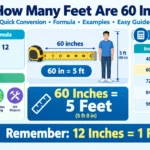
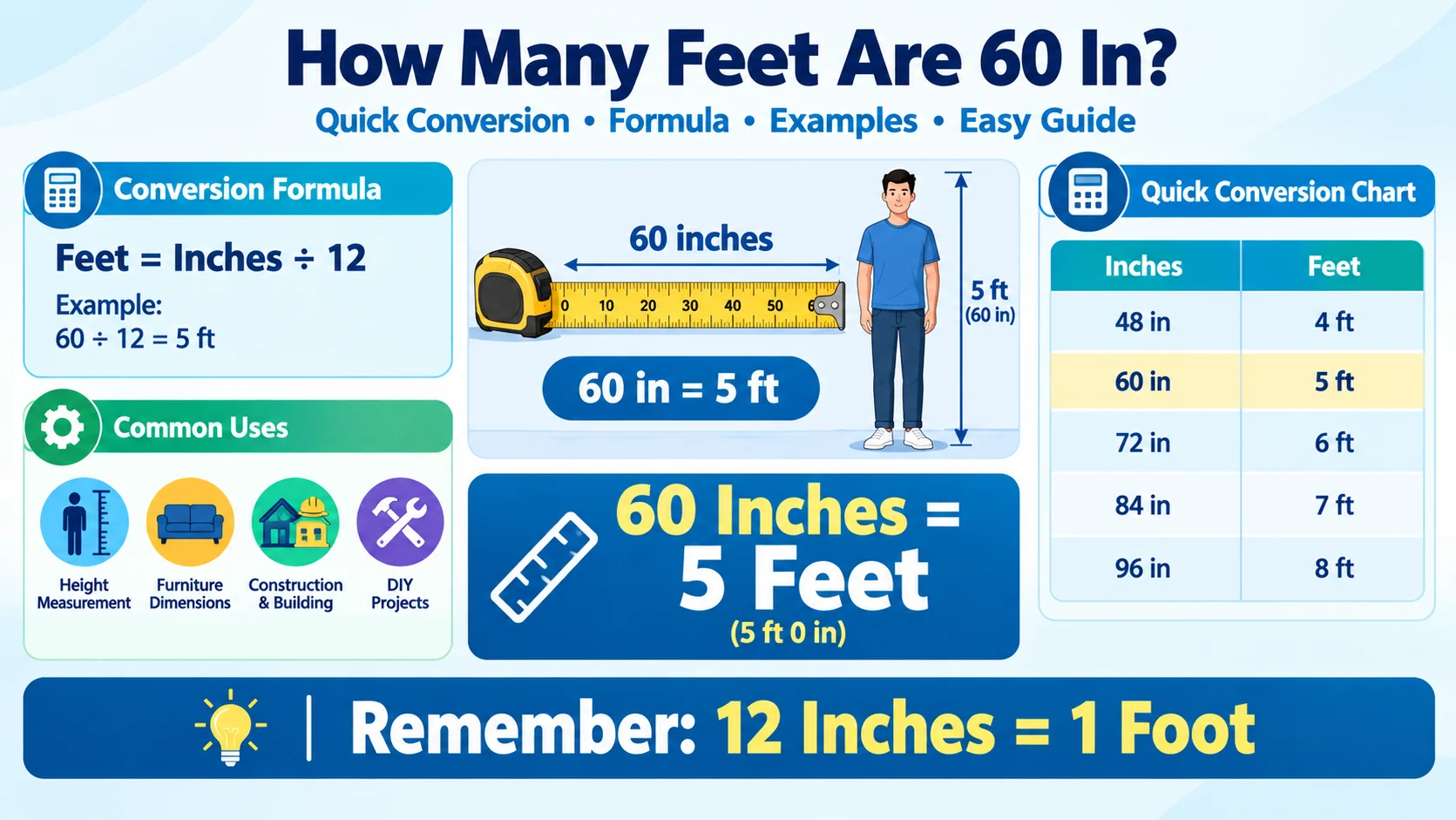
The answer is 5 feet.
Because 1 foot equals 12 inches, you can convert 60 inches to feet by dividing 60 by 12:
60 ÷ 12 = 5
So:
60 inches = 5 feet
This is an exact measurement conversion, not an approximation. Once you remember that there are 12 inches in one foot, converting inches to feet becomes a quick division problem.
This guide explains exactly how the conversion works, shows several practical examples, provides useful conversion tables, and covers common mistakes. Whether you’re measuring a room, checking furniture dimensions, working on a construction project, helping a student with homework, or simply trying to read a U.S. customary measurement, you’ll be able to convert inches and feet confidently.
1. Quick Answer: How Many Feet Are 60 In?
60 inches are equal to exactly 5 feet.
The conversion formula is:
Feet = Inches ÷ 12
For 60 inches:
60 ÷ 12 = 5 feet
Therefore:
60 in = 5 ft
The reason is simple: 12 inches make 1 foot, so five groups of 12 inches make 60 inches.
12 × 5 = 60
If you’re looking for a quick answer without doing the calculation yourself, remember:
| Inches | Feet |
|---|---|
| 12 in | 1 ft |
| 24 in | 2 ft |
| 36 in | 3 ft |
| 48 in | 4 ft |
| 60 in | 5 ft |
| 72 in | 6 ft |
| 84 in | 7 ft |
| 96 in | 8 ft |
2. Understanding Inches and Feet
Both inches and feet are units of length in the U.S. customary measurement system. They are also commonly encountered in the broader family of imperial units.
An inch is a relatively small unit, making it useful for measuring objects such as screens, books, boards, clothing dimensions, and small spaces.
A foot is larger and is commonly used for people’s height, room dimensions, building measurements, distances around a property, and construction work.
The fundamental relationship is:
1 foot = 12 inches
That means:
- 2 feet = 24 inches
- 3 feet = 36 inches
- 4 feet = 48 inches
- 5 feet = 60 inches
- 6 feet = 72 inches
- 10 feet = 120 inches
What about metric measurements?
The metric system uses centimeters and meters instead of inches and feet.
For reference:
1 inch = 2.54 centimeters exactly
Therefore:
60 inches × 2.54 = 152.4 centimeters
And:
152.4 centimeters = 1.524 meters
So 60 inches can be expressed as:
- 60 inches
- 5 feet
- 152.4 centimeters
- 1.524 meters
For everyday U.S. measurements, however, 5 feet is the most natural answer.
3. Conversion Formula: Inches to Feet
The conversion formula is straightforward.
Formula
Feet = Inches ÷ 12
Why divide by 12?
Because one foot contains 12 inches. When you’re converting a smaller unit into a larger unit, you determine how many complete groups of the smaller unit fit inside the larger unit.
For 60 inches:
- Start with 60 inches.
- Identify the conversion factor: 12 inches = 1 foot.
- Divide 60 by 12.
- 60 ÷ 12 = 5.
- Add the unit: 5 feet.
Worked example
60 in ÷ 12 in/ft = 5 ft
The inches cancel out, leaving feet.
Remember: To convert inches to feet, divide by 12. To convert feet to inches, multiply by 12.
Reverse calculation
You can verify the answer by converting 5 feet back into inches:
5 × 12 = 60 inches
Because the reverse calculation returns the original number, the conversion is confirmed.
4. 60 Inches to Feet Conversion Table
Here is a broader conversion chart for values around 60 inches.
| Inches | Feet | Feet and Inches |
|---|---|---|
| 36 in | 3 ft | 3 ft 0 in |
| 42 in | 3.5 ft | 3 ft 6 in |
| 48 in | 4 ft | 4 ft 0 in |
| 54 in | 4.5 ft | 4 ft 6 in |
| 60 in | 5 ft | 5 ft 0 in |
| 66 in | 5.5 ft | 5 ft 6 in |
| 72 in | 6 ft | 6 ft 0 in |
| 78 in | 6.5 ft | 6 ft 6 in |
| 84 in | 7 ft | 7 ft 0 in |
| 90 in | 7.5 ft | 7 ft 6 in |
| 96 in | 8 ft | 8 ft 0 in |
The decimal-foot column is especially useful for technical calculations, while the feet-and-inches format is often more intuitive for everyday measurements.
5. Practical Examples of 60 Inches = 5 Feet
The conversion becomes more useful when you see where it appears in everyday life.
Example 1: Measuring a person’s height
Suppose someone is 60 inches tall.
Convert inches to feet:
60 ÷ 12 = 5
Their height is 5 feet, commonly written as 5 ft 0 in.
Example 2: Measuring furniture
Imagine a table is listed as 60 inches long.
Convert the length:
60 ÷ 12 = 5 feet
The table is therefore 5 feet long.
This can make it easier to visualize whether the furniture will fit against a particular wall.
Example 3: Home improvement
You need a piece of trim that is 60 inches long.
60 inches = 5 feet
If the store sells trim by the foot, you know that you need a piece measuring at least 5 feet, subject to any additional cutting allowance your project requires.
Example 4: Construction
A contractor’s drawing specifies a component as 60 inches long, while another measurement is written in feet.
Convert the first measurement:
60 ÷ 12 = 5 feet
Now both measurements use the same unit, making it easier to calculate total lengths.
Example 5: Reverse conversion
Suppose you need a board that is 5 feet long but your measuring tape or cutting plan uses inches.
Convert feet to inches:
5 × 12 = 60 inches
So a 5-foot board is 60 inches long.
6. Common Conversion Mistakes
The calculation itself is easy, but measurement errors often happen when people use the wrong operation or confuse different units.
Mistake 1: Multiplying instead of dividing
To convert 60 inches to feet, divide by 12.
Incorrect:
60 × 12 = 720 feet
Correct:
60 ÷ 12 = 5 feet
Multiplication is used for the reverse conversion, from feet to inches.
Mistake 2: Forgetting that 12 inches make a foot
A useful anchor is:
12 in = 1 ft
Once that relationship is memorized, most basic length conversion becomes automatic.
Mistake 3: Confusing feet with square feet
Feet measure length. Square feet measure area.
For example:
- 60 inches = 5 feet of length.
- 60 square inches is an area measurement and cannot simply be treated as 5 square feet.
The word “square” changes the type of measurement.
Mistake 4: Mixing inches and feet in one calculation
Suppose a room has one dimension listed as 10 feet and another as 60 inches. Convert 60 inches to 5 feet before calculating an area:
10 ft × 5 ft = 50 sq ft
Mixing units without converting them first can produce an incorrect result.
Mistake 5: Rounding too early
60 inches converts perfectly to 5 feet, so no rounding is necessary.
With values such as 61 inches, however:
61 ÷ 12 = 5.0833… feet
It is usually better to keep sufficient precision until the final step.
7. Quick Mental Conversion Tips
You don’t need a conversion calculator for simple inch-to-foot conversions.
Memorize multiples of 12
Knowing these values makes mental conversion fast:
- 12 in = 1 ft
- 24 in = 2 ft
- 36 in = 3 ft
- 48 in = 4 ft
- 60 in = 5 ft
- 72 in = 6 ft
- 84 in = 7 ft
- 96 in = 8 ft
- 108 in = 9 ft
- 120 in = 10 ft
Use groups of 12
For 60 inches, think:
12 + 12 + 12 + 12 + 12 = 60
That’s five groups of 12, so the answer is 5 feet.
For half-foot values
Six inches equals half a foot:
6 in = 0.5 ft
So:
- 18 in = 1.5 ft
- 30 in = 2.5 ft
- 42 in = 3.5 ft
- 54 in = 4.5 ft
- 66 in = 5.5 ft
This shortcut is useful when reading tape measures and working with construction dimensions.
8. Comparison Between Inches and Feet
Both units measure length, but their practical uses differ.
| Feature | Inches | Feet |
|---|---|---|
| Basic relationship | 12 in = 1 ft | 1 ft = 12 in |
| Relative size | Smaller | Larger |
| Typical precision | Useful for detailed dimensions | Useful for larger dimensions |
| Common uses | Objects, components, small dimensions | Rooms, buildings, height, construction |
| U.S. customary symbol | in or ″ | ft or ′ |
| Metric equivalent | 2.54 cm | 0.3048 m |
| Main advantage | Convenient for small measurements | Convenient for larger measurements |
Common values to remember
| Measurement in Feet | Equivalent Inches |
|---|---|
| 1 ft | 12 in |
| 2 ft | 24 in |
| 3 ft | 36 in |
| 4 ft | 48 in |
| 5 ft | 60 in |
| 6 ft | 72 in |
| 7 ft | 84 in |
| 8 ft | 96 in |
| 9 ft | 108 in |
| 10 ft | 120 in |
The key difference is scale. Inches are generally convenient for smaller dimensions, while feet make larger measurements easier to communicate.
9. Why Accurate Measurement Matters
A one-unit mistake can create surprisingly large problems when measurements are used repeatedly.
Construction
Builders need consistent dimensions when cutting lumber, installing doors, framing walls, and planning materials. Converting every measurement into a common unit helps prevent errors.
Engineering and manufacturing
Manufactured components often need precise dimensions. A mistake caused by confusing inches and feet can make a component unsuitable for its intended application.
Home renovation
When ordering flooring, trim, cabinetry, shelving, or furniture, accurate measurements help ensure that products fit the intended space.
Education
Inches-to-feet conversion is an excellent example of mathematical reasoning because students can see the connection between multiplication, division, fractions, and units.
DIY projects
For a simple project, writing measurements in one consistent unit before calculating can prevent many avoidable mistakes.
A realistic scenario
Suppose you want to install shelving along a wall that is 60 inches wide.
You convert the width:
60 ÷ 12 = 5 feet
Now you know the wall section is 5 feet wide.
If a shelf is sold in 2-foot sections, you can compare the shelf length with the available wall space using the same unit:
5 ft ÷ 2 ft = 2.5 sections
That does not necessarily mean you should buy exactly 2.5 sections—the product’s available sizes and cutting requirements matter—but the common unit makes the planning calculation much clearer.
Measurement rule: Before adding, subtracting, multiplying, or comparing measurements, make sure the quantities use compatible units.
10. Final Thoughts: How Many Feet Are 60 In?
So, how many feet are 60 in?
The answer is:
60 inches = 5 feet
The conversion formula is:
Feet = Inches ÷ 12
Therefore:
60 ÷ 12 = 5 feet
The reverse formula is equally important:
Inches = Feet × 12
So:
5 × 12 = 60 inches
Key takeaways
- 12 inches = 1 foot
- 60 inches = 5 feet
- Divide inches by 12 to convert to feet.
- Multiply feet by 12 to convert to inches.
- Keep units consistent when calculating measurements.
- Don’t confuse feet with square feet; length and area are different measurements.
Whether you’re checking a furniture dimension, reading a tape measure, working on a DIY project, or teaching a unit conversion lesson, this relationship is one of the most useful U.S. customary measurement facts to remember.
Ready to convert another measurement? Explore more measurement conversion guides for length, area, weight, and volume, and make everyday calculations faster and easier.
Frequently Asked Questions
1. How many feet are 60 inches?
60 inches are exactly 5 feet. The calculation is 60 ÷ 12 = 5 because there are 12 inches in one foot. You can also verify the result by reversing the calculation: 5 × 12 = 60 inches. Since the conversion produces a whole number, there is no decimal or rounding involved. In standard U.S. customary notation, the measurement can be written as 5 ft 0 in.
2. What is the easiest way to convert 60 inches to feet?
The easiest method is to divide 60 by 12. Since 12 inches equal one foot, the calculation is 60 ÷ 12 = 5. For common measurements, memorizing multiples of 12 can make the conversion almost instant. For example, 48 inches is 4 feet, 60 inches is 5 feet, and 72 inches is 6 feet.
3. Can I convert 60 inches to feet without a calculator?
Yes. You can do it mentally because 60 is a familiar multiple of 12. Think of 60 as five groups of 12: 12 × 5 = 60. Therefore, 60 inches equals 5 feet. This is one reason learning common unit relationships is useful: you can handle many everyday measurement conversions without reaching for a measurement calculator.
4. Why are there 12 inches in a foot?
The foot and inch developed from historical measurement traditions rather than the modern metric system. The relationship of 12 inches to a foot became standardized in the English measurement tradition and remains part of the U.S. customary system. Today, the relationship is fixed: 1 foot equals exactly 12 inches. The modern inch itself is defined precisely as 2.54 centimeters.
5. Is 60 inches exactly 5 feet?
Yes. 60 inches = 5 feet exactly. There is no rounding required. Because one foot contains exactly 12 inches, five feet contain exactly 60 inches: 5 × 12 = 60. This makes the conversion particularly simple compared with measurements that produce repeating decimals, such as converting 61 inches to feet.
6. What formula should I use to convert inches to feet?
Use the conversion formula feet = inches ÷ 12. For example, to convert 60 inches, calculate 60 ÷ 12 = 5 feet. If you’re converting in the opposite direction, use inches = feet × 12. Keeping these two formulas straight prevents the most common multiplication-versus-division error in inch-to-foot conversions.
7. How many centimeters are 60 inches?
Because 1 inch equals exactly 2.54 centimeters, multiply 60 by 2.54:
60 × 2.54 = 152.4 centimeters
Therefore, 60 inches = 152.4 cm, which is also 1.524 meters. This is useful when converting between U.S. customary units and metric units for international product specifications, engineering, education, or travel.
8. What is 60 inches in feet and inches?
60 inches is 5 feet 0 inches. To determine this, divide 60 by 12. The result is 5 with no remainder. If an inch measurement does not divide evenly by 12, the whole-number result represents feet and the remainder represents inches. For example, 62 inches would be 5 feet 2 inches.
9. Where is the 60-inch measurement commonly used?
A 60-inch dimension appears in many everyday settings. It can describe the width or length of furniture, the height of a person, a piece of construction material, a wall section, or another household object. Converting 60 inches to 5 feet can make the measurement easier to visualize when planning a room, comparing product dimensions, or working from construction drawings.
10. Is a foot the same as a square foot?
No. A foot is a unit of length, while a square foot is a unit of area. Five feet describes a length. Five square feet describes an area. For example, a rectangle measuring 5 feet by 1 foot has an area of 5 square feet. Keeping length and area units separate is essential when you calculate measurements for rooms, flooring, construction, or other projects.
What’s 170cm in Feet? Exact Conversion, Formula, Tables & Examples