If you’re calculating how much soil, mulch, gravel, compost, concrete, or yard waste you need to move, one question quickly becomes important: how many cubic feet in a wheelbarrow?
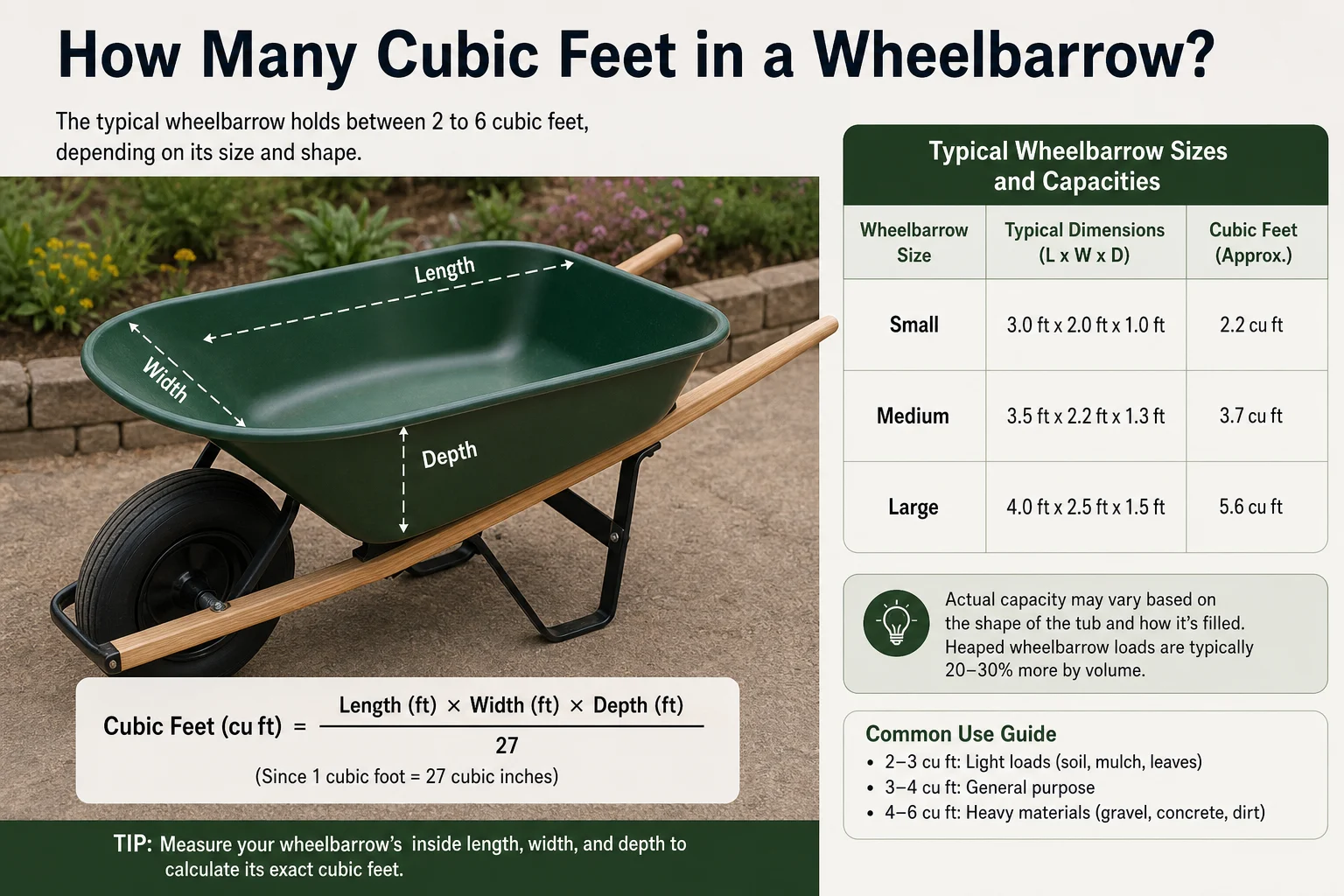
The short answer is that there is no single standard wheelbarrow size. Many wheelbarrows sold in the United States have capacities around 4 to 6 cubic feet, with 6 cubic feet being a common full-size capacity. Smaller garden barrows may hold about 4 cubic feet, while larger models can hold 8 cubic feet or more.
So, if your wheelbarrow is labeled 6 cu. ft., one completely filled load represents approximately 6 cubic feet of volume. A 4-cubic-foot wheelbarrow represents 4 cubic feet, and so on.
That distinction matters when estimating materials. If you’re ordering 2 cubic yards of mulch, for example, knowing your wheelbarrow’s capacity lets you estimate how many trips you’ll need. In this measurement guide, we’ll explain the conversion formula, show useful tables, work through realistic examples, and cover the mistakes that can turn a simple volume calculation into an expensive material shortage.
A typical wheelbarrow holds approximately 4 to 6 cubic feet, depending on its design and manufacturer.
For a commonly used 6-cubic-foot wheelbarrow:
1 full wheelbarrow = approximately 6 cubic feet
For a 4-cubic-foot model:
1 full wheelbarrow = approximately 4 cubic feet
The important point is that “one wheelbarrow” is not a standardized unit of volume.
Quick Reference
| Wheelbarrow Capacity | Cubic Feet per Full Load |
|---|---|
| Small garden barrow | 2–3 cu. ft. |
| 4-cu.-ft. wheelbarrow | 4 cu. ft. |
| 5-cu.-ft. wheelbarrow | 5 cu. ft. |
| 6-cu.-ft. wheelbarrow | 6 cu. ft. |
| 8-cu.-ft. wheelbarrow | 8 cu. ft. |
Always check the manufacturer’s stated capacity or the label on your wheelbarrow before using it for a project estimate.
Understanding How Many Cubic Feet in a Wheelbarrow
A cubic foot is a unit of volume equal to the space contained in a cube measuring 1 foot × 1 foot × 1 foot.
A wheelbarrow, by contrast, is a physical container rather than a standardized measurement unit. Its volume depends on the dimensions and shape of its tray.
That is why asking how many cubic feet are in “a wheelbarrow” is somewhat like asking how many gallons are in “a bucket.” The answer depends on the particular container.
What Determines Wheelbarrow Capacity?
Several factors affect the volume:
- Tray length
- Tray width
- Tray depth
- Sloped sides
- Rounded corners
- Manufacturer’s design
- Maximum fill level
Wheelbarrow capacities are commonly advertised in cubic feet, making them useful for landscaping and construction calculations.
U.S. Customary Units and Metric Units
Cubic feet are commonly used in U.S. construction, landscaping, gardening, and home-improvement projects.
For reference:
- 1 cubic foot = 1,728 cubic inches
- 1 cubic foot ≈ 7.48 U.S. gallons
- 1 cubic foot ≈ 0.0283 cubic meters
- 1 cubic yard = 27 cubic feet
That last relationship is especially useful when buying bulk landscaping materials.
How Many Cubic Feet in a Wheelbarrow? Conversion Formula
If you know your wheelbarrow’s rated capacity, the calculation is straightforward.
Basic Formula
Cubic feet per load = wheelbarrow capacity in cubic feet
For example, if the wheelbarrow is rated at 6 cubic feet:
1 load × 6 cubic feet = 6 cubic feet
If you’re trying to determine the number of wheelbarrow loads needed for a project, use:
Number of loads = Total cubic feet ÷ Wheelbarrow capacity
Example 1: 24 Cubic Feet of Mulch
Suppose you need to move 24 cubic feet of mulch with a 6-cubic-foot wheelbarrow.
- Total material = 24 cubic feet
- Wheelbarrow capacity = 6 cubic feet
- Divide 24 by 6
- 24 ÷ 6 = 4 loads
You would need 4 full wheelbarrow loads.
Example 2: 30 Cubic Feet Using a 5-Cubic-Foot Barrow
30 ÷ 5 = 6 loads
So the job requires approximately 6 full loads.
Example 3: 20 Cubic Feet Using a 4-Cubic-Foot Wheelbarrow
20 ÷ 4 = 5 loads
Again, that’s 5 full loads.
The arithmetic is simple. The tricky part is making sure the capacity you’re using matches the actual wheelbarrow.
Wheelbarrow Cubic Feet Conversion Table
Use this conversion table when estimating the number of loads required for a project.
| Total Material | 4-cu.-ft. Barrow | 5-cu.-ft. Barrow | 6-cu.-ft. Barrow |
|---|---|---|---|
| 4 cu. ft. | 1 load | 0.8 load | 0.67 load |
| 6 cu. ft. | 1.5 loads | 1.2 loads | 1 load |
| 10 cu. ft. | 2.5 loads | 2 loads | 1.67 loads |
| 12 cu. ft. | 3 loads | 2.4 loads | 2 loads |
| 18 cu. ft. | 4.5 loads | 3.6 loads | 3 loads |
| 20 cu. ft. | 5 loads | 4 loads | 3.33 loads |
| 24 cu. ft. | 6 loads | 4.8 loads | 4 loads |
| 30 cu. ft. | 7.5 loads | 6 loads | 5 loads |
| 36 cu. ft. | 9 loads | 7.2 loads | 6 loads |
| 54 cu. ft. | 13.5 loads | 10.8 loads | 9 loads |
Important: You cannot make a fraction of a physical trip, so round the final number of loads up when planning actual work.
For example, 20 cubic feet in a 6-cu.-ft. wheelbarrow equals 3.33 theoretical loads, meaning you’ll need 4 trips if every trip is filled to capacity.
Practical Examples of Wheelbarrow Volume
The calculation becomes much more useful when you connect it to real projects.
Construction
Suppose a contractor needs to move 54 cubic feet of sand using a 6-cu.-ft. wheelbarrow.
54 ÷ 6 = 9 loads
That’s exactly 9 full wheelbarrow loads.
However, actual construction work may require partial loads because of weight limits, uneven terrain, or the need to keep the material safely balanced.
Home Landscaping
Imagine you’re spreading 2 cubic yards of mulch.
Since:
1 cubic yard = 27 cubic feet
Then:
2 × 27 = 54 cubic feet
Using a 6-cu.-ft. wheelbarrow:
54 ÷ 6 = 9 loads
So two cubic yards equals 9 theoretical full loads in a 6-cubic-foot wheelbarrow.
Using a 4-Cubic-Foot Wheelbarrow
The same 54 cubic feet becomes:
54 ÷ 4 = 13.5 loads
Because you cannot make half a trip, plan on 14 loads.
This example shows why knowing your exact wheelbarrow capacity matters.
Converting Cubic Feet to Cubic Yards
If you have a volume expressed in cubic feet and want to convert it to cubic yards:
Cubic yards = cubic feet ÷ 27
For example:
81 cubic feet ÷ 27 = 3 cubic yards
This is particularly useful when comparing a contractor’s material estimate with the number of wheelbarrow loads you’ll actually move.
Common Conversion Mistakes
Even simple volume calculations can go wrong. Here are the mistakes to watch for.
1. Assuming Every Wheelbarrow Holds 6 Cubic Feet
This is a common misconception.
Six cubic feet is a common capacity, but it isn’t a universal standard. Four-, five-, six-, and larger wheelbarrows are available.
2. Confusing Cubic Feet With Square Feet
These measurements describe different things.
- Square feet measure area.
- Cubic feet measure volume.
A mulch bed might be measured in square feet, but the amount of mulch required is calculated in cubic feet or cubic yards.
3. Ignoring the Material’s Weight
A wheelbarrow may have a particular volume capacity, but that doesn’t mean you should fill it with every material to the brim.
A load of dry leaves and a load of wet gravel can occupy the same volume while having dramatically different weights.
4. Assuming “Full” Means Heaped Above the Rim
A manufacturer’s rated capacity should not automatically be interpreted as a giant mound piled above the tray.
For repeatable calculations, use the manufacturer’s stated capacity and maintain a consistent fill level.
5. Rounding Too Early
Suppose you calculate:
25 ÷ 6 = 4.1667
Don’t round that to 4 loads. For physical work, you need 5 trips if the wheelbarrow must carry all 25 cubic feet.
6. Mixing Cubic Feet and Cubic Yards
Remember:
1 cubic yard = 27 cubic feet
Not 10, not 30, and not 100.
Quick Mental Conversion Tips
You don’t always need a conversion calculator.
Tip 1: Remember 27
The most useful landscaping relationship is:
1 cubic yard = 27 cubic feet
If you remember 27, you can quickly move between cubic yards and cubic feet.
Tip 2: Memorize Common Wheelbarrow Capacities
For everyday work, remember:
- 4 cu. ft. = smaller common barrow
- 5 cu. ft. = medium capacity
- 6 cu. ft. = common full-size capacity
- 8 cu. ft. = larger capacity
Tip 3: Divide by the Capacity
To estimate trips:
Total volume ÷ barrow capacity = number of loads
For example:
36 ÷ 6 = 6
So 36 cubic feet requires six theoretical loads in a 6-cu.-ft. barrow.
Tip 4: Build in a Practical Margin
Real work rarely matches a perfect mathematical model. Material may spill, the tray may not be filled completely, or you may deliberately carry a lighter load.
For project planning, it’s sensible to allow some extra capacity rather than assuming every trip will be perfectly full.
Comparison Between Wheelbarrow Volume and Other Units
Understanding how cubic feet relates to other units makes the conversion much easier to visualize.
| Unit | Equivalent Volume | Typical Use |
|---|---|---|
| 1 cubic foot | 1 cu. ft. | Small material quantities |
| 1 cubic yard | 27 cu. ft. | Landscaping and bulk materials |
| 1 U.S. gallon | 0.1337 cu. ft. | Liquid volume |
| 1 cubic meter | 35.315 cu. ft. | Metric construction/material estimates |
| 6-cu.-ft. wheelbarrow | 6 cu. ft. | Material transport |
| 8-cu.-ft. wheelbarrow | 8 cu. ft. | Larger material transport |
A 6-cubic-foot wheelbarrow is therefore:
6 ÷ 27 = 0.222 cubic yards
So one completely filled 6-cu.-ft. barrow represents about 0.22 cubic yard of volume.
Conversely:
27 ÷ 6 = 4.5
Therefore, one cubic yard contains the equivalent volume of 4.5 theoretical full loads in a 6-cu.-ft. wheelbarrow.
In real work, you’ll often make 5 trips because the final amount must be transported physically.
Why Accurate Measurement Matters
Accurate volume measurement isn’t just useful for math homework. It can save money, time, and unnecessary physical labor.
Construction
Concrete, sand, gravel, soil, and aggregate are frequently ordered by volume. An incorrect estimate can mean too little material or an expensive surplus.
Engineering
Engineers need consistent units when calculating material quantities, loads, dimensions, and project requirements. A mistake involving cubic units can become significant as project sizes increase.
Manufacturing
Factories often work with precise material volumes. Consistent measurement supports repeatability and quality control.
Home Renovation
Whether you’re filling a raised bed, leveling an area, installing drainage material, or moving debris, knowing the volume helps you estimate the work involved.
Education
The wheelbarrow provides an excellent real-world example of volume conversion because students can connect abstract cubic units with something they can actually see and handle.
Realistic Case Study
Imagine a homeowner orders 3 cubic yards of topsoil.
First convert the order into cubic feet:
3 × 27 = 81 cubic feet
The homeowner has a 6-cu.-ft. wheelbarrow:
81 ÷ 6 = 13.5 loads
Mathematically, that’s 13.5 full loads. Practically, the homeowner should plan for 14 trips, with additional trips possible if the wheelbarrow isn’t filled completely.
That small calculation turns a vague question—“How much work is this?”—into a concrete estimate.
Expert measurement tip: Always separate volume capacity from safe load weight. A wheelbarrow can have room for a certain volume while the material inside may be too heavy to move safely at that fill level.
FAQ: How Many Cubic Feet in a Wheelbarrow?
1. How many cubic feet are in a standard wheelbarrow?
There isn’t one universal standard capacity. Many commonly sold wheelbarrows hold about 4 to 6 cubic feet, while larger models can hold more. A 6-cubic-foot wheelbarrow is a common reference point for landscaping and construction calculations. Always check the capacity printed on your particular model rather than assuming every wheelbarrow holds six cubic feet.
2. How many cubic feet are in a 6-cubic-foot wheelbarrow?
A wheelbarrow rated at 6 cubic feet holds 6 cubic feet when filled to its rated capacity. In cubic yards, that equals 6 ÷ 27, or approximately 0.22 cubic yard. Therefore, the volume of four full 6-cu.-ft. loads is 24 cubic feet, while five full loads would represent 30 cubic feet.
3. How many wheelbarrow loads are in one cubic yard?
One cubic yard equals 27 cubic feet. With a 6-cubic-foot wheelbarrow, 27 ÷ 6 equals 4.5 theoretical loads. Since a physical job requires complete trips, you would generally plan for 5 loads if each load is filled to the rated capacity. A smaller 4-cu.-ft. wheelbarrow would require 6.75 theoretical loads, or 7 trips.
4. Can I calculate wheelbarrow volume without a calculator?
Yes. If you know the rated capacity, simply divide the total cubic feet by the wheelbarrow’s capacity. For example, 24 cubic feet ÷ 6 cubic feet per load = 4 loads. For common numbers, basic mental math is often enough. A calculator becomes more useful when dealing with decimals, irregular quantities, or conversions between cubic feet, cubic yards, and cubic meters.
5. Is a wheelbarrow’s cubic-foot capacity exact?
The manufacturer’s stated capacity is the best reference, but actual working loads can vary. You may not fill the tray perfectly every time, and different materials can behave differently. A loose, heaped load also isn’t necessarily equivalent to a measured cubic-foot volume. For accurate project estimates, use the manufacturer’s capacity and keep your fill level reasonably consistent.
6. How many cubic feet are in a 4-cubic-foot wheelbarrow?
A wheelbarrow rated at 4 cubic feet has a stated volume capacity of 4 cubic feet. That’s approximately 0.148 cubic yard because 4 ÷ 27 ≈ 0.148. Four such full loads equal 16 cubic feet, and seven full loads equal 28 cubic feet. Four-cubic-foot models are commonly used for gardening and general residential hauling.
7. What formula should I use for wheelbarrow load calculations?
Use this simple formula:
Number of loads = total material volume ÷ wheelbarrow capacity
For example, if you have 48 cubic feet of material and a 6-cu.-ft. wheelbarrow:
48 ÷ 6 = 8 loads
If the result includes a fraction, round up when calculating the number of actual trips required.
8. How many wheelbarrow loads are in 2 cubic yards?
Two cubic yards equal 54 cubic feet because 2 × 27 = 54. With a 6-cu.-ft. wheelbarrow, 54 ÷ 6 = 9 full loads. With a 4-cu.-ft. wheelbarrow, 54 ÷ 4 = 13.5, so you would need 14 trips if every load were filled to its rated capacity.
9. Does the type of material change the cubic-foot conversion?
No. A cubic foot remains a cubic foot regardless of whether it contains soil, mulch, sand, gravel, or another material. What changes is the weight and behavior of the material. Heavy materials can make a full wheelbarrow difficult or unsafe to move, so volume capacity should never be treated as a recommended weight limit.
Final Thoughts
So, how many cubic feet in a wheelbarrow? The answer depends on the wheelbarrow’s rated capacity. For many common U.S. models, 4 to 6 cubic feet is a useful working range, with 6 cubic feet being a common full-size capacity.
The essential formula is simple:
Number of wheelbarrow loads = total cubic feet ÷ wheelbarrow capacity
And remember the most useful landscaping conversion:
1 cubic yard = 27 cubic feet
Once you know those two relationships, you can estimate material quantities, calculate trips, compare wheelbarrow sizes, and translate supplier estimates into practical work.
For the most accurate result, check your wheelbarrow’s actual capacity instead of relying on the phrase “standard wheelbarrow.” A few minutes spent checking specifications can prevent hours of unnecessary trips.
Ready to make your next measurement easier? Explore more measurement conversion guides to quickly convert cubic feet, cubic yards, gallons, inches, feet, pounds, and other everyday U.S. customary units.