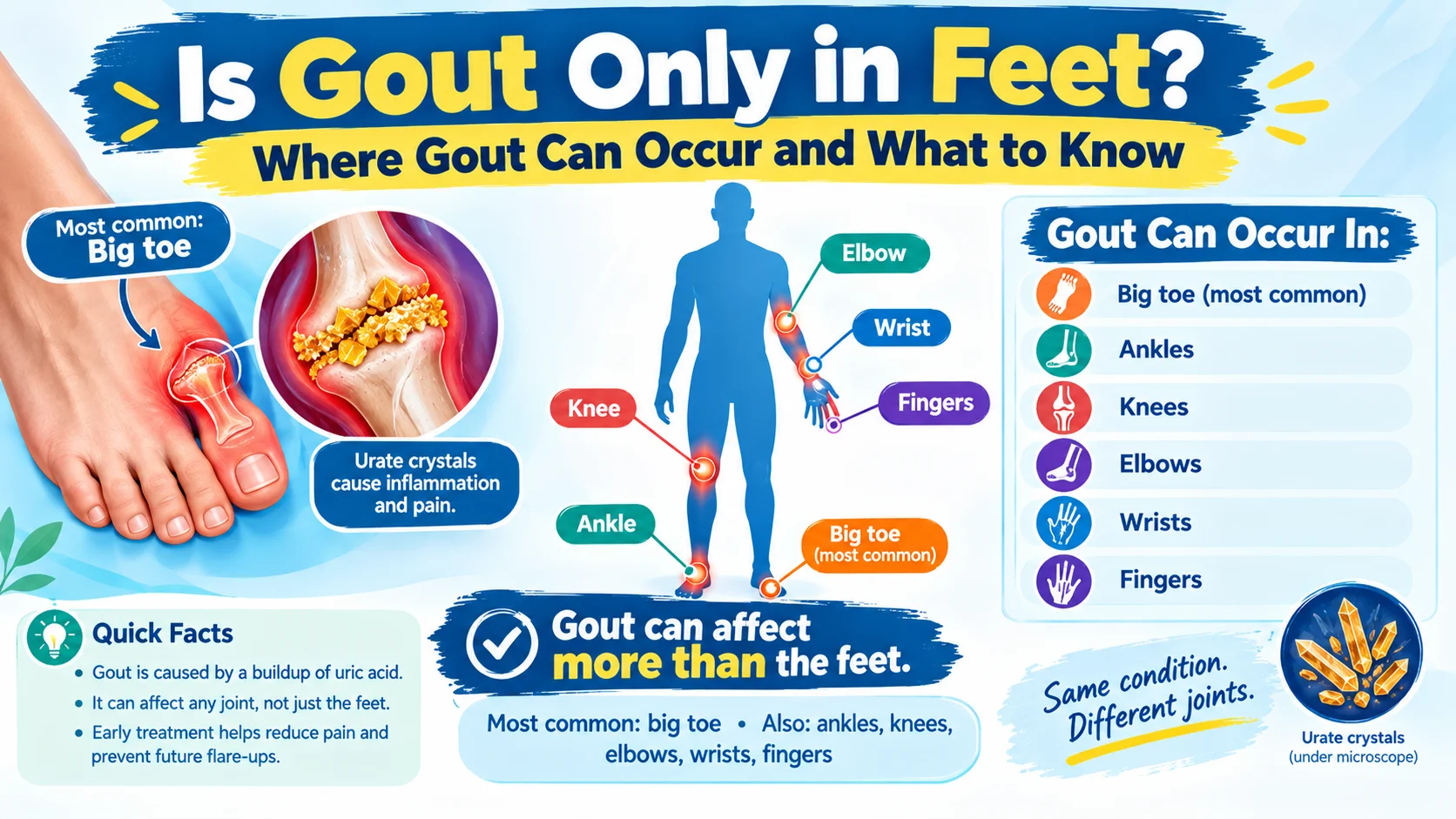
If you suddenly wake up with a swollen, red, intensely painful big toe, gout may be one of the first conditions that comes to mind. But is gout only in feet? No. Although the feet—especially the joint at the base of the big toe—are classic locations for gout, gout can affect several other joints throughout the body.
Gout is a form of inflammatory arthritis caused by urate crystals building up in and around a joint. These crystals can trigger a sudden inflammatory attack, or “flare,” producing severe pain, warmth, swelling, redness, and tenderness. The big toe is the most recognizable location, but gout can also affect the ankles, knees, fingers, wrists, elbows, and other joints.
That distinction matters. Someone with unexplained joint pain should not assume that gout is impossible simply because the pain isn’t in the foot. Conversely, not every painful, swollen foot or joint is gout.
This guide explains where gout can occur, why it commonly starts in the feet, how doctors diagnose it, what symptoms to watch for, and when sudden joint pain needs prompt medical attention.
No. Gout is not limited to the feet.
Gout most commonly affects the joint at the base of the big toe, but it can also occur in:
- Ankles
- Knees
- Fingers
- Wrists
- Elbows
- Other joints and surrounding tissues
The important point is simple: gout is a disease of urate crystal deposition, not a disease exclusively of the feet.
| Location | Can gout occur there? | Typical significance |
|---|---|---|
| Big toe | Yes | Classic and very common location |
| Other toes | Yes | Can occur during gout flares |
| Foot | Yes | Common area for early gout |
| Ankle | Yes | Recognized gout location |
| Knee | Yes | Can cause a very painful swollen knee |
| Fingers | Yes | Possible site, especially with established gout |
| Wrist | Yes | Possible site of inflammation |
| Elbow | Yes | May involve the joint or form tophi |
Understanding Why Gout Commonly Affects the Feet
Gout develops when urate levels become high enough for crystals to form in or around joints. Those crystals activate inflammation, which produces the characteristic pain and swelling of a gout flare.
So why does gout so often show up in the big toe?
The exact reason is complex, but the big toe joint is particularly susceptible to urate crystal formation. Gout also tends to affect peripheral joints, making the feet and ankles familiar locations for attacks.
A typical flare can begin suddenly, sometimes during the night. The joint may become:
- Extremely painful
- Warm or hot
- Swollen
- Red or discolored
- Very sensitive to touch
- Difficult to move or bear weight on
Gout pain often reaches its greatest intensity within the first several hours, although discomfort can continue for days or longer.
Important: A painful big toe can be consistent with gout, but symptoms alone cannot always establish the diagnosis.
Is Gout Only in Feet? Other Places Gout Can Affect
Although the feet are strongly associated with gout, the condition can occur beyond them.
Ankles
Gout can cause sudden ankle pain and swelling. Because an ankle flare may resemble a sprain or another inflammatory condition, the absence of an obvious injury can be an important clue.
Knees
The knee can become swollen, hot, and extremely painful during a gout flare. Knee gout can sometimes be confused with other forms of arthritis or infection.
Fingers and Hands
Gout can affect the fingers and other hand joints, particularly in people who have had gout for a longer period. Deposits called tophi may also develop under the skin around affected joints.
Wrists
Although less famous than the big toe, wrists can also become inflamed during a gout attack.
Elbows
Gout may affect the elbow joint or produce tophi around the elbow. Tophi are collections of urate crystals that can develop when gout remains inadequately controlled over time.
Is Gout Only in Feet? Understanding the Cause
The location of a flare does not change the underlying mechanism.
Gout occurs when excess urate builds up and forms crystals in or around joints. Uric acid is produced when the body breaks down purines, substances found naturally in the body and in various foods.
The kidneys normally remove uric acid through urine. Gout risk can increase when the body produces too much uric acid, removes too little, or both.
Factors associated with increased gout risk include:
- Family history of gout
- Reduced kidney function
- Obesity
- High blood pressure and certain metabolic conditions
- Alcohol consumption
- Some medications, including certain diuretics
- Diets high in certain purine-rich foods
- Sugary drinks containing fructose
Importantly, having a high uric acid level does not automatically mean a person has gout. Many people with elevated serum urate never develop gout.
Gout Symptoms: How Can You Recognize a Flare?
One of the clearest features of gout is the sudden onset of intense joint pain.
A typical flare may involve sudden and severe pain, followed by swelling, warmth, redness, and tenderness. Attacks frequently affect one joint at a time, although multiple joints can become involved, particularly as gout progresses.
| Symptom | What it may feel like |
|---|---|
| Sudden pain | Severe pain that develops rapidly |
| Swelling | Joint appears visibly enlarged |
| Heat | Skin over the joint feels unusually warm |
| Redness | Inflamed skin may become red or darker |
| Tenderness | Even light pressure can hurt |
| Stiffness | Joint movement becomes difficult |
| Limited mobility | Walking or using the joint becomes difficult |
Skin redness can be harder to see on darker skin tones, so swelling, warmth, tenderness, and pain are also important signs.
How Is Gout Diagnosed?
A symptom-based guess is not always enough to diagnose gout. A healthcare professional may consider several pieces of evidence.
- Medical history: When did the pain start? Which joints are affected? Have similar attacks happened before?
- Physical examination: The joint may be examined for swelling, warmth, redness, tenderness, and limited movement.
- Blood testing: A serum urate test may be used, although the result needs to be interpreted in context.
- Joint-fluid analysis: Fluid removed from the affected joint can be examined for urate crystals.
- Imaging: Ultrasound or specialized CT imaging may sometimes help identify crystal deposits.
Joint-fluid analysis can be particularly useful when the diagnosis is uncertain because several conditions can produce a hot, swollen joint.
For example, pseudogout, also called CPPD disease, can resemble gout but involves calcium pyrophosphate crystals rather than urate crystals.
Gout vs. Other Causes of Joint Pain
Not every swollen toe, foot, knee, or finger is gout.
| Condition | Typical clue | Crystal-related? |
|---|---|---|
| Gout | Sudden, severe pain, often in the big toe | Urate crystals |
| Pseudogout/CPPD | Often affects knee or wrist | Calcium pyrophosphate crystals |
| Osteoarthritis | Gradual pain and stiffness | No |
| Rheumatoid arthritis | Often affects multiple joints | No |
| Joint infection | Hot, swollen joint with possible fever | Infection |
| Sprain/injury | Usually follows trauma or overuse | No |
A joint infection is particularly important to rule out because it may require urgent treatment.
Seek prompt medical attention for a hot, swollen, painful joint accompanied by fever or feeling very unwell.
How Gout Is Treated and Managed
Treatment depends on whether the goal is controlling an active flare, preventing future attacks, or reducing long-term urate accumulation.
During a flare, healthcare professionals may use anti-inflammatory medicines, colchicine, or corticosteroids depending on the person’s circumstances.
For people with recurrent or more advanced gout, medicines that lower urate can help prevent future flares and complications. Lifestyle measures may also be part of an overall management plan.
Common management strategies include:
- Following the treatment plan prescribed by a healthcare professional.
- Taking urate-lowering medication consistently when prescribed.
- Limiting alcohol, particularly beer and spirits.
- Reducing consumption of foods and drinks that can increase urate levels.
- Maintaining an appropriate level of physical activity.
- Managing related health conditions.
- Staying adequately hydrated unless a clinician has advised otherwise.
Expert tip: Treating the underlying urate problem is different from simply treating today’s pain. Repeated gout attacks deserve medical evaluation because untreated gout can lead to more frequent attacks, tophi, and joint damage.
Common Mistakes About Gout
Mistake 1: “Gout only affects the big toe.”
The big toe is the classic location, but gout can affect ankles, knees, fingers, wrists, elbows, and other areas.
Mistake 2: “If my uric acid is high, I definitely have gout.”
Not necessarily. Many people have elevated urate without developing gout.
Mistake 3: “If the pain isn’t in my foot, it can’t be gout.”
Gout outside the feet is well documented. A painful knee, finger, ankle, or wrist can also be affected.
Mistake 4: “All swollen joints are gout.”
Infection, injury, osteoarthritis, rheumatoid arthritis, pseudogout, and other conditions can produce similar symptoms.
Mistake 5: “Once the flare disappears, the problem is gone.”
Symptoms can disappear between flares while urate crystals remain. Recurrent untreated gout can become more frequent and cause long-term complications.
Why Accurate Diagnosis Matters
Imagine someone develops a red, swollen knee overnight. They assume they injured it and wait several days. The pain becomes severe, and eventually a fever develops.
That situation should not simply be labeled “gout.” A hot, swollen joint accompanied by fever can indicate septic arthritis, a joint infection that requires urgent medical assessment.
Accurate diagnosis matters because treatment depends on the cause.
For confirmed gout, long-term management may reduce attacks and prevent crystal accumulation. For an infection, treatment is entirely different. For pseudogout, the underlying crystal type is different again.
The safest approach is to avoid diagnosing yourself based solely on where the pain occurs.
Quick Gout Facts at a Glance
| Question | Answer |
|---|---|
| Is gout only in feet? | No. |
| Most common location? | Base of the big toe |
| Can gout affect ankles? | Yes |
| Can gout affect knees? | Yes |
| Can gout affect fingers? | Yes |
| Can gout affect elbows? | Yes |
| Is high uric acid always gout? | No |
| Can gout cause tophi? | Yes |
| Can gout cause kidney stones? | It can |
| Can another condition mimic gout? | Yes |
Expert Takeaways
- Gout is not restricted to the feet.
- The big toe is the classic site, but other joints can be affected.
- Sudden severe pain with warmth, swelling, and tenderness is characteristic of a gout flare.
- High uric acid alone does not prove that someone has gout.
- A hot, swollen joint with fever needs prompt medical assessment.
- Recurrent gout should be medically managed rather than treated as an isolated pain episode.
FAQ: Is Gout Only in Feet?
1. Is gout only in feet?
No. Gout commonly affects the feet, particularly the joint at the base of the big toe, but it can also affect the ankles, knees, fingers, wrists, elbows, and other joints. Gout results from urate crystal deposition and inflammation, so the condition is not defined by where the pain occurs.
2. Can gout occur in the knee?
Yes. Gout can affect the knee and cause sudden, severe pain, swelling, warmth, and difficulty moving the joint. Knee gout can resemble other forms of arthritis or even infection, so a new hot and swollen knee should not automatically be assumed to be gout.
3. Can gout affect the fingers?
Yes. Gout can affect finger joints, particularly in people with longstanding or inadequately controlled disease. Tophi—collections of urate crystals—can also develop around the fingers and hands. Persistent swelling or pain in a finger should be evaluated rather than automatically attributed to gout.
4. Why does gout usually start in the big toe?
The big toe joint is the most common site of gout, although gout can occur elsewhere. The tendency for gout to affect peripheral joints, combined with conditions that favor urate crystal formation, helps explain why the big toe is such a familiar location. The exact biological reasons for its prominence are complex.
5. Can you have gout without foot pain?
Yes. A gout flare does not have to involve the foot. Some people develop gout in the ankle, knee, wrist, elbow, or fingers. Therefore, the location of joint pain alone cannot rule gout in or out.
6. Does high uric acid mean I have gout?
No. Elevated blood urate increases the risk of gout, but many people with high urate levels never develop gout. A diagnosis considers symptoms, examination findings, medical history, laboratory results, and sometimes identification of urate crystals in joint fluid.
7. How long does a gout flare last?
An untreated gout flare may last about one to two weeks, although the duration varies. Pain is often most intense early in the attack, while residual discomfort can continue after the worst pain improves. Recurrent attacks can become more frequent or last longer when gout remains untreated.
8. Can gout cause problems beyond joints?
Yes. Longstanding uncontrolled gout can produce tophi, which are deposits of urate crystals under the skin and around joints. Gout is also associated with urate-related kidney stones. Effective long-term management aims to reduce these complications as well as prevent painful flares.
9. When should I seek medical care for possible gout?
Seek medical evaluation for a first episode of sudden, severe joint pain or swelling. Prompt or urgent assessment is especially important when a joint is hot and inflamed and you also have a fever or feel very unwell, because a joint infection can resemble gout and may require immediate treatment.
Final Thoughts: Is Gout Only in Feet?
No—gout is not only in the feet. The big toe is its best-known target, but gout can also affect the ankles, knees, fingers, wrists, elbows, and other joints.
The key concept is that gout is caused by urate crystal deposition and inflammation, not by a problem limited to one particular body part. A sudden, extremely painful, swollen joint deserves attention regardless of whether it is in the foot, hand, knee, or another location.
If you’ve had repeated attacks, unexplained joint swelling, or symptoms that resemble gout for the first time, getting an accurate diagnosis is more useful than trying to identify the condition from location alone.
Explore more evidence-based guides on gout symptoms, uric acid, arthritis, joint pain, and related health questions to better understand your symptoms and discuss them with a qualified healthcare professional.