A measurement can look simple until you need to use it in a different unit. If a contractor says a wall is 40 feet long, a student gets a 40-foot measurement in a math problem, or you are checking the length of a property, you may need the answer in inches instead.
So, how many inches in 40 feet?
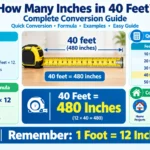
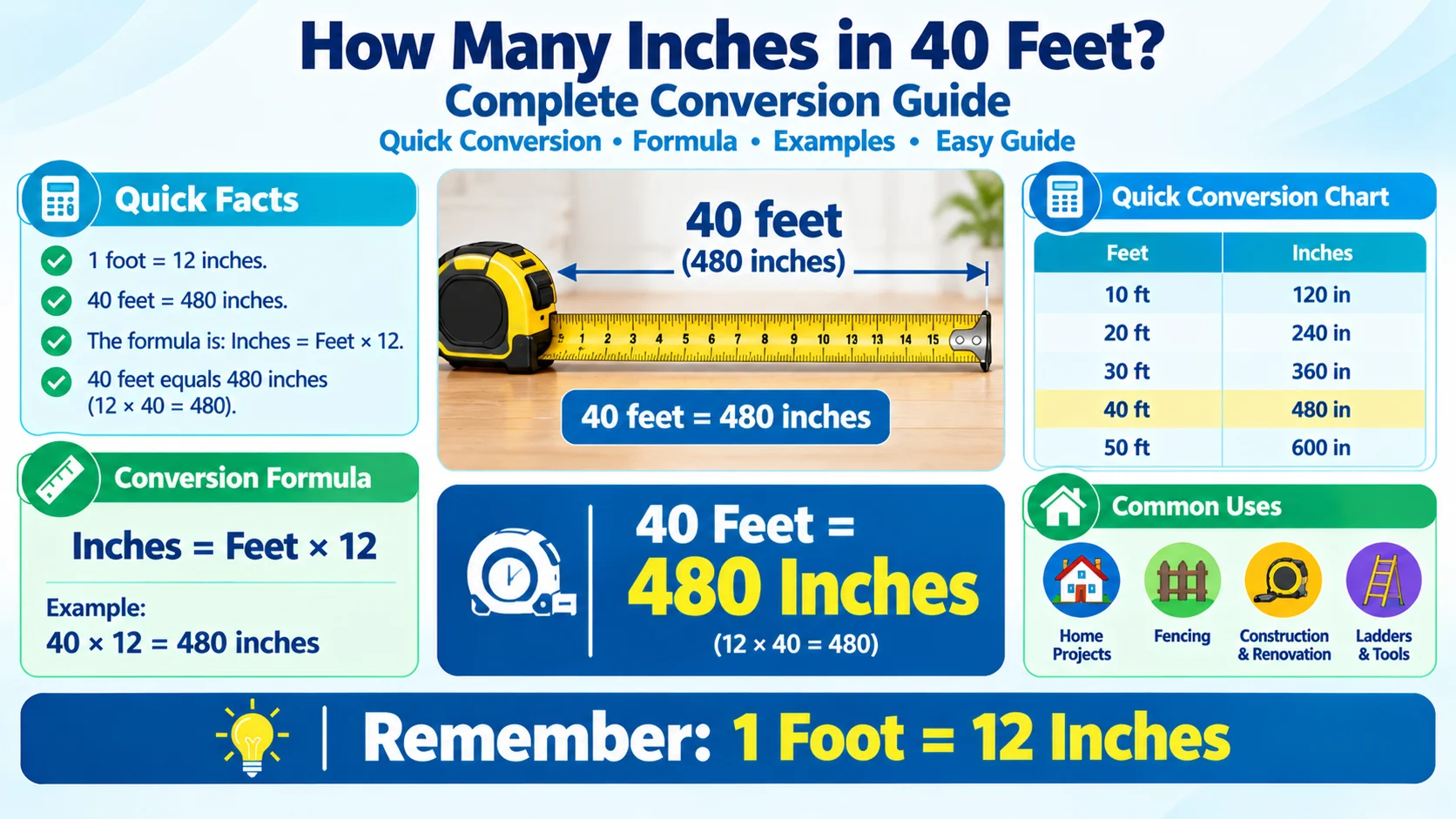
The answer is 480 inches.
The calculation is straightforward because 1 foot contains exactly 12 inches. Therefore:
40 feet × 12 inches per foot = 480 inches
This is an exact conversion, not an estimate. Whether you are working on a home-improvement project, calculating dimensions for a DIY build, reading a construction plan, or solving a unit-conversion problem, knowing this relationship makes the calculation quick and reliable.
In this guide, you’ll learn exactly how to convert 40 feet to inches, why the formula works, how to reverse the calculation, and how the measurement applies to real-world situations. You’ll also find conversion charts, practical examples, mental-math shortcuts, common mistakes, and answers to frequently asked questions.
40 feet equals exactly 480 inches.
The conversion formula is:
Inches = Feet × 12
For 40 feet:
40 × 12 = 480 inches
Therefore:
40 ft = 480 in
Because both feet and inches are U.S. customary units, this conversion does not require rounding or estimation.
Quick conversion
| Measurement | Equivalent |
|---|---|
| 40 feet | 480 inches |
| 40 feet | 13.333 yards |
| 40 feet | 12.192 meters |
| 40 feet | 1,219.2 centimeters |
If you only need the answer, remember:
40 feet × 12 = 480 inches.
Understanding Feet and Inches
The foot and inch are both units of length used in the U.S. customary system and, historically, the imperial measurement system.
The relationship between them is fixed:
1 foot = 12 inches
That means every foot contains exactly 12 equal inches.
The inch is the smaller unit, making it useful for more detailed measurements. Feet are more convenient for larger everyday dimensions such as room lengths, building dimensions, people’s heights, and distances around a property.
For example:
- A pencil might be measured in inches.
- A doorway may be measured in feet and inches.
- A room might be described as 12 feet long.
- A construction project may use both feet and inches depending on the required precision.
The metric equivalent is also useful to know:
1 inch = 2.54 centimeters
Therefore:
40 feet = 480 inches = 1,219.2 centimeters = 12.192 meters
Feet versus inches
| Unit | Symbol | Relationship | Common Uses |
|---|---|---|---|
| Foot | ft | 1 ft = 12 in | Rooms, buildings, height, construction |
| Inch | in | 1 in = 1/12 ft | Small dimensions, materials, tools |
| Yard | yd | 1 yd = 3 ft | Landscaping, fabric, sports |
| Meter | m | 1 m ≈ 3.28084 ft | Metric measurements, science, engineering |
How to Convert 40 Feet to Inches
The conversion formula is simple because the relationship between feet and inches is exact.
Conversion formula
Inches = Feet × 12
To convert 40 feet:
40 × 12 = 480
So:
40 feet = 480 inches
Step-by-step calculation
- Start with the measurement: 40 feet.
- Remember that 1 foot = 12 inches.
- Multiply 40 by 12.
- 40 × 12 = 480.
- Write the final result as 480 inches.
That’s all you need for this conversion.
Why do we multiply by 12?
Think of 40 feet as 40 groups of 1 foot.
Each foot contains 12 inches:
12 + 12 + 12 + … + 12 for 40 groups.
Multiplication is simply a faster way to add those identical groups:
40 × 12 = 480
This is why the conversion uses multiplication rather than division.
Reverse conversion
If you already know the measurement in inches and want feet, divide by 12:
Feet = Inches ÷ 12
For example:
480 ÷ 12 = 40 feet
This gives you a useful way to check your work. If converting 40 feet to inches gives 480 inches, converting 480 inches back to feet should return exactly 40 feet.
Feet to Inches Conversion Table
A conversion chart can make nearby measurements much easier to reference.
| Feet | Inches |
|---|---|
| 1 ft | 12 in |
| 2 ft | 24 in |
| 5 ft | 60 in |
| 10 ft | 120 in |
| 15 ft | 180 in |
| 20 ft | 240 in |
| 25 ft | 300 in |
| 30 ft | 360 in |
| 35 ft | 420 in |
| 40 ft | 480 in |
| 45 ft | 540 in |
| 50 ft | 600 in |
| 60 ft | 720 in |
| 100 ft | 1,200 in |
The pattern is easy to see: every additional foot adds 12 inches.
Practical Examples of 40 Feet in Inches
Understanding a measurement becomes easier when you can picture where it might appear in real life.
Example 1: Construction
Suppose a contractor is working with a wall that is 40 feet long. A technical drawing requires the length to be entered in inches.
Use the conversion formula:
40 × 12 = 480 inches
The wall should therefore be recorded as 480 inches long.
This type of conversion can be useful when plans, material specifications, or software require dimensions in a single unit.
Example 2: Home improvement
Imagine you’re planning a long fence and need to calculate its total length. Your property plan gives the fence run as 40 feet.
Converting it to inches:
40 ft × 12 = 480 in
If individual fence components are specified in inches, having the total length in inches makes the measurements easier to compare.
Example 3: Education
A math worksheet might ask:
How many inches are in 40 feet?
The correct method is:
40 × 12 = 480
Answer:
480 inches
The key concept is recognizing the conversion factor of 12 inches per foot.
Example 4: Manufacturing
A manufacturer may receive specifications using feet while production equipment is configured in inches.
If the required length is 40 feet:
40 feet = 480 inches
Converting the entire specification into inches can prevent different parts of a production process from using incompatible units.
Example 5: Sports and recreation
A distance or facility dimension may be listed in feet but need to be compared with equipment measured in inches.
For example, a 40-foot section of a facility is:
480 inches long
This makes direct comparison with inch-based dimensions possible.
Common Conversion Mistakes
Although converting feet to inches is easy, several mistakes occur repeatedly.
1. Multiplying by the wrong number
The correct relationship is:
1 foot = 12 inches
So:
40 × 12 = 480
Multiplying by 10, 3, or another number would produce an incorrect result.
2. Dividing instead of multiplying
When converting feet to inches, multiply by 12.
When converting inches to feet, divide by 12.
A useful way to remember it is:
- Larger unit → smaller unit: multiply.
- Smaller unit → larger unit: divide.
3. Confusing feet with yards
There are 3 feet in 1 yard, not 12.
Therefore:
40 feet ÷ 3 = 13⅓ yards
That’s a different conversion from feet to inches.
4. Mixing metric and U.S. customary units
Feet and inches are not metric units.
If you need to convert 40 feet to meters, use:
40 × 0.3048 = 12.192 meters
Do not treat 1 foot as 1 meter.
5. Rounding an exact conversion
There is no reason to round 40 feet to inches.
Because 1 foot is exactly 12 inches, the answer is exactly:
480 inches
Expert tip: Keep exact conversions exact whenever possible. Save rounding for situations where an approximation is actually needed.
Quick Mental Conversion Tips for Feet to Inches
You can calculate 40 feet in your head almost instantly.
The key fact is:
1 foot = 12 inches
To multiply 40 by 12, break 12 into 10 + 2:
40 × 10 = 400
40 × 2 = 80
Add them:
400 + 80 = 480
So:
40 × 12 = 480
A useful shortcut
For any whole number of feet, multiply by 12.
For example:
- 10 ft → 120 in
- 20 ft → 240 in
- 30 ft → 360 in
- 40 ft → 480 in
- 50 ft → 600 in
You can also remember that every additional 10 feet adds 120 inches.
Professional calculation method
For technical work, write the units into the calculation:
40 ft × (12 in / 1 ft) = 480 in
The ft units cancel, leaving in.
This method is called dimensional analysis. It is particularly useful when working with multiple conversions because it helps prevent unit errors.
Comparing Feet, Inches, Yards, and Meters
Different measurement units are useful for different situations.
| Unit | Size | Typical Uses | Main Advantage |
|---|---|---|---|
| Inch | 1/12 of a foot | Small dimensions, hardware, materials | Fine detail |
| Foot | 12 inches | Buildings, rooms, height, construction | Convenient everyday size |
| Yard | 3 feet | Landscaping, fabric, sports | Useful for medium distances |
| Meter | 3.28084 feet | Science, engineering, international measurements | Standard metric length unit |
For a 40-foot measurement:
| Unit | Equivalent |
|---|---|
| Feet | 40 ft |
| Inches | 480 in |
| Yards | 13⅓ yd |
| Meters | 12.192 m |
| Centimeters | 1,219.2 cm |
Each value describes the same physical length; only the unit changes.
Why Accurate Measurement Matters
Accurate measurement is more than getting the right answer on a worksheet. In real projects, a small unit error can lead to wasted materials, incorrect cuts, or components that do not fit.
This is particularly important in:
- Construction, where dimensions determine how materials are cut and installed.
- Engineering, where precise measurements affect designs and tolerances.
- Manufacturing, where parts must meet exact specifications.
- Home renovation, where measurements determine whether furniture, flooring, cabinets, or fixtures will fit.
- DIY projects, where an incorrect calculation can mean buying the wrong amount of material.
- Education, where understanding unit conversion provides a foundation for algebra, geometry, physics, and technical mathematics.
A realistic case study
Suppose you’re building a fence and the project plans specify a 40-foot section. Your supplier, however, lists material lengths in inches.
First convert the project length:
40 ft × 12 in/ft = 480 in
Now the total length is 480 inches.
If you need to divide that length into 8 equal sections:
480 ÷ 8 = 60 inches
So each section would be 60 inches, or 5 feet, long.
This illustrates why converting units can make the next stage of a project much easier.
Measurement rule: Before calculating, make sure all measurements are expressed in the same unit.
Common Values and Useful Conversions
Here is another quick-reference chart for common feet-to-inches calculations.
| Feet | Inches | Feet | Inches |
|---|---|---|---|
| 5 | 60 | 30 | 360 |
| 10 | 120 | 35 | 420 |
| 15 | 180 | 40 | 480 |
| 20 | 240 | 45 | 540 |
| 25 | 300 | 50 | 600 |
This table can be especially handy for homeowners, students, teachers, contractors, and anyone who frequently works with U.S. customary measurements.
Worked Conversion Examples
Example 1: Convert 40 feet to inches
Given: 40 ft
Formula:
Inches = feet × 12
Calculation:
40 × 12 = 480
Answer: 480 inches
Example 2: Convert 25 feet to inches
25 × 12 = 300
Therefore:
25 feet = 300 inches
Example 3: Convert 7.5 feet to inches
Decimal feet work the same way.
7.5 × 12 = 90
Therefore:
7.5 feet = 90 inches
This is useful because decimal measurements do not need to be converted to feet and inches first.
Example 4: Convert 480 inches back to feet
Use division:
480 ÷ 12 = 40
Therefore:
480 inches = 40 feet
This is the reverse conversion and provides a useful accuracy check.
Example 5: Convert 40 feet to meters
If you need a metric measurement instead:
40 × 0.3048 = 12.192
Therefore:
40 feet = 12.192 meters
Notice that this is a different conversion factor from feet to inches.
Expert Tips for Better Measurement Conversions
Keep these principles in mind whenever you calculate measurements:
- Memorize the basic relationship: 1 foot = 12 inches.
- Write the units down instead of calculating only with numbers.
- Use dimensional analysis when multiple conversions are involved.
- Do not round exact conversions unnecessarily.
- Convert everything to one unit before adding, subtracting, or comparing measurements.
- Use a conversion calculator when dealing with complicated or chained conversions.
- Double-check critical measurements physically before cutting or installing materials.
- Distinguish decimal feet from feet-and-inches notation.
For example, 40.5 feet is not 40 feet 5 inches. Instead:
0.5 × 12 = 6 inches
So:
40.5 feet = 40 feet 6 inches
That distinction becomes important in construction and technical measurements.
Frequently Asked Questions
How many inches are in 40 feet?
There are exactly 480 inches in 40 feet. The calculation uses the fixed relationship of 12 inches per foot: 40 × 12 = 480. Because the conversion factor is exact, there is no rounding involved. Whether you are solving a math problem, checking a construction specification, or converting a property dimension, 40 feet will always equal 480 inches.
What is the easiest way to convert 40 feet to inches?
The easiest method is to multiply the number of feet by 12. The formula is inches = feet × 12. For 40 feet, calculate 40 × 12 = 480 inches. This works for any whole or decimal number of feet. For example, 2.5 feet equals 30 inches, while 40.5 feet equals 486 inches.
Can I convert 40 feet to inches without a calculator?
Yes. Since 40 × 12 can be calculated mentally, no calculator is necessary. Break 12 into 10 + 2: 40 × 10 = 400 and 40 × 2 = 80. Then add them: 400 + 80 = 480. This shortcut is useful when working with simple feet-to-inches conversions in everyday situations.
Why is the conversion from feet to inches important?
Feet and inches are frequently used together in the U.S. for construction, home improvement, furniture dimensions, manufacturing, and other applications. Converting between them ensures that measurements are expressed in compatible units. For example, if a construction plan gives a length in feet but a material specification uses inches, converting both to the same unit makes calculations easier and reduces the risk of errors.
Is 40 feet to 480 inches an exact conversion?
Yes. 40 feet equals exactly 480 inches. The relationship between the two units is defined as exactly 12 inches per foot. Unlike conversions involving approximate physical measurements, there is no uncertainty in this mathematical conversion. Any calculator, conversion chart, or reliable measurement guide should give the same result.
What formula should I remember for feet to inches?
The most important formula is:
Inches = Feet × 12
For example:
40 × 12 = 480 inches
For the reverse calculation, use:
Feet = Inches ÷ 12
So:
480 ÷ 12 = 40 feet
Remembering these two formulas is enough for most basic feet-and-inches unit conversions.
How many yards are in 40 feet?
There are 13⅓ yards in 40 feet because one yard equals 3 feet. The calculation is:
40 ÷ 3 = 13⅓ yards
This is different from the feet-to-inches conversion, which multiplies by 12. When converting to a larger unit such as yards, you divide by the number of smaller units contained in one larger unit.
How many meters are in 40 feet?
40 feet equals 12.192 meters. To convert feet to meters, multiply by the exact conversion factor 0.3048:
40 × 0.3048 = 12.192 meters
This conversion is useful when comparing U.S. customary measurements with metric specifications used in science, engineering, manufacturing, and international construction.
How can I convert other feet measurements to inches?
Use the same formula every time:
Feet × 12 = inches
For example, 10 feet is 120 inches, 20 feet is 240 inches, 30 feet is 360 inches, and 50 feet is 600 inches. Once you remember that 1 foot = 12 inches, you can convert virtually any feet measurement quickly, including decimal measurements such as 7.5 feet.
Final Thoughts: How Many Inches in 40 Feet?
So, how many inches in 40 feet?
The answer is:
40 feet = 480 inches
The conversion formula is simple:
Feet × 12 = Inches
Therefore:
40 × 12 = 480 inches
The important takeaway is that 1 foot always contains exactly 12 inches, making this one of the easiest length conversions to perform. For reverse conversions, divide inches by 12 to get feet.
Whether you’re measuring a fence, checking a construction plan, working on a DIY project, studying mathematics, or simply trying to understand a measurement, keeping your units consistent is one of the best ways to avoid mistakes.
Ready to convert another measurement? Explore more measurement conversion guides for feet, inches, yards, meters, centimeters, and other U.S. customary and metric units.
How Many Square Feet in a Roof Square?