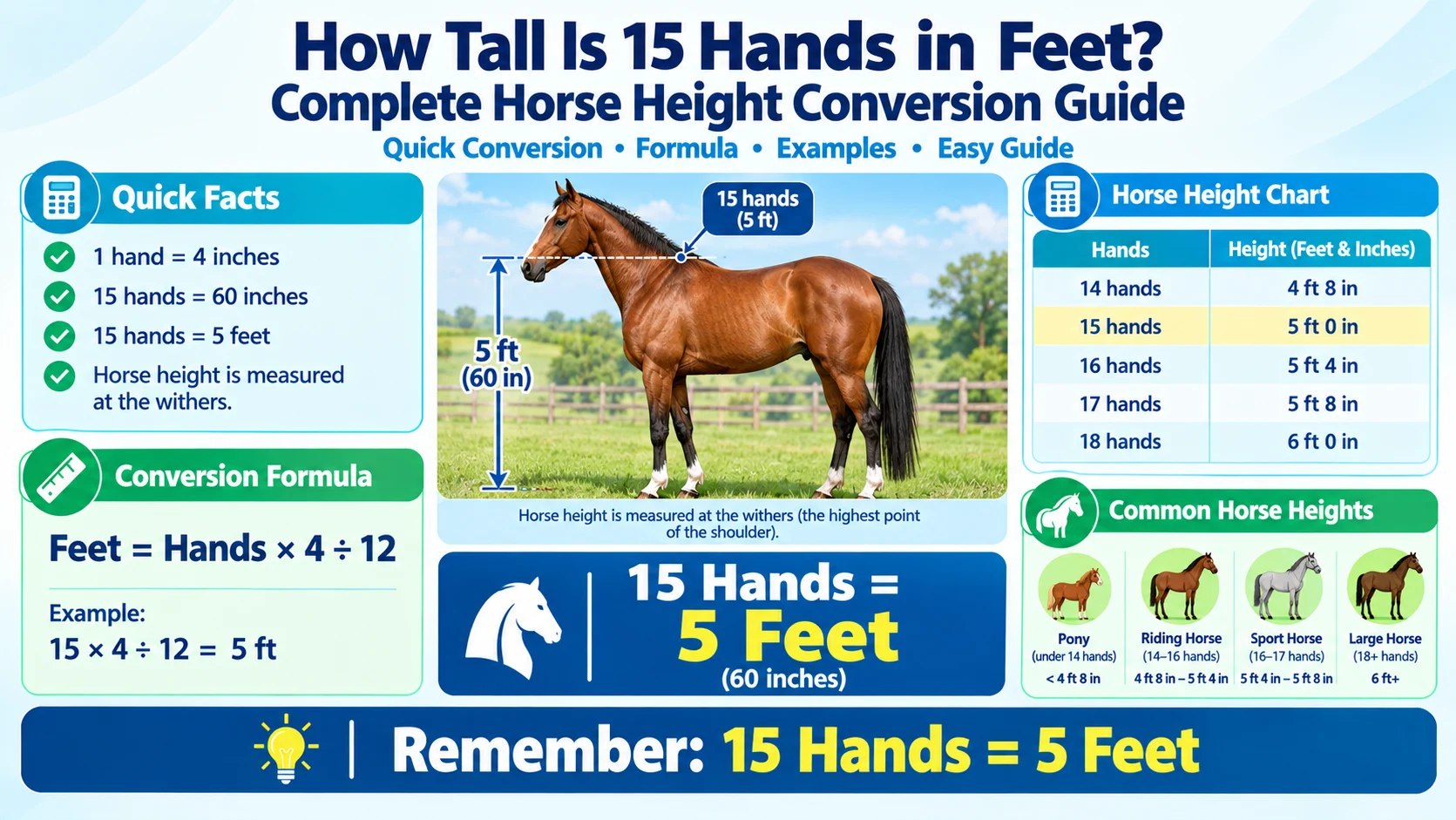
If you have ever looked at a horse listing and wondered what 15 hands actually means in everyday measurements, you are not alone. Horse height is commonly expressed in “hands,” a traditional unit that can be confusing if you are more familiar with feet and inches.
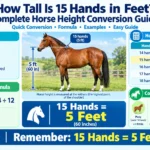
So, how tall is 15 hands in feet? A horse measuring 15 hands is 5 feet tall at the withers. That is equivalent to 60 inches or 152.4 centimeters.
The calculation is straightforward because one hand is defined as exactly 4 inches:
15 hands × 4 inches = 60 inches
Then:
60 inches ÷ 12 = 5 feet
That makes 15 hands a useful reference point when comparing horses, planning stable spaces, selecting equipment, or simply visualizing a horse’s size.
There is one important detail, though: horse height is not measured from the ground to the top of the head. It is normally measured vertically from the ground to the withers, the ridge between the horse’s shoulder blades. This standard makes horse heights consistent even when a horse moves its head.
Let’s break down the measurement, the formula, useful conversions, and the practical meaning of a 15-hand horse.
15 hands = 5 feet = 60 inches = 152.4 centimeters.
Here is the calculation:
15 hands × 4 inches per hand = 60 inches
Since 12 inches make one foot:
60 inches ÷ 12 = 5 feet
Quick conversion
| Horse Height | Inches | Feet | Centimeters |
|---|---|---|---|
| 14 hands | 56 in | 4 ft 8 in | 142.24 cm |
| 15 hands | 60 in | 5 ft 0 in | 152.40 cm |
| 15.1 hands | 61 in | 5 ft 1 in | 154.94 cm |
| 15.2 hands | 62 in | 5 ft 2 in | 157.48 cm |
| 16 hands | 64 in | 5 ft 4 in | 162.56 cm |
The important takeaway is that 15 hands is exactly 5 feet, when measured to the horse’s withers.
Understanding the Units
A hand is a traditional unit of length used primarily for measuring the height of horses and other equines.
One hand equals:
1 hand = 4 inches = 10.16 centimeters
Unlike many everyday measurements, horse height uses a specialized notation. A horse listed as 15 hands is often written as 15 hh, where “hh” means “hands high.”
The word high refers to the vertical height of the horse at the withers.
What are the withers?
The withers are the raised area at the base of a horse’s neck, above the shoulders. They provide a relatively stable anatomical reference point for measuring height.
This matters because a horse can raise or lower its head by several feet. Measuring to the top of the head would therefore produce inconsistent results.
U.S. customary and metric comparison
For American readers, 15 hands converts neatly to 5 feet. In metric measurement, it is 152.4 centimeters or 1.524 meters.
| Measurement System | 15 Hands |
|---|---|
| Hands | 15 |
| Inches | 60 in |
| Feet | 5 ft |
| Feet and inches | 5 ft 0 in |
| Centimeters | 152.4 cm |
| Meters | 1.524 m |
The hand is therefore a specialized traditional measurement rather than a standard unit you would normally use for construction or household length measurements.
How Tall Is 15 Hands in Feet? Conversion Formula
The conversion formula is simple enough to remember without a calculator.
Formula 1: Hands to inches
Inches = Hands × 4
For 15 hands:
15 × 4 = 60 inches
Formula 2: Inches to feet
Feet = Inches ÷ 12
Therefore:
60 ÷ 12 = 5 feet
Combined formula
You can combine both steps:
Feet = Hands × 4 ÷ 12
Because 4 ÷ 12 equals 1/3:
Feet = Hands ÷ 3
So:
15 ÷ 3 = 5 feet
That shortcut works particularly well for whole-number hand measurements.
Worked example: 14 hands
- Convert hands to inches:
- 14 × 4 = 56 inches
- Convert inches to feet:
- 56 ÷ 12 = 4 feet 8 inches
Therefore, a 14-hand horse is 4 feet 8 inches at the withers.
Worked example: 16 hands
- 16 × 4 = 64 inches
- 64 inches ÷ 12 = 5 feet 4 inches
So a 16-hand horse is 5 feet 4 inches at the withers.
15-Hands Conversion Table
A conversion chart makes it easier to compare neighboring horse heights.
| Hands | Inches | Feet & Inches | Centimeters |
|---|---|---|---|
| 12 hands | 48 in | 4 ft 0 in | 121.92 cm |
| 13 hands | 52 in | 4 ft 4 in | 132.08 cm |
| 14 hands | 56 in | 4 ft 8 in | 142.24 cm |
| 15 hands | 60 in | 5 ft 0 in | 152.40 cm |
| 16 hands | 64 in | 5 ft 4 in | 162.56 cm |
| 17 hands | 68 in | 5 ft 8 in | 172.72 cm |
| 18 hands | 72 in | 6 ft 0 in | 182.88 cm |
Every additional hand adds exactly 4 inches to the horse’s measured height.
Practical Examples: How Tall Is 15 Hands in Feet in Real Life?
Understanding the number is one thing; visualizing it is another. A 15-hand horse stands about 5 feet from the ground to its withers.
1. Comparing a horse with a person
A person who is 5 feet tall would be approximately the same height as a 15-hand horse at the withers.
However, the horse’s head and neck extend considerably higher than the withers, so the animal itself will appear much taller when standing beside a person.
2. Choosing stable equipment
Horse owners may need height information when selecting stable equipment, grooming tools, blankets, or other gear.
The 15-hand measurement can help establish the horse’s general size, but height alone does not determine the correct equipment size. Body length, chest circumference, weight, breed, and build can also matter.
3. Riding and sports
Horse height is frequently discussed in equestrian sports. A 15-hand horse falls into a medium-sized range compared with horses that may measure 16, 17, or even 18 hands.
The appropriate horse for a rider depends on much more than height, including temperament, build, discipline, rider experience, and conformation.
4. Education
For students learning measurement conversion, 15 hands provides a useful example because the arithmetic is clean:
15 hands × 4 = 60 inches
60 inches ÷ 12 = 5 feet
It demonstrates how one unit can be converted into another through a simple chain of multiplication and division.
5. Visualizing stable dimensions
Suppose a stable doorway is 7 feet high. A 15-hand horse has a withers height of 5 feet, leaving roughly 2 feet between the withers and the top of the doorway.
That does not mean the doorway is automatically safe or suitable. A horse’s head, ears, neck position, rider, and equipment must also be considered.
Common Conversion Mistakes
Even straightforward unit conversions can produce errors. Here are the mistakes worth watching for.
Mistake 1: Treating one hand as one foot
A hand is 4 inches, not 12 inches.
Incorrect:
15 hands = 15 feet
Correct:
15 hands × 4 = 60 inches = 5 feet
Mistake 2: Forgetting that horse height uses the withers
A horse’s “height” does not normally refer to the top of its ears or head.
The standard measurement is from the ground to the withers.
Mistake 3: Misreading decimal-style horse heights
Horse height can sometimes be written as 15.1 or 15.2. These do not mean ordinary decimal feet.
For example:
- 15.1 hands = 15 hands + 1 inch = 61 inches
- 15.2 hands = 15 hands + 2 inches = 62 inches
- 15.3 hands = 15 hands + 3 inches = 63 inches
- 16.0 hands = 16 hands = 64 inches
A notation such as 15.2 hh should therefore not be interpreted as 15.2 × 4 inches.
Mistake 4: Rounding too early
If you are converting between hands, inches, and centimeters, keep the exact value as long as possible.
For example:
15 hands = 60 inches = 152.4 cm
There is no need to round 152.4 cm to 152 cm unless the application calls for a whole-number approximation.
Mistake 5: Mixing measurement systems
Do not accidentally combine inches and centimeters in the same calculation.
A reliable measurement conversion should identify the starting unit, conversion factor, and final unit.
Expert tip: Write the units alongside every number during a calculation. The units act like a built-in error check.
Quick Mental Conversion Tips
You do not always need a measurement calculator to convert horse height.
Remember the four-inch rule
The most important fact is:
1 hand = 4 inches
From there, everything follows.
For whole hands, divide by three
Because 4 inches equals one-third of a foot:
Hands ÷ 3 = feet
For example:
15 ÷ 3 = 5 feet
This shortcut is especially convenient for 12, 15, and 18 hands:
- 12 hands = 4 feet
- 15 hands = 5 feet
- 18 hands = 6 feet
Memorize common reference points
| Horse Height | Equivalent Height |
|---|---|
| 12 hands | 4 ft |
| 13 hands | 4 ft 4 in |
| 14 hands | 4 ft 8 in |
| 15 hands | 5 ft |
| 16 hands | 5 ft 4 in |
| 17 hands | 5 ft 8 in |
| 18 hands | 6 ft |
These reference values make quick estimates much easier.
Comparison Between the Units
The hand, inch, foot, and centimeter serve different purposes. Understanding their characteristics helps prevent confusion.
| Unit | Size | Typical Use | Precision | Main Advantage |
|---|---|---|---|---|
| Hand | 4 inches | Horse height | Moderate | Standard for equine height |
| Inch | 1/12 foot | Small measurements | High | Convenient for detailed measurements |
| Foot | 12 inches | Everyday U.S. measurements | Moderate | Easy to visualize |
| Centimeter | 0.01 meter | Metric measurement | High | Common internationally |
| Meter | 100 centimeters | Larger metric measurements | High | Standard metric length unit |
The hand is unusual because its modern use is highly specialized. You would generally use feet and inches for ordinary U.S. measurements, while centimeters and meters are common in metric systems.
Why Accurate Measurement Matters
Accurate measurement is more than getting a number right on paper. In practical work, a small measurement error can create larger problems.
Construction
Builders rely on accurate dimensions when cutting materials, laying out spaces, and installing components. A mistake in a conversion can cause materials to be too short or too long.
Engineering and manufacturing
Engineers and manufacturers often work with precise tolerances. Converting units incorrectly can affect dimensions, fit, performance, and safety.
Home renovation
A homeowner measuring a doorway, countertop, piece of furniture, or flooring area needs consistent units. Switching between feet, inches, and metric measurements without a clear conversion can lead to expensive mistakes.
Education
Measurement conversions teach students an important mathematical skill: identifying relationships between units and applying a conversion factor correctly.
Realistic case study
Imagine a student is researching horse breeds and finds a horse listed as 15 hands high. The student needs to enter the height into a project using feet and inches.
Using the conversion:
- 15 hands × 4 inches = 60 inches
- 60 inches ÷ 12 = 5 feet
- Therefore, the horse is 5 feet tall at the withers
If the project requires metric units:
60 inches × 2.54 = 152.4 centimeters
The same original measurement has now been expressed accurately in three common forms: 15 hands, 5 feet, and 152.4 cm.
FAQ: How Tall Is 15 Hands in Feet?
1. How tall is 15 hands in feet?
15 hands is exactly 5 feet at the withers. Since one hand equals 4 inches, multiply 15 by 4 to get 60 inches. Then divide 60 by 12 inches per foot to get 5 feet. In metric terms, 15 hands equals 152.4 centimeters. Remember that horse height is normally measured from the ground to the withers rather than to the top of the horse’s head.
2. What is the easiest way to convert hands to feet?
The easiest method is to remember that one hand equals 4 inches. For whole-number hand measurements, you can also divide the number of hands by 3 to get the equivalent number of feet because four inches is one-third of a foot. For example, 15 hands ÷ 3 = 5 feet. This shortcut works neatly for whole hands but is less intuitive for fractional or hand-and-inch measurements.
3. How many inches is 15 hands?
15 hands equals 60 inches. The formula is simple: 15 × 4 = 60. If you need feet, divide the result by 12: 60 ÷ 12 = 5 feet. This makes 60 inches another useful way to express a 15-hand horse’s measured height. The measurement refers to the distance from the ground to the horse’s withers.
4. Is 15 hands the same as 15 feet?
No. 15 hands is only 5 feet, not 15 feet. A hand is a much smaller unit than a foot: one hand equals 4 inches, while one foot equals 12 inches. Therefore, three hands equal one foot. Confusing hands with feet is one of the easiest mistakes to make when first encountering horse-height measurements.
5. How tall is a 15.2-hand horse in feet?
A 15.2-hand horse is 62 inches tall at the withers, which equals 5 feet 2 inches. In traditional horse-height notation, the “.2” represents two additional inches rather than two-tenths of a hand. The calculation is 15 hands × 4 inches = 60 inches, plus 2 inches = 62 inches, or 5 feet 2 inches.
6. How many centimeters is 15 hands?
15 hands equals 152.4 centimeters. First convert hands to inches: 15 × 4 = 60 inches. Then use the standard conversion of 1 inch = 2.54 centimeters: 60 × 2.54 = 152.4 centimeters. This metric equivalent is useful when comparing horse measurements with international specifications or records that use centimeters rather than hands.
7. Can I convert 15 hands without a calculator?
Yes. For this particular conversion, mental math is easy. One hand equals 4 inches, so 15 hands equals 60 inches. Because 12 inches make one foot, 60 inches equals 5 feet. An even faster shortcut for whole-number hand measurements is to divide by 3: 15 ÷ 3 = 5 feet. For unusual values, writing down the unit conversions can help prevent errors.
8. Why are horses measured in hands?
The hand is a traditional unit that became associated with measuring horses and other equines. Its fixed modern value of 4 inches provides a standardized way to describe horse height. Measuring to the withers also creates a consistent reference point because a horse’s head and neck can move substantially. Although feet, inches, centimeters, and meters can express the same physical height, “hands high” remains common in equestrian contexts.
Final Thoughts
So, how tall is 15 hands in feet? The answer is simple:
15 hands = 5 feet = 60 inches = 152.4 centimeters.
The key conversion to remember is:
1 hand = 4 inches
From there:
15 hands × 4 = 60 inches
60 ÷ 12 = 5 feet
The most important detail is that horse height is measured to the withers, not the top of the head. Also, when you encounter values such as 15.1 or 15.2 hands, remember that the digits after the whole number represent additional inches rather than decimal fractions.
Whether you are studying measurement, comparing horses, working on a DIY project, or simply trying to make sense of an equestrian listing, understanding the relationship between hands, inches, feet, and centimeters makes the conversion quick and reliable.
How Much Is 69 Inches in Feet?