Need to convert a measurement quickly? If you’re looking at a furniture specification, measuring a wall, checking a construction plan, or helping a student with homework, you may be wondering: 86 in is how many feet?
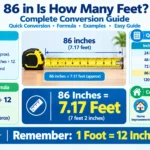
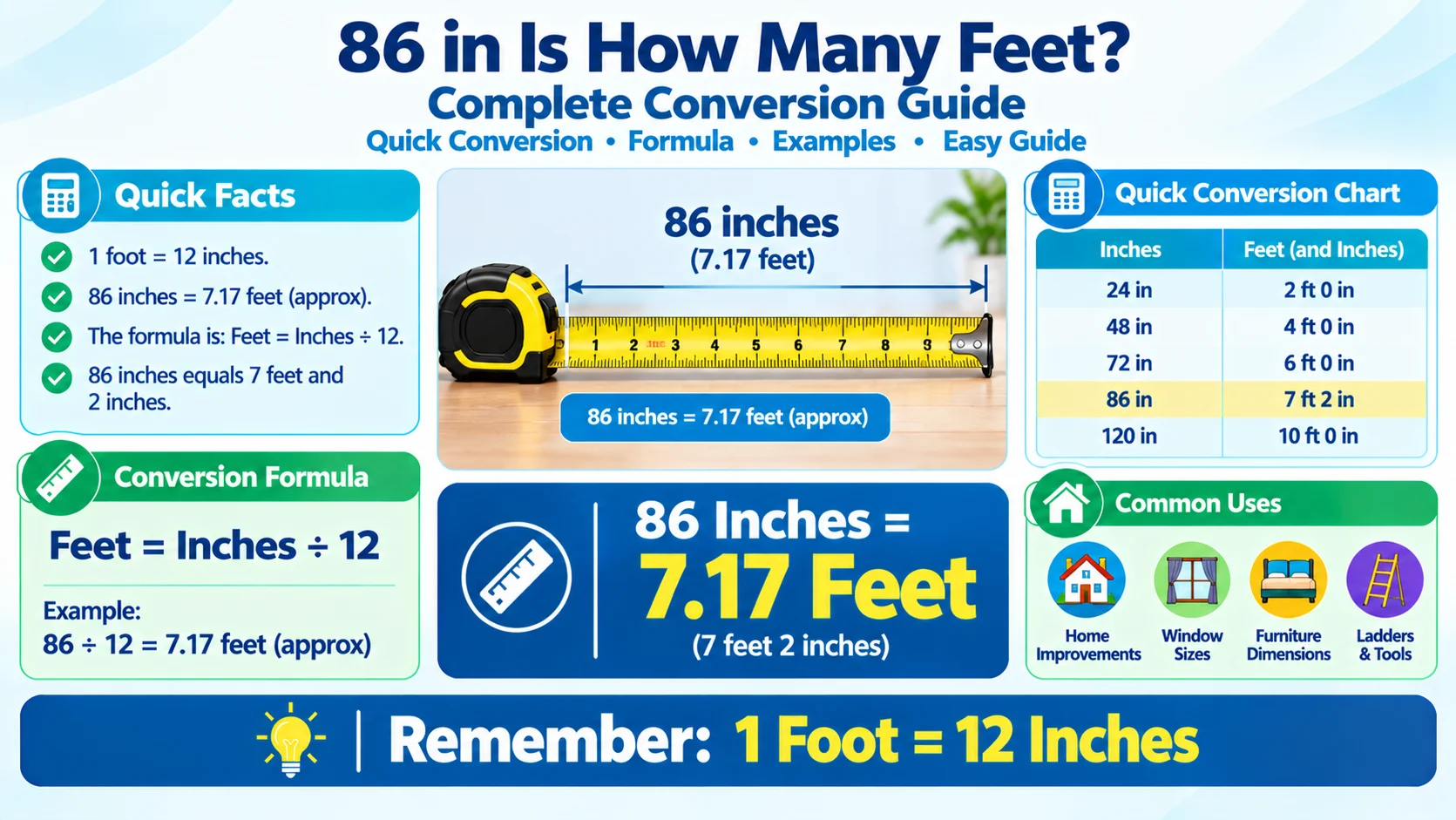
The answer is 7 feet 2 inches, or approximately 7.17 feet.
Here’s the calculation:
86 inches ÷ 12 = 7.1667 feet
Because 1 foot contains exactly 12 inches, converting inches to feet simply requires division by 12. The result can then be expressed as a mixed measurement: 7 feet and 2 inches.
That distinction is useful. A decimal measurement such as 7.17 feet works well for calculations, while 7 feet 2 inches is often easier to understand when you’re measuring furniture, doors, walls, ceilings, or other physical objects.
This guide explains exactly how the conversion works, how to convert the result back to inches, how 86 inches compares with nearby measurements, and how to avoid common unit-conversion mistakes.
86 inches = 7.1667 feet, which is normally rounded to 7.17 feet.
In feet and inches:
86 inches = 7 feet 2 inches
The basic conversion formula is:
Feet = Inches ÷ 12
So:
86 ÷ 12 = 7.1667 feet
Since 12 inches make one foot, 7 complete feet account for:
7 × 12 = 84 inches
That leaves:
86 − 84 = 2 inches
Therefore:
86 inches = 7 feet 2 inches
At a glance
| Measurement | Equivalent |
|---|---|
| 86 inches | 7.1667 feet |
| 86 inches, rounded | 7.17 feet |
| Feet and inches | 7 ft 2 in |
| Inches in 7 feet | 84 inches |
| Remaining inches | 2 inches |
Understanding the Units: Inches and Feet
Both inches and feet are units of length used in the U.S. customary measurement system. They are especially common in construction, home improvement, manufacturing, interior design, and everyday measurements in the United States.
The fundamental relationship is:
1 foot = 12 inches
An inch is the smaller unit, while a foot is larger.
For example:
- 12 inches = 1 foot
- 24 inches = 2 feet
- 36 inches = 3 feet
- 48 inches = 4 feet
- 60 inches = 5 feet
- 72 inches = 6 feet
- 84 inches = 7 feet
- 86 inches = 7 feet 2 inches
- 96 inches = 8 feet
The foot has a long history in measurement systems, while the modern inch is precisely defined in relation to the international yard. Today, these units remain standard for many everyday measurements in the United States.
Where inches are commonly used
Inches are particularly useful for relatively small or precise dimensions, including:
- Furniture dimensions
- Screen sizes
- Lumber dimensions
- Clothing measurements
- Appliance specifications
- Door and window dimensions
- Hand tools
- Small construction measurements
Where feet are commonly used
Feet are more convenient for larger dimensions, such as:
- Room length and width
- Ceiling height
- Building dimensions
- Property measurements
- Landscaping
- Construction plans
Metric measurements use centimeters and meters instead, but inches and feet remain important in U.S. customary units.
Conversion Formula: How to Convert 86 Inches to Feet
The conversion formula is simple:
Feet = Inches ÷ 12
Why divide by 12? Because every foot contains 12 inches.
Step-by-step calculation
To convert 86 inches:
Step 1: Start with the measurement.
86 inches
Step 2: Divide by 12.
86 ÷ 12 = 7.166666…
Step 3: Round if necessary.
86 inches ≈ 7.17 feet
So the decimal answer is:
86 inches = 7.1667 feet
Converting into feet and inches
Sometimes a decimal isn’t the most useful format.
Since:
7 feet = 84 inches
subtract 84 from 86:
86 − 84 = 2 inches
Therefore:
86 inches = 7 feet 2 inches
This is often the preferred format for physical measurements.
Important: 7.17 feet does not mean 7 feet 17 inches. The decimal portion represents a fraction of a foot.
86 Inches to Feet Conversion Table
A nearby-value conversion chart makes it easier to estimate measurements without repeatedly using a conversion calculator.
| Inches | Decimal Feet | Feet & Inches |
|---|---|---|
| 72 in | 6.00 ft | 6 ft |
| 74 in | 6.17 ft | 6 ft 2 in |
| 76 in | 6.33 ft | 6 ft 4 in |
| 78 in | 6.50 ft | 6 ft 6 in |
| 80 in | 6.67 ft | 6 ft 8 in |
| 82 in | 6.83 ft | 6 ft 10 in |
| 84 in | 7.00 ft | 7 ft |
| 86 in | 7.17 ft | 7 ft 2 in |
| 88 in | 7.33 ft | 7 ft 4 in |
| 90 in | 7.50 ft | 7 ft 6 in |
| 92 in | 7.67 ft | 7 ft 8 in |
| 94 in | 7.83 ft | 7 ft 10 in |
| 96 in | 8.00 ft | 8 ft |
This table also reveals a useful pattern: every 12-inch increase adds exactly one foot.
Practical Examples of 86 Inches in Real Life
The number 86 inches becomes easier to understand when you connect it with everyday objects and projects.
1. Home improvement
Suppose you’re measuring a wall for a cabinet or shelving system and the available vertical space is 86 inches.
You could record that measurement as:
86 inches = 7 feet 2 inches
If a product is listed as 7 feet tall, you have:
86 − 84 = 2 inches
of additional space.
That extra 2 inches can matter when checking whether a cabinet, storage unit, or other fixture will fit.
2. Furniture
Furniture specifications are often listed in inches because manufacturers need precise dimensions.
A bookcase measuring 86 inches tall is therefore:
7 feet 2 inches tall
For someone planning the room layout, the feet-and-inches version may be much easier to visualize.
3. Construction
Contractors may encounter dimensions expressed in either decimal feet or feet and inches.
If a drawing specifies 86 inches, the equivalent is:
7 ft 2 in
If a digital system requires decimal feet, use:
86 ÷ 12 = 7.1667 ft
Using the appropriate format helps prevent mistakes when transferring dimensions between plans and physical measurements.
4. Interior design
An interior designer might measure a floor-to-ceiling feature, curtain installation point, or built-in unit in inches.
Converting 86 inches to feet gives approximately 7.17 feet, while 7 feet 2 inches provides the practical measurement needed during installation.
5. Education
For students learning measurement conversion, 86 inches provides a good example because it doesn’t divide evenly into feet.
The exercise demonstrates both:
- Decimal conversion: 7.1667 feet
- Mixed-unit conversion: 7 feet 2 inches
More Worked Examples
Understanding several examples makes the conversion formula easier to apply.
Example 1: Convert 60 inches to feet
60 ÷ 12 = 5
Therefore:
60 inches = 5 feet
Example 2: Convert 90 inches to feet
90 ÷ 12 = 7.5
Therefore:
90 inches = 7.5 feet
In feet and inches:
7 feet 6 inches
Example 3: Convert 100 inches to feet
100 ÷ 12 = 8.3333 feet
The whole-foot portion is 8 feet:
8 × 12 = 96 inches
Remaining:
100 − 96 = 4 inches
Therefore:
100 inches = 8 feet 4 inches
Example 4: Reverse conversion
Suppose you need to convert 7 feet 2 inches into inches.
First convert the feet:
7 × 12 = 84 inches
Then add the remaining 2 inches:
84 + 2 = 86 inches
Therefore:
7 ft 2 in = 86 in
This reverse calculation is especially useful when comparing product specifications or checking measurements on a tape measure.
Common Conversion Mistakes to Avoid
Converting inches to feet is easy, but several small mistakes occur frequently.
1. Multiplying instead of dividing
When converting inches to feet, divide by 12:
86 ÷ 12 = 7.1667
Don’t multiply 86 by 12.
Multiplication is used when converting feet into inches.
2. Treating decimal feet as feet and inches
This is one of the most important mistakes to avoid.
7.17 feet does not mean 7 feet 17 inches.
The .17 represents a fraction of one foot.
To convert the decimal portion to inches:
0.1667 × 12 ≈ 2 inches
So 7.1667 feet is 7 feet 2 inches.
3. Rounding too early
The exact decimal is approximately:
7.1666667 feet
If you’re performing additional calculations, keep several decimal places until the final step.
For everyday measurements, 7.17 feet is generally sufficient.
4. Mixing measurement systems
Don’t accidentally combine inches and centimeters or feet and meters without converting them first.
For example, an 86-inch measurement is approximately 218.44 centimeters, not 86 centimeters.
5. Reading a tape measure incorrectly
On a standard tape measure, inches are divided into smaller fractions such as halves, quarters, eighths, and sixteenths.
When recording a measurement, make sure the starting point is aligned correctly and that you distinguish whole inches from fractional inches.
Quick Mental Conversion Tips
You can convert many inch measurements to feet without a calculator.
Tip 1: Memorize the multiples of 12
The most useful values are:
| Feet | Inches |
|---|---|
| 1 ft | 12 in |
| 2 ft | 24 in |
| 3 ft | 36 in |
| 4 ft | 48 in |
| 5 ft | 60 in |
| 6 ft | 72 in |
| 7 ft | 84 in |
| 8 ft | 96 in |
| 9 ft | 108 in |
| 10 ft | 120 in |
For 86 inches, you can immediately recognize that it is 2 inches more than 84 inches, or 7 feet.
Therefore:
86 inches = 7 ft 2 in
Tip 2: Separate the whole feet
For any measurement above 12 inches:
- Find the largest whole-foot multiple of 12.
- Subtract it from the original measurement.
- The remainder is inches.
For 86:
86 − 84 = 2
So the answer is 7 ft 2 in.
Tip 3: Use decimal feet for calculations
If you’re entering dimensions into software or performing engineering calculations, use:
86 ÷ 12 = 7.1667 ft
Keep the decimal format when mathematical operations require it.
Comparison Between Inches, Feet, Yards, and Meters
Different units are useful for different measurement tasks.
| Unit | Relationship to 86 in | Typical Uses | Main Advantage |
|---|---|---|---|
| Inch | 86 in | Small dimensions, products, furniture | Precise and familiar |
| Foot | 7.1667 ft | Rooms, buildings, construction | Convenient for larger dimensions |
| Yard | 2.3889 yd | Landscaping, sports, fabric | Useful for medium distances |
| Meter | 2.1844 m | Metric construction, science | Standard international unit |
| Centimeter | 218.44 cm | Small metric dimensions | Fine metric precision |
Common length conversions
| Measurement | Equivalent |
|---|---|
| 1 inch | 0.08333 ft |
| 12 inches | 1 ft |
| 36 inches | 3 ft = 1 yd |
| 72 inches | 6 ft |
| 84 inches | 7 ft |
| 86 inches | 7 ft 2 in = 7.1667 ft |
| 96 inches | 8 ft |
| 120 inches | 10 ft |
Why Accurate Measurement Matters
Accurate unit conversion can make the difference between a project fitting perfectly and requiring an expensive correction.
Construction
Builders frequently work with feet and inches. A small conversion error can affect framing, cabinetry, doors, windows, or other components.
Engineering
Engineering calculations may require decimal values rather than mixed feet-and-inches measurements. Converting accurately ensures that calculations use consistent units.
Manufacturing
Manufacturers need precise dimensions to ensure components fit together correctly. Even seemingly small errors can create problems when tolerances are tight.
Home renovation
A homeowner installing shelving or furniture needs to know both the actual available space and the product dimensions. Converting 86 inches to 7 feet 2 inches makes comparison easier.
Education
Unit conversion teaches students how different measurement systems relate to each other. It also builds skills in division, fractions, decimals, estimation, and mathematical reasoning.
A practical case study
Imagine a homeowner has a vertical space measuring 86 inches and wants to install a storage cabinet.
The cabinet is advertised as 7 feet tall.
First convert 7 feet to inches:
7 × 12 = 84 inches
Compare:
86 − 84 = 2 inches
The homeowner has 2 inches of extra vertical space.
Now suppose another cabinet is listed as 7.25 feet.
Convert it to inches:
7.25 × 12 = 87 inches
That cabinet would be 1 inch too tall.
This illustrates why understanding both decimal feet and feet-and-inches measurements is valuable when choosing products or planning construction work.
Expert Tips for Better Measurement Conversions
For reliable results, experienced professionals tend to follow a few simple habits:
- Write the units at every stage of a calculation.
- Use 12 inches = 1 foot as your primary reference.
- Keep decimal precision until the final answer when accuracy matters.
- Use feet-and-inches notation for physical installation work.
- Use decimal feet when entering measurements into software or performing calculations.
- Double-check unusual results against a rough estimate.
- Don’t confuse length with area or volume. Square feet and cubic feet require different conversion methods.
- Measure twice when cutting once. Conversion accuracy cannot compensate for an incorrect original measurement.
Expert tip: If a dimension will be physically installed, communicate it in the format the installer expects. For example, 7 ft 2 in is usually more useful on a tape-measure-based job than simply writing 7.1667 ft.
FAQ: 86 in Is How Many Feet?
How many feet is 86 inches?
86 inches equals 7.1667 feet, or approximately 7.17 feet. If you prefer the traditional feet-and-inches format, the answer is 7 feet 2 inches. To calculate it, divide 86 by 12 because one foot contains exactly 12 inches. For practical construction or home-improvement work, 7 feet 2 inches is usually the clearest way to communicate the measurement.
What is the easiest way to convert 86 inches to feet?
The easiest method is to divide the number of inches by 12. Calculate 86 ÷ 12 = 7.1667 feet. If you want feet and inches rather than a decimal, recognize that 7 feet equals 84 inches. Subtract 84 from 86, leaving 2 inches. Therefore, the final measurement is 7 feet 2 inches.
Is 86 inches the same as 7 feet?
No. 7 feet equals 84 inches, while 86 inches is 2 inches longer. Therefore, 86 inches is 7 feet 2 inches. In decimal form, it is approximately 7.1667 feet. This difference is small, but it can matter when you’re checking whether furniture, cabinets, doors, or other objects will fit into a specific space.
How do I convert 86 inches to decimal feet?
Use the formula feet = inches ÷ 12. For 86 inches, calculate 86 ÷ 12 = 7.166666…. Rounded to four decimal places, this is 7.1667 feet. For general calculations, you can use 7.17 feet. Keep more decimal places if the conversion will be used in a calculation where precision is important.
How do I convert 7 feet 2 inches back to inches?
First convert the 7 feet into inches: 7 × 12 = 84 inches. Then add the remaining 2 inches: 84 + 2 = 86 inches. Therefore, 7 feet 2 inches equals 86 inches. This reverse conversion is useful for checking your work and comparing measurements when one specification uses feet and inches and another uses inches only.
Can I convert inches to feet without a calculator?
Yes. Memorize the multiples of 12. Since 84 inches equals 7 feet, you can see immediately that 86 inches is 7 feet plus 2 inches. For decimal feet, divide by 12. Mental conversion is particularly easy for measurements close to familiar values such as 24, 36, 48, 60, 72, 84, and 96 inches.
Why is converting inches to feet important?
The conversion makes measurements easier to interpret and compare. A furniture height of 86 inches may be more meaningful to a homeowner when expressed as 7 feet 2 inches. Contractors may use feet and inches for physical installation, while engineers or software systems may require decimal feet. Converting accurately helps maintain consistency and avoid costly measurement errors.
Is 7.17 feet exactly the same as 86 inches?
Not mathematically exactly. 86 inches equals 7.166666… feet, while 7.17 feet is a rounded value. The difference is extremely small for many everyday purposes, but it matters in precise calculations. When accuracy is important, use 7.1667 feet or retain additional decimal places rather than rounding immediately.
What other measurements can I convert using the same method?
Any inch measurement can be converted to feet using inches ÷ 12. For example, 48 inches is 4 feet, 72 inches is 6 feet, and 120 inches is 10 feet. The problem, or simply trying to make sense of a product’s dimensions, understanding this conversion helps you move confidently between different ways of reverse conversion uses feet × 12. These simple relationships are foundational to length conversion within the U.S. customary system.
Final Thoughts: 86 in Is How Many Feet?
If you’ve been searching 86 in is how many feet, the essential answer is:
86 inches = 7 feet 2 inches = approximately 7.17 feet
Remember the conversion formula:
Feet = Inches ÷ 12
For 86 inches:
86 ÷ 12 = 7.1667 feet
And for a practical feet-and-inches measurement:
7 feet = 84 inches
86 − 84 = 2 inches
So the clearest physical measurement is 7 ft 2 in.
Whether you’re measuring furniture, planning a renovation, checking a construction specification, solving a homework problem, or simply trying to make sense of a product’s dimensions, understanding this conversion helps you move confidently between different ways of expressing length.
Ready to calculate another measurement? Explore more length-conversion guides for inches, feet, yards, meters, centimeters, and other U.S. customary and metric units.
How Many Square Feet in a Roof Square?