Imagine walking into a room and being told someone is 1.95 meters tall. If you are more familiar with feet and inches, that number may not immediately mean much. Is 1.95 m around 6 feet? Closer to 6 feet 5 inches? And how can you convert it accurately without guessing?
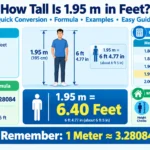
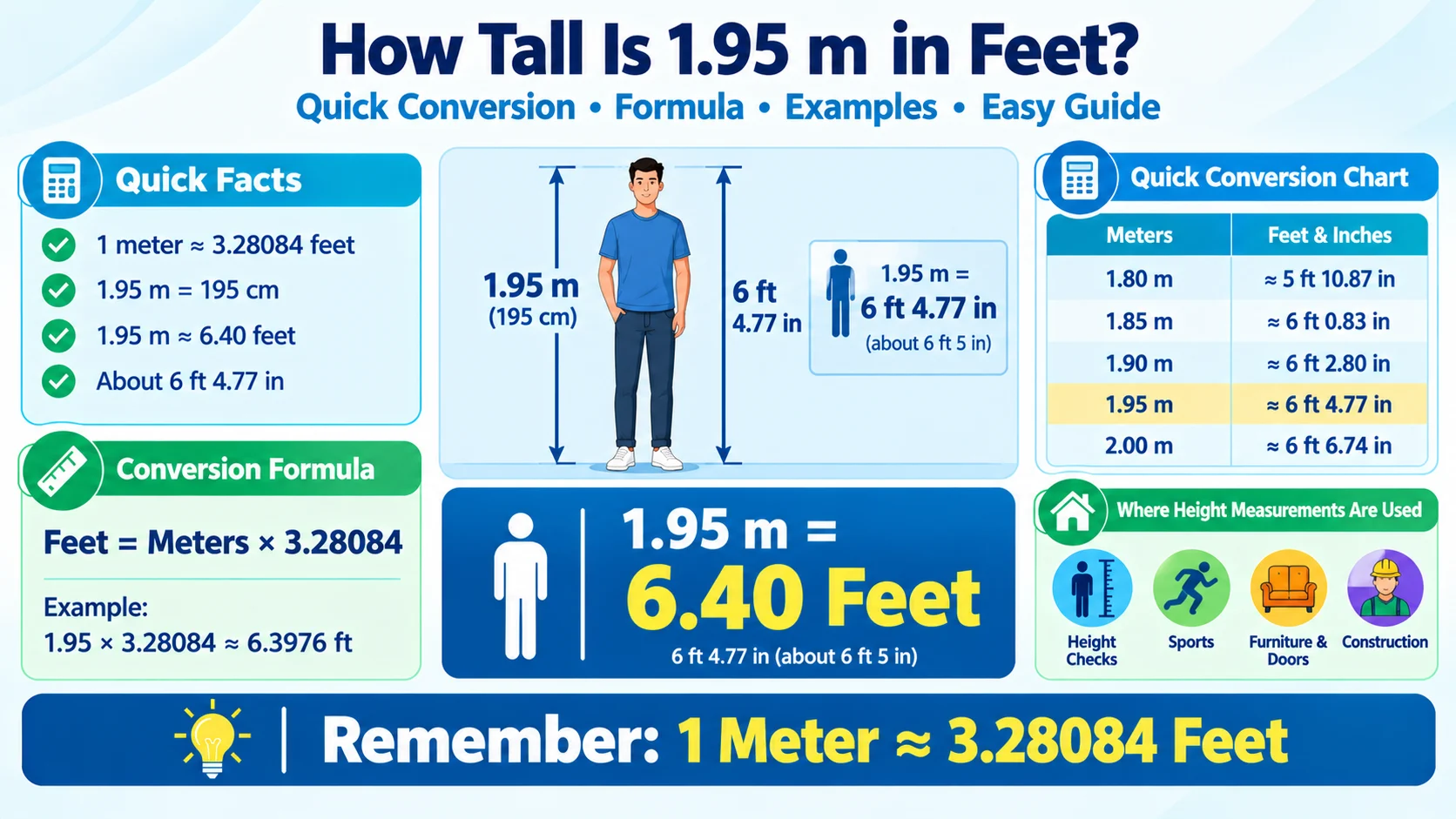
If you have searched how tall is 1.95 m in feet, the quick answer is approximately 6.40 feet, or 6 feet 4.77 inches. For everyday height measurements, you can round that to 6 feet 5 inches.
The conversion is straightforward because one meter equals exactly 3.280839895 feet. Multiplying 1.95 by that conversion factor gives approximately 6.3976 feet.
This measurement is useful when comparing heights, reading international specifications, working on construction or home-improvement projects, understanding sports statistics, or simply translating a metric height into the feet-and-inches format commonly used in the United States.
In this guide, you will learn exactly how the conversion works, how to convert the decimal portion into inches, where 1.95 meters falls on a height chart, and how to avoid common measurement mistakes.
1.95 meters = 6.3976 feet, which is approximately:
1.95 m = 6 feet 4.77 inches ≈ 6 ft 5 in
For most practical purposes, someone who is 1.95 meters tall is about 6 feet 5 inches tall.
The basic conversion formula is:
Meters × 3.28084 = Feet
So:
1.95 × 3.28084 = 6.39764 feet
Because a foot contains 12 inches, the decimal portion can be converted into inches:
0.39764 × 12 = 4.77168 inches
Therefore:
1.95 m = 6 ft 4.77 in
At a glance
| Measurement | Equivalent |
|---|---|
| Meters | 1.95 m |
| Centimeters | 195 cm |
| Decimal feet | 6.3976 ft |
| Feet and inches | 6 ft 4.77 in |
| Rounded height | 6 ft 5 in |
Understanding the Units Behind 1.95 m
To understand the conversion, it helps to know what the two units represent.
A meter (m) is the standard metric unit of length. The metric system is used throughout most of the world and is especially common in science, engineering, education, and international commerce.
A foot (ft) belongs to the U.S. customary and imperial measurement traditions. In the United States, feet and inches are commonly used for human height, room dimensions, building measurements, and many everyday applications.
The relationship between the units is fixed:
1 meter = 3.280839895 feet
And:
1 foot = 0.3048 meter
These are exact conversion relationships.
For height, however, decimal feet are not always intuitive. Saying that a person is 6.3976 feet tall is mathematically correct, but most people would naturally express the same height as 6 feet 4.77 inches or approximately 6 feet 5 inches.
Metric versus U.S. customary units
| Feature | Meter | Foot |
|---|---|---|
| Symbol | m | ft |
| Measurement system | Metric | U.S. customary / imperial tradition |
| Smaller common unit | Centimeter | Inch |
| Used for human height | Common internationally | Common in the U.S. |
| Relationship | 1 m = 3.28084 ft | 1 ft = 0.3048 m |
How Tall Is 1.95 m in Feet? The Conversion Formula
The easiest way to convert meters to feet is to multiply the number of meters by 3.28084.
Formula
Feet = Meters × 3.28084
For 1.95 meters:
1.95 × 3.28084 = 6.397638 feet
So the decimal-foot answer is:
1.95 m ≈ 6.3976 ft
But if you want feet and inches, there is one more step.
Step 1: Take the whole number
The whole number is 6, so you have:
6 feet
Step 2: Convert the decimal portion to inches
The remaining decimal is approximately 0.397638.
Multiply it by 12 because there are 12 inches in one foot:
0.397638 × 12 = 4.771656 inches
Step 3: Combine the measurements
That gives:
6 feet + 4.77 inches
Therefore:
1.95 meters = 6 feet 4.77 inches
Rounded to the nearest whole inch:
1.95 meters ≈ 6 feet 5 inches
Why the two answers look different
You may see 6.40 feet on a conversion calculator and 6 feet 5 inches elsewhere. There is no contradiction.
6.40 feet is a decimal-foot measurement.
6 feet 5 inches is a feet-and-inches measurement.
The decimal 0.40 feet does not mean 40 inches. It represents a fraction of one foot. Multiplying that fraction by 12 converts it into inches.
1.95 Meters to Feet Conversion Table
A small conversion chart makes it easier to compare 1.95 meters with nearby heights.
| Height in Meters | Decimal Feet | Approx. Feet & Inches |
|---|---|---|
| 1.80 m | 5.9055 ft | 5 ft 10.87 in |
| 1.85 m | 6.0696 ft | 6 ft 0.83 in |
| 1.90 m | 6.2336 ft | 6 ft 2.80 in |
| 1.95 m | 6.3976 ft | 6 ft 4.77 in |
| 2.00 m | 6.5617 ft | 6 ft 6.74 in |
| 2.05 m | 6.7257 ft | 6 ft 8.71 in |
| 2.10 m | 6.8898 ft | 6 ft 10.68 in |
| 2.15 m | 7.0538 ft | 7 ft 0.65 in |
This chart also shows something useful: adding 0.05 meter, or 5 centimeters, adds about 1.97 inches.
Practical Examples of a 1.95 m Measurement
A height of 1.95 meters appears in many everyday situations. Although height is the most obvious application, the same conversion principle applies whenever a measurement is given in meters and needs to be understood in feet.
1. Sports
A basketball, volleyball, or other tall athlete may have a listed height of 1.95 m.
Instead of reading the metric figure, a U.S. audience can interpret it as approximately:
6 ft 5 in
That makes comparisons with other players easier when their heights are listed in feet and inches.
2. Construction and home improvement
Suppose an international building specification states that a partition is 1.95 meters high.
Using the conversion:
1.95 m ≈ 6 ft 4.77 in
A contractor working with a U.S. customary tape measure can understand the approximate equivalent immediately.
For actual construction, however, avoid rounding too early. If the dimension affects whether materials fit, use the more precise conversion or verify it with the project’s required tolerance.
3. Interior design
A homeowner might purchase a cabinet, wardrobe, mirror, or doorway listed as 1.95 m high.
Knowing that it is roughly 6 ft 5 in makes it much easier to visualize whether the item will fit into a room.
4. Education
Students often encounter metric-to-imperial conversions in mathematics and science.
The 1.95-meter example demonstrates an important lesson: converting to decimal feet and converting to feet-and-inches are related but different presentation formats.
5. Travel and international specifications
Hotels, sports facilities, luggage specifications, equipment manufacturers, and international websites may use metric measurements. A simple unit conversion helps U.S. readers interpret those dimensions without having to estimate.
Common Conversion Mistakes to Avoid
Even simple length conversions can produce surprisingly large errors when the units are mixed.
Mistake 1: Dividing instead of multiplying
To convert meters to feet, multiply by approximately 3.28084.
To convert feet to meters, multiply by 0.3048.
Using the wrong operation or conversion factor can produce an incorrect result.
Mistake 2: Treating decimal feet as feet and inches
This is one of the most common mistakes.
For example:
6.40 feet ≠ 6 feet 40 inches
Instead:
0.40 × 12 = 4.8 inches
So 6.40 feet is approximately 6 feet 4.8 inches.
Mistake 3: Rounding too soon
If you round 1.95 meters to 2 meters before converting, you get a noticeably different result:
2 m ≈ 6 ft 6.74 in
That is almost 2 inches taller than the actual 1.95-meter conversion.
Mistake 4: Confusing centimeters and meters
1.95 m = 195 cm, not 1.95 cm.
A missing factor of 100 completely changes the measurement.
Expert measurement tip
Keep several decimal places during the calculation, then round only the final answer.
This is particularly important in construction, engineering, manufacturing, and other situations where small differences can matter.
How Tall Is 1.95 m in Feet? Quick Mental Conversion Tips
You do not always need a calculator for a rough estimate.
A useful mental shortcut is:
1 meter ≈ 3.28 feet
Therefore:
2 meters ≈ 6.56 feet
Since 1.95 meters is only 0.05 meter below 2 meters:
0.05 meter ≈ 0.164 feet ≈ 1.97 inches
So:
6 ft 6.74 in − 1.97 in ≈ 6 ft 4.77 in
That gives you the correct neighborhood quickly.
A simple rule to remember
For meters-to-feet conversions:
Meters × 3.28 ≈ feet
For greater accuracy:
Meters × 3.28084 = feet
For human height, convert the decimal portion of the feet into inches by multiplying it by 12.
Quick reference
| Conversion | Rule |
|---|---|
| Meters → feet | Multiply by 3.28084 |
| Feet → meters | Multiply by 0.3048 |
| Decimal feet → inches | Multiply decimal portion by 12 |
| Meters → centimeters | Multiply by 100 |
| Centimeters → meters | Divide by 100 |
Comparing Meters, Feet, and Inches
The best unit depends on the situation. Meters are convenient for metric measurements, while feet and inches are often more intuitive for U.S. readers.
| Measurement Unit | Unit Size | Typical Uses | Precision |
|---|---|---|---|
| Meter | 1 m | Science, construction, international measurements | High |
| Centimeter | 0.01 m | Small dimensions, body measurements | High |
| Foot | 0.3048 m | U.S. construction, room dimensions, height | Moderate |
| Inch | 0.0254 m | Detailed U.S. measurements, tools, materials | High |
| Decimal foot | Fraction of a foot | Engineering, surveying, technical calculations | Very high |
Which format is best?
- 1.95 m is convenient in the metric system.
- 6.3976 ft is useful for mathematical calculations.
- 6 ft 4.77 in is easier to interpret as a person’s height.
- 6 ft 5 in is a convenient rounded everyday description.
The important point is to choose the format appropriate to the task rather than assuming one representation is universally better.
Why Accurate Measurement Matters
A conversion may look like a simple arithmetic exercise, but accurate measurements have real consequences.
In construction, an incorrect conversion can result in improperly sized materials or components.
In engineering and manufacturing, small dimensional errors can affect whether parts fit together correctly.
In home renovation, a few inches can determine whether a cabinet, appliance, doorway, or piece of furniture fits.
In education, accurate unit conversion builds the foundation for more advanced mathematics, physics, geometry, and technical work.
In DIY projects, correct measurements reduce wasted materials and frustrating rework.
A realistic scenario
Suppose you order a storage cabinet advertised internationally as 1.95 m tall. Your available ceiling clearance is listed as 6 feet 5 inches.
The cabinet’s exact height is approximately 6 feet 4.77 inches.
Mathematically, it fits—but only by about 0.23 inch.
That is a good example of why precision matters. If the floor is uneven, the ceiling is not perfectly level, or the manufacturer’s stated dimension has a tolerance, the cabinet may not fit as comfortably as the basic conversion suggests.
For fit-critical projects, don’t rely on rounded conversions alone. Measure the actual product and available space using the same unit system whenever possible.
More Common Height Conversions Around 1.95 Meters
If you are comparing several heights, this reference table can save time.
| Meters | Centimeters | Feet | Approx. Height |
|---|---|---|---|
| 1.85 m | 185 cm | 6.0696 ft | 6 ft 0.83 in |
| 1.90 m | 190 cm | 6.2336 ft | 6 ft 2.80 in |
| 1.91 m | 191 cm | 6.2664 ft | 6 ft 3.20 in |
| 1.92 m | 192 cm | 6.2992 ft | 6 ft 3.59 in |
| 1.93 m | 193 cm | 6.3320 ft | 6 ft 3.92 in |
| 1.94 m | 194 cm | 6.3648 ft | 6 ft 4.37 in |
| 1.95 m | 195 cm | 6.3976 ft | 6 ft 4.77 in |
| 1.96 m | 196 cm | 6.4304 ft | 6 ft 5.16 in |
| 1.97 m | 197 cm | 6.4633 ft | 6 ft 5.56 in |
| 1.98 m | 198 cm | 6.4961 ft | 6 ft 5.95 in |
| 1.99 m | 199 cm | 6.5289 ft | 6 ft 6.35 in |
| 2.00 m | 200 cm | 6.5617 ft | 6 ft 6.74 in |
This also illustrates how small metric changes translate into familiar U.S. height measurements.
Frequently Asked Questions
How tall is 1.95 m in feet and inches?
1.95 meters is approximately 6 feet 4.77 inches, or about 6 feet 5 inches when rounded to the nearest whole inch. In decimal form, the same measurement is approximately 6.3976 feet. The difference between the two formats is simply how the measurement is expressed: decimal feet are convenient for calculations, while feet and inches are easier for most people to interpret as human height.
Is 1.95 meters the same as 6 feet 5 inches?
Not exactly, but they are extremely close. 1.95 meters equals about 6 feet 4.77 inches. If you round to the nearest whole inch, that becomes 6 feet 5 inches. The difference between the exact conversion and the rounded height is only about 0.23 inch. For casual height descriptions, 6 feet 5 inches is an appropriate rounded answer; for technical work, use the more precise value.
What is the easiest way to convert 1.95 meters to feet?
The simplest method is to multiply the meter measurement by 3.28084. For example, 1.95 × 3.28084 = 6.3976 feet. If you need feet and inches, take the decimal part, 0.3976, and multiply it by 12. That gives approximately 4.77 inches. Therefore, the final result is 6 feet 4.77 inches.
Can I convert 1.95 meters to feet without a calculator?
Yes, you can get a useful estimate mentally. Since 1 meter is about 3.28 feet, 2 meters is approximately 6.56 feet. Because 1.95 meters is 0.05 meter less than 2 meters, subtract roughly 0.16 foot, or about 2 inches. This gives an estimate near 6 feet 5 inches. For construction or other precision-sensitive work, however, use the exact conversion factor.
Is the conversion from meters to feet exact?
The standard conversion relationship is exact: 1 meter equals exactly 3.280839895013123 feet, based on the internationally defined inch and foot. In everyday writing, this is normally rounded to 3.28084 feet per meter. The resulting answer is therefore often displayed to several decimal places rather than with the full conversion factor. The choice of rounding should depend on how precise the measurement needs to be.
What formula should I remember for meters to feet?
Remember this simple conversion formula:
Feet = meters × 3.28084
For example:
1.95 × 3.28084 ≈ 6.3976 feet
If you need inches as well, take the decimal portion of the feet and multiply it by 12. This produces approximately 6 feet 4.77 inches. For quick estimates, multiplying meters by 3.28 is usually sufficient.
Why is converting 1.95 meters to feet useful?
Converting between metric and U.S. customary units is useful whenever information comes from a different measurement system. A height may be given in meters on an international website but need to be understood in feet and inches in the United States. The same issue occurs with furniture dimensions, construction specifications, sports statistics, equipment, travel information, and educational problems involving unit conversion.
Is 1.95 m considered tall?
For a human being, 1.95 meters, or approximately 6 feet 5 inches, is generally considered tall. The exact context matters because average heights vary by country, age, and population. In sports such as basketball and volleyball, 1.95 meters may be relatively ordinary compared with elite athletes, while in the general population it is noticeably above average in many countries.
How many centimeters is 1.95 meters?
1.95 meters equals 195 centimeters. The conversion is particularly simple because one meter contains exactly 100 centimeters:
1.95 × 100 = 195 cm
So the same height can be written as 1.95 m, 195 cm, 6.3976 ft, or approximately 6 ft 5 in. These are different representations of the same physical length.
Final Thoughts: How Tall Is 1.95 m in Feet?
So, how tall is 1.95 m in feet?
The exact decimal conversion is:
1.95 meters = 6.397638 feet
Converted into the feet-and-inches format used for human height:
1.95 meters = 6 feet 4.77 inches
Rounded to the nearest inch:
1.95 m ≈ 6 feet 5 inches
The key conversion formula to remember is:
Feet = meters × 3.28084
And when you need feet and inches, multiply the decimal portion of the result by 12 to find the inches.
Whether you are comparing a person’s height, checking a piece of furniture, reading a technical specification, or completing a school assignment, understanding both the exact and rounded answers helps you choose the right level of precision.
Explore More Measurement Conversions
Need another conversion? Explore more measurement guides to quickly convert meters, feet, inches, centimeters, yards, and other common units.