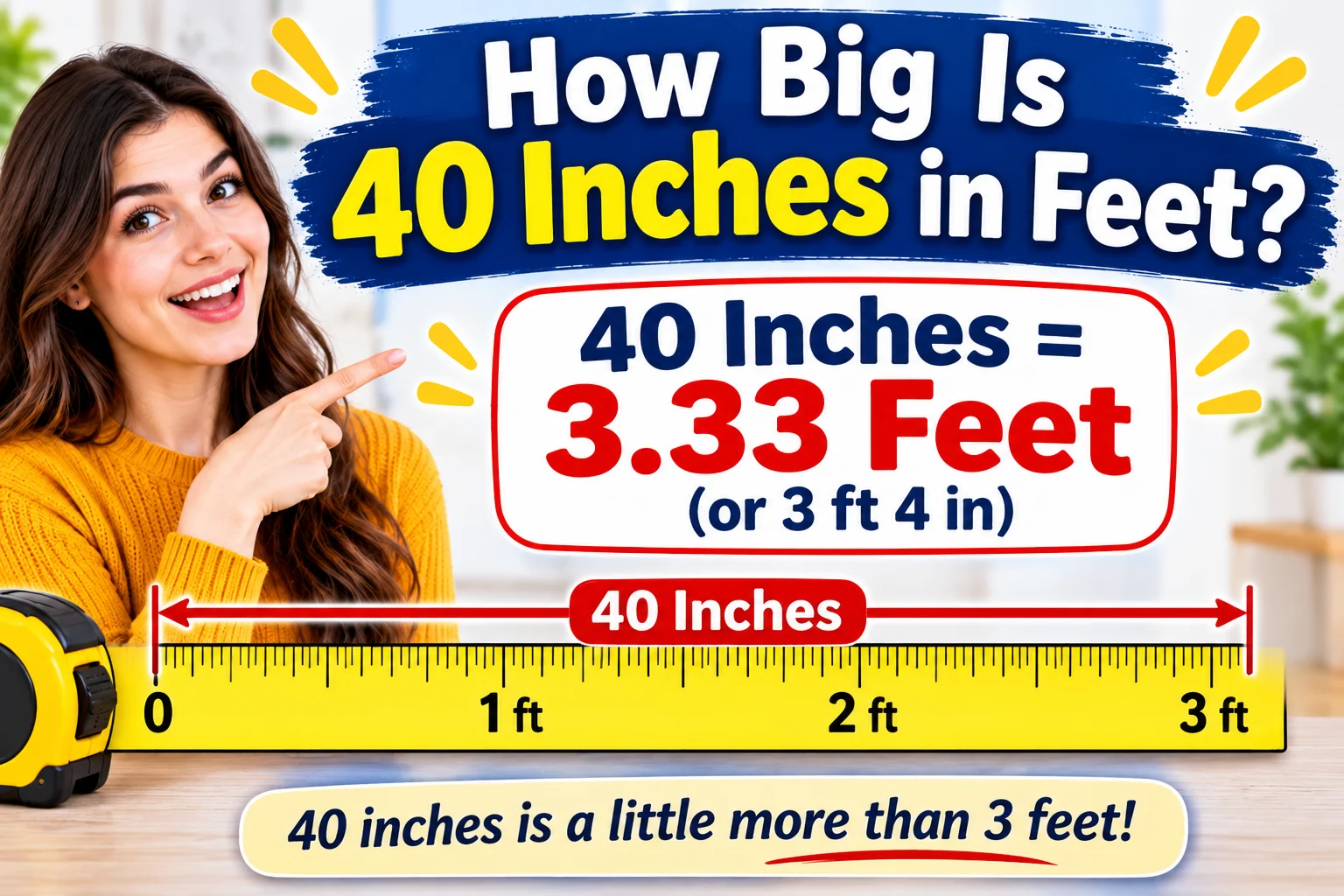
Imagine you’re buying a new television, measuring a desk for your home office, or checking whether a piece of furniture will fit through a doorway. The measurement reads 40 inches, but you find it easier to picture the size in feet. So, how big is 40 inches in feet, and what does that measurement look like in everyday life?
The answer is straightforward: 40 inches equals 3.333 feet, or 3 feet and 4 inches. Both measurements describe exactly the same length.
Understanding this conversion is useful when working with measuring tapes, planning home improvement projects, shopping for furniture, or completing school assignments. It also helps you compare dimensions when product listings use different units.
The good news is that you don’t need a calculator or advanced math skills to convert inches into feet. Once you understand the relationship between these two units, you can calculate the answer in seconds.
In this measurement guide, you’ll learn the conversion formula, see a helpful conversion table, explore practical examples, and discover easy mental math techniques for converting inches to feet accurately.
1. Quick Answer: How Big Is 40 Inches in Feet?
40 inches = 3.3333 feet, approximately 3.33 feet when rounded to two decimal places.
The same length can be expressed as 3 feet 4 inches.
There are 12 inches in 1 foot. To convert 40 inches into feet, divide the measurement by 12.
Therefore:
- Exact mixed-unit measurement: 3 feet 4 inches
- Decimal measurement: 3.3333… feet
- Rounded measurement: 3.33 feet
- Metric equivalent: 101.6 centimeters or 1.016 meters
The mixed-unit measurement is often easiest to visualize when using a tape measure. The decimal measurement is especially useful in calculations involving construction, engineering, and technical drawings.
2. Understanding Inches and Feet
Inches and feet are units of length in the U.S. customary measurement system. They are also part of the broader family of imperial-origin units used in several countries.
Although both units measure length, they serve different purposes depending on the size of the object.
What Is an Inch?
An inch is a relatively small unit of length commonly used to measure everyday objects.
You might use inches to measure:
- A smartphone’s screen size
- The thickness of a wooden board
- The width of a book
- The height of a small household object
- The dimensions of a picture frame
One inch is defined as exactly 2.54 centimeters.
What Is a Foot?
A foot is a larger unit of length equal to 12 inches.
Feet are commonly used for measuring room dimensions, ceiling heights, furniture, building materials, and people’s heights.
For example, a person who is 5 feet 8 inches tall has a height of 68 inches.
How Inches and Feet Relate
The relationship between these units is fixed:
| Measurement | Equivalent |
|---|---|
| 1 foot | 12 inches |
| 2 feet | 24 inches |
| 3 feet | 36 inches |
| 3 feet 4 inches | 40 inches |
| 4 feet | 48 inches |
| 1 inch | 0.08333… feet |
The modern foot is internationally standardized, making conversions consistent across applications.
For metric measurements, 40 inches equals 101.6 centimeters. This is useful when comparing U.S. product dimensions with specifications provided in centimeters or meters.
3. Conversion Formula: How to Convert 40 Inches to Feet
The standard conversion formula is simple:
You divide inches by 12 because each foot contains exactly 12 inches.
Step-by-Step Calculation
Let’s convert 40 inches into feet.
Step 1: Write down the measurement.
Step 2: Divide by 12.
Step 3: Express the result in feet.
The repeating decimal means the result continues indefinitely. For most everyday purposes, 3.33 feet is sufficiently precise.
Example 1: Convert 30 Inches to Feet
Therefore, 30 inches equals 2.5 feet, or 2 feet 6 inches.
Example 2: Convert 45 Inches to Feet
Therefore, 45 inches equals 3.75 feet, or 3 feet 9 inches.
Example 3: Convert 3.5 Feet to Inches
To reverse the conversion, multiply feet by 12.
Therefore, 3.5 feet equals 42 inches.
Example 4: Convert 40 Inches to Centimeters
Since 1 inch equals exactly 2.54 centimeters:
Therefore, 40 inches equals 101.6 centimeters.
These examples demonstrate the basic rule: divide by 12 to convert inches to feet, and multiply by 12 to convert feet to inches.
4. Inches to Feet Conversion Table
Use this conversion table to compare 40 inches with nearby measurements.
| Inches | Feet (Decimal) | Feet and Inches |
|---|---|---|
| 12 | 1.000 | 1 ft 0 in |
| 18 | 1.500 | 1 ft 6 in |
| 24 | 2.000 | 2 ft 0 in |
| 30 | 2.500 | 2 ft 6 in |
| 36 | 3.000 | 3 ft 0 in |
| 38 | 3.167 | 3 ft 2 in |
| 40 | 3.333 | 3 ft 4 in |
| 42 | 3.500 | 3 ft 6 in |
| 44 | 3.667 | 3 ft 8 in |
| 48 | 4.000 | 4 ft 0 in |
| 60 | 5.000 | 5 ft 0 in |
| 72 | 6.000 | 6 ft 0 in |
Note: Decimal values are rounded to three decimal places where necessary.
For a quick estimate, remember that 36 inches equals 3 feet. Since 40 inches is 4 inches more than 36 inches, the measurement is 3 feet plus one-third of a foot.
That makes 40 inches equal to 3 feet 4 inches.
5. Practical Examples: Where Is 40 Inches Used?
Knowing how big 40 inches is becomes more useful when you connect the measurement to everyday situations.
Construction and Home Improvement
Suppose you’re measuring a workbench, shelf, or section of wall that is 40 inches long. Converting it to feet gives you approximately 3.33 feet.
If you’re planning a project with several dimensions, expressing them consistently in feet can make calculations easier.
For example, a 40-inch board is 3 feet 4 inches long. If you need two such boards, their combined length is:
The total is 6 feet 8 inches.
Furniture and Interior Design
A desk, cabinet, or tabletop measuring 40 inches across may be described in feet when comparing it with a room’s dimensions.
If your available wall space is 5 feet wide, convert that measurement to inches:
A 40-inch-wide item would leave 20 inches of remaining space, assuming the measurements refer to the same dimension and no other clearance is required.
Always check the item’s height, width, and depth before purchasing furniture.
Television and Screen Sizes
Television screens are commonly advertised by their diagonal measurement in inches. A 40-inch television has a diagonal screen measurement of approximately 3.33 feet.
However, 40 inches does not represent the television’s width. The actual width depends on the screen’s aspect ratio and bezel design.
For a typical 16:9 screen, a 40-inch diagonal corresponds to a screen width of approximately 34.9 inches and a screen height of approximately 19.6 inches, excluding the bezel.
Education and Mathematics
Students frequently convert inches into feet when learning ratios, fractions, decimals, and measurement systems.
The 40-inch example is particularly useful because it produces a simple mixed measurement:
Since 36 inches equals 3 feet, the remaining 4 inches give the final answer of 3 feet 4 inches.
Shopping and Product Dimensions
Online product listings may show dimensions in inches, while your measuring tape or room plan uses feet.
Converting the measurements helps you compare storage containers, rugs, shelves, and other household items without confusing the units.
6. Common Conversion Mistakes to Avoid
Even a straightforward unit conversion can produce errors if you use the wrong operation or misread the measurement.
Mistake 1: Multiplying Instead of Dividing
To convert inches to feet, divide by 12.
Incorrect:
Correct:
Multiplication is the correct operation when converting feet into inches.
Mistake 2: Confusing Decimal Feet With Feet and Inches
A result of 3.33 feet does not mean 3 feet 33 inches.
The decimal portion represents a fraction of a foot. For example:
Therefore, 3.3333… feet equals 3 feet 4 inches.
Mistake 3: Rounding Too Early
If you round 40 inches to 3.33 feet before using the value in a series of calculations, small differences can accumulate.
Keep the full value, 3.3333…, during intermediate calculations and round the final answer to the precision your project requires.
Mistake 4: Mixing Measurement Systems
One inch equals 2.54 centimeters, but one foot equals 12 inches. These relationships should not be confused.
When switching between customary and metric units, write the units beside each number to reduce mistakes.
Mistake 5: Reading a Tape Measure Incorrectly
On a standard tape measure, the longer numbered marks usually indicate inches, while smaller subdivisions indicate fractions such as halves, quarters, eighths, and sixteenths.
Always confirm which markings you are reading before recording a measurement.
Expert tip: For construction or fitting projects, measure twice and record the unit beside every value. A correct conversion cannot compensate for an inaccurate original measurement.
7. Quick Mental Conversion Tips
You can convert 40 inches into feet without using a conversion calculator.
Method 1: Break the Measurement Into Feet and Inches
Find the largest multiple of 12 that does not exceed 40.
Since 36 inches equals 3 feet, the answer is 3 feet 4 inches.
This is often the quickest method when using a tape measure.
Method 2: Divide Into a Whole Number and a Remainder
Divide 40 by 12.
- 12 goes into 40 three times.
- Three feet account for 36 inches.
- Four inches remain.
The result is 3 feet 4 inches.
Method 3: Use Familiar Benchmarks
Memorize these common values:
- 12 inches = 1 foot
- 24 inches = 2 feet
- 36 inches = 3 feet
- 48 inches = 4 feet
- 60 inches = 5 feet
Since 40 inches falls between 36 and 48 inches, you immediately know it falls between 3 and 4 feet.
Method 4: Estimate the Decimal
The remaining 4 inches represent one-third of a foot because:
Therefore:
This explains why the decimal result repeats as 3.3333…
8. Inches vs. Feet: A Comparison Table
Both units measure length, but the best unit depends on what you’re measuring and how the result will be used.
| Feature | Inches | Feet |
|---|---|---|
| Unit size | Smaller | Larger |
| Relationship | 12 inches = 1 foot | 1 foot = 12 inches |
| Typical uses | Small objects and detailed dimensions | Rooms, furniture, and building dimensions |
| Practical precision | Convenient for fractions of an inch | Convenient for larger measurements |
| Advantages | Detailed measurements are easy to record | Large dimensions are easier to communicate |
| Common applications | Screens, boards, hardware, and product sizes | Room lengths, ceiling heights, and construction plans |
Neither unit is inherently more accurate than the other. Accuracy depends on the measuring instrument, recording method, and level of precision.
For example, 40 inches and 3 feet 4 inches represent exactly the same length. The choice is simply how you prefer to express it.
9. Why Accurate Measurement Matters
Accurate measurement is essential whenever dimensions affect fit, safety, cost, or performance.
Construction and Engineering
Builders and engineers must maintain consistent dimensions when planning structures, cutting materials, and reading technical drawings. A conversion error can lead to wasted materials or components that do not fit.
Manufacturing
Manufacturing processes often rely on precise specifications. When dimensions are transferred between measurement systems, the correct conversion and appropriate rounding become important.
Home Renovation and DIY Projects
When installing cabinets, assembling shelves, or cutting lumber, an incorrect measurement can cause gaps, uneven edges, or unnecessary expenses.
Education
Learning to convert inches into feet helps students understand division, fractions, decimals, and the relationship between different units of measurement.
A Practical Case Study
Imagine you’re building a shelf and need three wooden pieces, each 40 inches long.
The total required length is:
Convert that total into feet:
You need 10 feet of material for the three pieces before accounting for cutting losses, saw kerf, or other project requirements.
If you mistakenly treated 40 inches as 4 feet, you would estimate 12 feet instead of 10 feet. That would overstate the required length by 2 feet.
This example shows why knowing how to calculate measurements correctly matters, even for a simple DIY project.
10. Frequently Asked Questions
1. How big is 40 inches in feet exactly?
Forty inches equals 3⅓ feet, or 3 feet 4 inches. As a decimal, the result is 3.3333… feet, with the digit 3 repeating indefinitely. For most everyday measurements, 3.33 feet is a suitable rounded value. Use the exact mixed measurement of 3 feet 4 inches when working directly with a tape measure.
2. What is the easiest way to convert 40 inches to feet?
The easiest method is to divide 40 by 12 because one foot contains 12 inches. The calculation is 40 ÷ 12 = 3.3333… feet. Alternatively, recognize that 36 inches equals 3 feet, leaving 4 inches. Both approaches give the same result: 3 feet 4 inches.
3. Can I convert 40 inches to feet without a calculator?
Yes. First, identify how many complete groups of 12 inches fit into 40 inches. Three groups equal 36 inches, leaving 4 inches. Your answer is therefore 3 feet 4 inches. This method is especially helpful when measuring furniture, checking building materials, or completing schoolwork without a calculator.
4. Is 40 inches more than 3 feet?
Yes. Three feet equals 36 inches, and 40 inches is 4 inches longer. Therefore, 40 inches is one-third of a foot greater than 3 feet. Its total length is 3 feet 4 inches, or approximately 3.33 feet.
5. How many centimeters are in 40 inches?
Forty inches equals exactly 101.6 centimeters. To calculate this, multiply 40 by 2.54, because one inch is defined as exactly 2.54 centimeters. This conversion is useful when comparing U.S. product dimensions with metric specifications or when working with international measurements.
6. Is 3.33 feet the same as 3 feet 4 inches?
They are approximately the same, but not exactly. Three feet 4 inches equals 3.3333… feet, while 3.33 feet equals 39.96 inches. The difference is only 0.04 inch, so it is negligible for many everyday estimates but may matter in precision work.
7. What formula should I remember for inches to feet?
Remember this conversion formula: feet = inches ÷ 12. To convert feet back into inches, use inches = feet × 12. These two formulas cover everyday length conversions between the units and help you avoid confusing multiplication with division.
8. Why is converting inches to feet important?
This conversion makes measurements easier to understand when planning rooms, purchasing furniture, cutting lumber, comparing product dimensions, or reading construction plans. It also helps you combine measurements consistently. For accurate results, keep the original units clear and avoid rounding too early during calculations.
Conclusion: How Big Is 40 Inches in Feet?
So, how big is 40 inches in feet? The answer is 3.3333… feet, or exactly 3 feet 4 inches.
The conversion is easy once you remember the basic relationship: 12 inches make 1 foot. Divide inches by 12 to convert them into decimal feet, or break the measurement into groups of 12 to express it in feet and inches.
Here are the key takeaways:
- 40 inches = 3⅓ feet.
- 40 inches = 3 feet 4 inches.
- 40 inches = 101.6 centimeters.
- Divide inches by 12 to calculate feet.
- Multiply feet by 12 to calculate inches.
Whether you’re measuring furniture, planning a home improvement project, helping a student with math, or comparing product dimensions, this simple conversion helps you work with measurements confidently.
Ready to make your next measurement easier? Explore more inches-to-feet, feet-to-inches, and metric conversion guides to build your measurement skills and avoid common calculation mistakes.