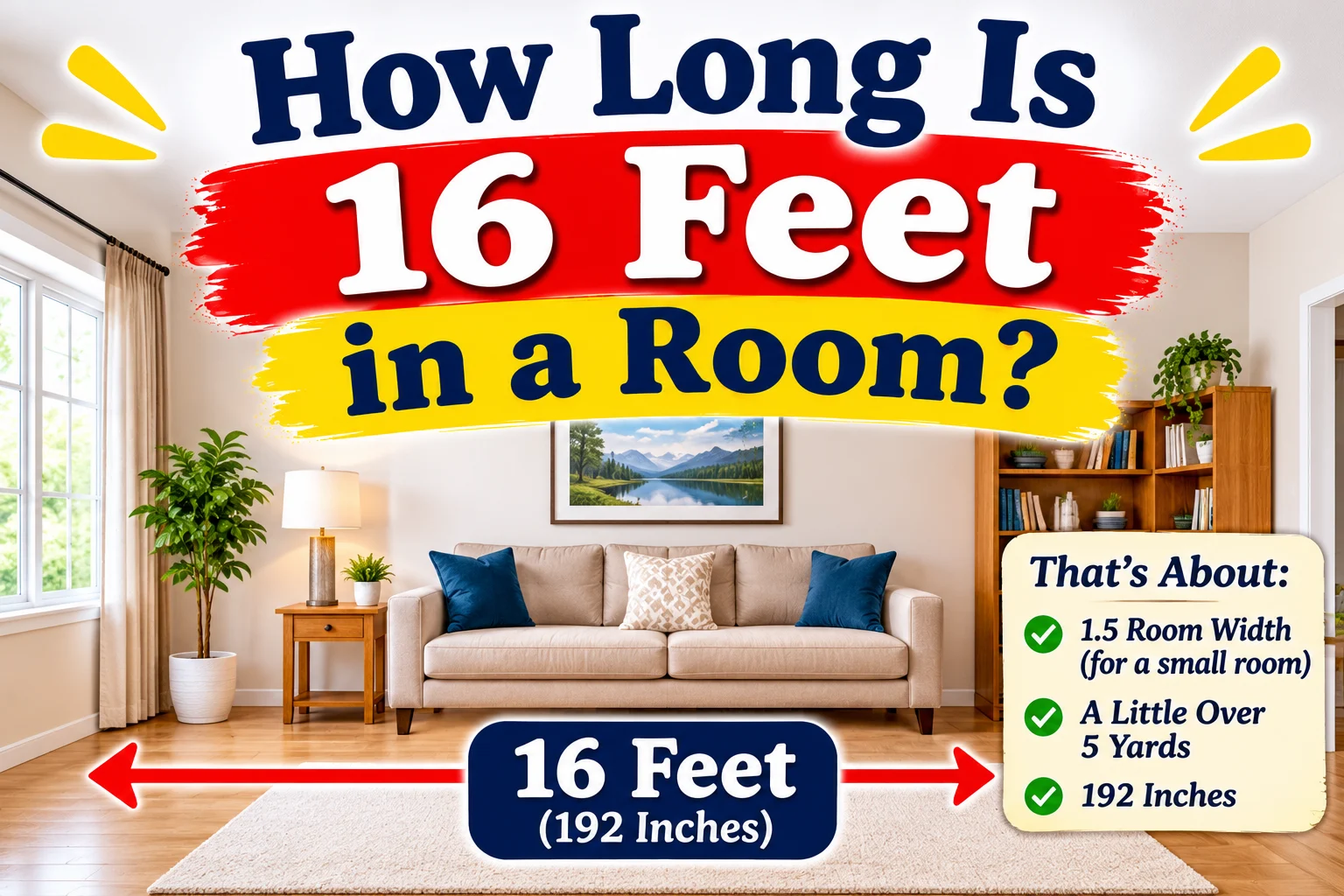
Imagine you are planning a new living room layout, buying a sofa, or deciding whether a 16-foot wall can accommodate your television, shelves, and furniture. You know the measurement on paper, but what does 16 feet actually look like inside a room?
Understanding how long is 16 feet in a room helps you visualize distances, plan furniture arrangements, and make better decisions before spending money on home improvements.
Sixteen feet equals 192 inches, 5.4864 meters, or approximately 5.49 meters. In a typical home, this is a substantial distance. It could represent the length of a small-to-medium bedroom, one dimension of a spacious living room, or a long interior wall.
However, the actual impression depends on the room’s width, ceiling height, furniture placement, and the amount of open floor space.
In this measurement guide, you will learn how to calculate 16 feet in different units, compare it with familiar household objects, estimate room dimensions, and avoid common measuring mistakes. Whether you are a homeowner, renter, DIY enthusiast, student, or contractor, these practical examples will help you picture the measurement with confidence.
1. Quick Answer: How Long Is 16 Feet in a Room?
16 feet is 192 inches, 5.4864 meters, or approximately 18.67% of an 86-foot distance. More practically, it is about 5.49 meters long and can span a substantial wall or the length of a compact room.
Here is the basic conversion:
- Feet to inches: 16 × 12 = 192 inches
- Feet to meters: 16 × 0.3048 = 4.8768 meters
- Feet to yards: 16 ÷ 3 = 5.333 yards
Correction for the metric comparison: 16 feet equals 4.8768 meters, or approximately 4.88 meters.
For room planning, imagine standing at one wall and walking toward the opposite wall for approximately 4.88 meters. That distance gives you a useful starting point for visualizing the measurement.
Remember that length alone does not tell you the room’s area. A room measuring 16 feet long and 12 feet wide has a different floor area from one measuring 16 feet long and 16 feet wide.
2. Understanding Feet, Inches, and Meters
To visualize a room accurately, it helps to understand the units used to measure its dimensions.
What is a foot?
A foot is a standard unit of length in the U.S. customary measurement system. It is commonly used for room dimensions, furniture sizes, building plans, and property measurements.
One foot equals exactly 12 inches.
What is an inch?
An inch is a smaller unit used for precise measurements. People commonly use inches when measuring doors, shelves, television screens, and furniture clearances.
Since 16 feet contains 12 inches per foot, the total is 192 inches.
What is a meter?
A meter is the standard metric unit of length. It is widely used internationally for construction, engineering, architecture, and scientific measurements.
One foot equals exactly 0.3048 meters.
The following table compares the most useful units for a 16-foot measurement.
| Unit | Equivalent of 16 feet |
|---|---|
| Feet | 16 ft |
| Inches | 192 in |
| Yards | 5.333 yd |
| Meters | 4.8768 m |
| Centimeters | 487.68 cm |
| Millimeters | 4,876.8 mm |
In the United States, feet and inches are often the most convenient units for interior measurements. Metric conversions become useful when working with international furniture specifications, imported materials, or metric construction plans.
3. Conversion Formula: How to Calculate 16 Feet
You do not need a specialized measurement calculator to convert 16 feet. A simple multiplication or division will give you the answer.
Formula 1: Convert feet to inches
Use this formula:
Inches = Feet × 12
Step-by-step calculation:
- Start with 16 feet.
- Multiply 16 by 12 inches per foot.
- The result is 192 inches.
Formula 2: Convert feet to meters
Use the conversion factor of 0.3048 meters per foot.
Meters = Feet × 0.3048
Therefore, 16 feet equals 4.8768 meters.
Formula 3: Convert feet to yards
There are three feet in one yard.
Yards = Feet ÷ 3
Reverse conversion example
Suppose you measure a wall that is 240 inches long and want to express it in feet.
The wall is 20 feet long.
These formulas work for other measurements, too. Replace 16 with the number of feet you want to convert, then apply the appropriate conversion factor.
4. Conversion Table for 16 Feet and Nearby Measurements
When planning a room, comparing nearby measurements can help you choose the right furniture or understand a floor plan.
| Length in feet | Inches | Meters |
|---|---|---|
| 8 ft | 96 in | 2.4384 m |
| 10 ft | 120 in | 3.048 m |
| 12 ft | 144 in | 3.6576 m |
| 14 ft | 168 in | 4.2672 m |
| 16 ft | 192 in | 4.8768 m |
| 18 ft | 216 in | 5.4864 m |
| 20 ft | 240 in | 6.096 m |
| 24 ft | 288 in | 7.3152 m |
Notice that every additional foot adds 12 inches, or 0.3048 meters.
This consistent relationship makes length conversion straightforward. If a room measures 14 feet and you extend it by 2 feet, the new length becomes 16 feet.
5. Practical Examples: What Does 16 Feet Look Like in a Room?
The easiest way to understand a measurement is to connect it to familiar spaces and objects.
Example 1: A living room wall
Imagine a living room with a wall measuring 16 feet from corner to corner.
That provides 192 inches of horizontal wall space. You could potentially arrange a sofa, side tables, artwork, or a television setup along that wall, depending on the dimensions of the furniture and the location of doors and windows.
For example, a 90-inch sofa would occupy 7.5 feet of that wall, leaving 102 inches of remaining wall length before accounting for clearances or other furniture.
Example 2: A bedroom
Consider a bedroom measuring 16 feet long and 12 feet wide.
Its floor area would be:
This is a rectangular room with 192 square feet of floor space. Whether it feels spacious depends on the bed size, wardrobes, walking paths, and other furnishings.
Example 3: A furniture arrangement
Suppose you want to place a sofa and a coffee table in a room that measures 16 feet from front to back.
Convert the room length to inches:
If the sofa depth is 36 inches and the coffee table is 24 inches deep, their combined depth is 60 inches.
You have 132 inches remaining for spacing, circulation, and other furniture. The exact arrangement will depend on the placement of each item.
Example 4: A DIY flooring project
Suppose a rectangular room measures 16 feet long and 10 feet wide.
Calculate the floor area:
If you are purchasing flooring, you will generally need additional material for cuts and waste. The appropriate allowance depends on the flooring product, installation pattern, and room layout.
Example 5: Comparing a room with a sports measurement
A standard basketball court is much longer than 16 feet. A 16-foot distance represents only a small portion of the court, but it can still be a useful distance for measuring a practice area or planning space in a home gym.
The important lesson is that measurements become easier to visualize when you compare them with a familiar environment.
6. Common Measurement Conversion Mistakes
Even a simple conversion can lead to errors when you are measuring an actual room.
Mistake 1: Multiplying by the wrong number
One foot contains 12 inches, not 10.
Incorrect calculation:
Correct calculation:
Mistake 2: Confusing length with area
Feet measure length, while square feet measure area.
A 16-foot wall is not the same as a 16-square-foot wall. To calculate the floor area of a rectangular room, multiply its length by its width.
Mistake 3: Mixing feet and inches
Suppose a room is 16 feet 6 inches long. This is not 16.6 feet.
Convert the extra inches into a fraction of a foot:
Therefore, 16 feet 6 inches equals 16.5 feet.
Mistake 4: Rounding too early
When converting feet to meters, retain the full value until the final step if precision matters.
For example, 16 feet equals 4.8768 meters. Rounding it to 4.9 meters is usually sufficient for rough visualization, but not necessarily for precise installation work.
Expert measuring tips
- Measure from the finished interior wall surfaces when planning furniture.
- Check the measurement at more than one point if the walls appear uneven.
- Account for baseboards, door frames, and permanent obstructions where relevant.
- Record dimensions consistently in feet and inches or in metric units.
- Verify measurements before ordering custom furniture or construction materials.
7. Quick Mental Conversion Tips
You can estimate many room measurements without a calculator by memorizing a few useful relationships.
To convert feet to inches: Multiply by 12. For 16 feet, double 16 to get 32, then multiply by 6 to get 192.
To convert feet to meters: Multiply by approximately 0.3 for a quick estimate. Sixteen feet is approximately 4.8 meters using this shortcut; the exact result is 4.8768 meters.
To convert inches to feet: Divide by 12. For example, 96 inches divided by 12 equals 8 feet.
To convert feet to yards: Divide by 3. Sixteen feet is approximately 5.33 yards.
A useful mental benchmark is that 10 feet is approximately 3.05 meters. Therefore, 16 feet should be a little under 5 meters.
For accurate construction work, use the exact conversion factor rather than a mental estimate.
8. Comparison Between Feet, Inches, and Meters
Each unit is useful in a different measurement situation.
| Feature | Feet | Inches | Meters |
|---|---|---|---|
| Relative size | Medium | Small | Larger metric unit |
| Common uses | Room dimensions, walls | Furniture, clearances | Construction, international plans |
| Precision | Good for room layouts | Useful for detailed measurements | Good for metric plans |
| Main advantage | Familiar in U.S. housing | Easy for small dimensions | Standard metric unit |
| Example for this measurement | 16 ft | 192 in | 4.8768 m |
For most U.S. home projects, feet are convenient for measuring the overall room, while inches help with furniture placement and small gaps.
Meters are useful when comparing dimensions with metric specifications. The best unit is the one that matches your plans, tools, and required level of precision.
9. Why Accurate Measurement Matters
Accurate measurements help prevent costly mistakes in construction, engineering, manufacturing, and home improvement.
Construction and renovation
A small measuring error can affect the placement of framing, cabinetry, doors, and other building components. Contractors must work from consistent dimensions to ensure that materials fit correctly.
Interior design
Knowing the exact room length helps you select furniture that fits comfortably without blocking doors, windows, or walking routes.
Manufacturing
Manufacturers depend on precise dimensions to produce components that fit together. Converting measurements incorrectly can create material waste or assembly problems.
Education
Learning length conversion teaches students how multiplication, division, fractions, and measurement systems work together in practical situations.
A realistic case study
Imagine a homeowner planning custom storage along a 16-foot wall. The wall measures 192 inches, but the homeowner assumes the entire length is available for cabinetry.
During installation, they discover that a door frame and a wall obstruction reduce the usable span.
The lesson is simple: the overall room dimension is not always the usable installation dimension. Measure obstructions, clearances, and finished surfaces before ordering materials.
Accurate measurement saves time, reduces waste, and helps projects run more smoothly.
10. Final Thoughts: How Long Is 16 Feet in a Room?
The answer to how long is 16 feet in a room is straightforward: 16 feet equals 192 inches, 5.333 yards, or 4.8768 meters.
In practical terms, it is a substantial interior distance that could describe a bedroom dimension, a living room wall, or the length of a furniture arrangement area.
Remember these essential conversion formulas:
- Feet to inches: multiply by 12.
- Feet to meters: multiply by 0.3048.
- Feet to yards: divide by 3.
- Rectangular room area: multiply length by width.
Most importantly, distinguish between the total room dimension and the usable space available for furniture or construction. A quick measurement check can prevent expensive mistakes.
Ready to measure with confidence? Explore more measurement conversion guides to learn how to convert inches to feet, calculate square footage, measure furniture clearances, and plan your next home improvement project accurately.
Frequently Asked Questions (FAQs)
1. How many inches are in 16 feet?
There are exactly 192 inches in 16 feet. To calculate the conversion, multiply the number of feet by 12 because each foot contains 12 inches.
This conversion is useful when comparing room dimensions with furniture specifications, measuring wall space, or checking whether an object will fit in a particular area.
2. How long is 16 feet in a room in meters?
Sixteen feet equals exactly 4.8768 meters, or approximately 4.88 meters. To convert feet to meters, multiply the measurement by 0.3048.
This metric conversion is useful when reviewing international furniture dimensions, working with metric floor plans, or comparing room sizes across different measurement systems.
3. Is 16 feet a long distance for a room?
Sixteen feet is a substantial room dimension, but whether it feels long depends on the room’s width, ceiling height, and layout. A 16-by-10-foot room has 160 square feet of floor area, while a 16-by-16-foot room has 256 square feet. Furniture placement, doors, windows, and walking space also affect how large the room feels.
4. How can I visualize 16 feet without a measuring tape?
You can estimate 16 feet by imagining a distance of approximately 4.88 meters or 192 inches. If you know the dimensions of a familiar object, use it as a rough reference, but avoid relying on estimates for installation work. For accurate results, use a tape measure or a suitable laser distance meter and verify the measurement at the actual location.
5. How do I calculate the square footage of a 16-foot room?
You need both the room’s length and width to calculate its floor area. Multiply the two dimensions when they are measured in feet. For example, a room measuring 16 feet by 12 feet has an area of 192 square feet.
If the room has an irregular shape, divide it into smaller rectangles, calculate each area, and add the results.
6. Is the conversion from 16 feet to inches exact?
Yes. The conversion is exact because one foot is defined as exactly 12 inches. Therefore, 16 feet equals exactly 192 inches. The conversion to meters is also exact when using the defined relationship of 1 foot to 0.3048 meters, giving 4.8768 meters. Approximate values arise only when you round the result for convenience.
7. What is the easiest formula for converting feet to inches?
The easiest formula is inches = feet × 12. Simply multiply the number of feet by 12. For example, 8 feet equals 96 inches, 12 feet equals 144 inches, and 16 feet equals 192 inches. Memorizing this relationship makes it easier to interpret floor plans, compare furniture sizes, and complete everyday measurement calculations without a conversion calculator.
8. Why should I measure a room before buying furniture?
Measuring a room before purchasing furniture helps ensure that items fit through doorways and occupy the intended space without blocking walking routes. Room dimensions alone may not reveal obstacles such as radiators, built-in cabinets, windows, or door swings. Measure the available floor and wall space, then compare those dimensions with the furniture’s width, depth, and height before ordering.
9. How do I convert 192 inches back to feet?
To convert inches back to feet, divide the number of inches by 12 because each foot contains 12 inches.
This reverse conversion is useful when a furniture specification lists inches but your room measurements are recorded in feet. Keep units consistent when comparing dimensions to avoid calculation errors.