Imagine you are getting ready to pour a patio, driveway, walkway, or concrete slab. The supplier asks, “How many yards do you need?” You have measured the project in feet and inches, so one question naturally comes up: how many feet in a yard of concrete?
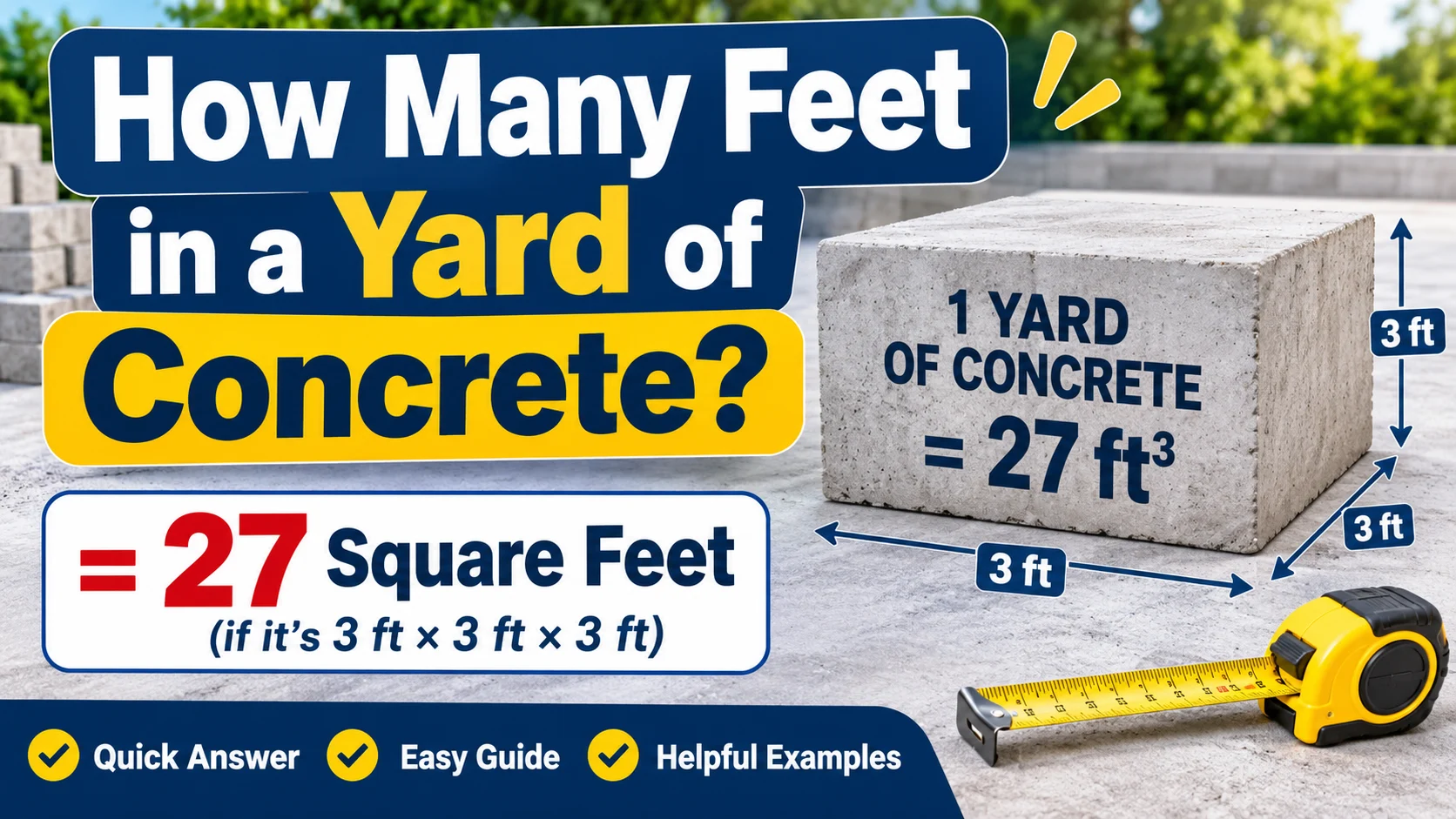
The short answer is 27 cubic feet in 1 cubic yard of concrete.
There is an important detail, though: concrete is normally measured by volume, so the correct comparison is cubic feet to cubic yards, not ordinary feet to yards. One cubic yard is a cube measuring 3 feet long × 3 feet wide × 3 feet deep. Therefore:
3 × 3 × 3 = 27 cubic feet
This simple conversion is essential when estimating concrete. A mistake with the number 27—or with the thickness of a slab—can leave you seriously short of material or paying for much more concrete than necessary.
In this measurement guide, you’ll learn the conversion formula, see practical examples and tables, discover easy mental-math shortcuts, and learn how to calculate the cubic yards needed for common concrete projects.
1. Quick Answer: How Many Feet in a Yard of Concrete?
One cubic yard of concrete equals exactly 27 cubic feet.
The basic conversion is:
1 cubic yard = 27 cubic feet
A cubic yard has three dimensions:
- Length: 3 feet
- Width: 3 feet
- Height/depth: 3 feet
So:
3 ft × 3 ft × 3 ft = 27 ft³
If you are converting cubic yards to cubic feet, multiply by 27.
If you are converting cubic feet to cubic yards, divide by 27.
| Concrete Volume | Cubic Feet | Cubic Yards |
|---|---|---|
| 0.25 yd³ | 6.75 ft³ | 0.25 yd³ |
| 0.5 yd³ | 13.5 ft³ | 0.5 yd³ |
| 1 yd³ | 27 ft³ | 1 yd³ |
| 2 yd³ | 54 ft³ | 2 yd³ |
| 3 yd³ | 81 ft³ | 3 yd³ |
| 5 yd³ | 135 ft³ | 5 yd³ |
2. How Many Feet in a Yard of Concrete? Understanding the Units
The wording “feet in a yard of concrete” can be confusing because feet measure length, while concrete is generally purchased by volume.
Feet and yards measure length
For ordinary length:
1 yard = 3 feet = 36 inches
For example, a 9-foot board is:
9 ÷ 3 = 3 yards
Cubic feet and cubic yards measure volume
Concrete occupies three-dimensional space, so its volume is measured in cubic units.
- 1 cubic foot = 12 in × 12 in × 12 in
- 1 cubic yard = 3 ft × 3 ft × 3 ft
- 1 cubic yard = 27 cubic feet
In U.S. construction, ready-mix concrete is commonly ordered in cubic yards. Project dimensions, however, are often measured in feet and inches. That is why unit conversion is such an important part of concrete estimating.
Metric comparison
For readers working with metric measurements:
1 cubic yard ≈ 0.7646 cubic meters
So a cubic yard is a little less than one cubic meter.
| Measurement | Equivalent |
|---|---|
| 1 yard | 3 feet |
| 1 yard | 36 inches |
| 1 cubic yard | 27 cubic feet |
| 1 cubic yard | 46,656 cubic inches |
| 1 cubic yard | ≈ 0.7646 m³ |
The key distinction is simple: a yard is a length; a cubic yard is a volume.
3. How Many Feet in a Yard of Concrete? The Conversion Formula
The fundamental conversion formula is:
Cubic yards to cubic feet
Cubic feet = cubic yards × 27
For example, if you have 4 cubic yards:
4 × 27 = 108 cubic feet
Therefore, 4 cubic yards equals 108 cubic feet.
Cubic feet to cubic yards
Use the reverse formula:
Cubic yards = cubic feet ÷ 27
For example:
81 ÷ 27 = 3 cubic yards
So 81 cubic feet of concrete equals 3 cubic yards.
Calculating concrete from project dimensions
For a rectangular slab, use:
Cubic yards = Length × Width × Thickness ÷ 27
All three dimensions must be in feet.
If thickness is given in inches, convert it first:
Thickness in feet = thickness in inches ÷ 12
For example, a 4-inch slab has a thickness of:
4 ÷ 12 = 0.3333 feet
Then calculate the volume.
Example: 10 × 12-foot slab
Suppose a patio is:
- 10 feet long
- 12 feet wide
- 4 inches thick
Step 1: Convert thickness.
4 ÷ 12 = 0.3333 ft
Step 2: Find cubic feet.
10 × 12 × 0.3333 ≈ 40 cubic feet
Step 3: Convert to cubic yards.
40 ÷ 27 ≈ 1.48 cubic yards
So the basic calculated volume is approximately 1.48 cubic yards.
4. Concrete Conversion Table
A conversion chart makes it easier to check your calculation without reaching for a measurement calculator every time.
| Cubic Yards | Cubic Feet | Approx. Cubic Meters |
|---|---|---|
| 0.25 | 6.75 | 0.191 |
| 0.5 | 13.5 | 0.382 |
| 0.75 | 20.25 | 0.573 |
| 1 | 27 | 0.765 |
| 1.5 | 40.5 | 1.147 |
| 2 | 54 | 1.529 |
| 2.5 | 67.5 | 1.911 |
| 3 | 81 | 2.294 |
| 4 | 108 | 3.058 |
| 5 | 135 | 3.823 |
| 10 | 270 | 7.646 |
Common thickness conversions
Because slab thickness is usually given in inches, this second table is particularly useful:
| Thickness | Thickness in Feet |
|---|---|
| 2 inches | 0.1667 ft |
| 3 inches | 0.25 ft |
| 4 inches | 0.3333 ft |
| 5 inches | 0.4167 ft |
| 6 inches | 0.5 ft |
| 8 inches | 0.6667 ft |
| 12 inches | 1 ft |
Expert tip: Don’t enter “4” into a formula as the thickness of a 4-inch slab. Convert the 4 inches to 4/12 = 0.3333 feet first.
5. Practical Examples of Concrete Measurements
The conversion becomes much easier when you see how it works on real projects.
Example 1: Basic conversion
You have 54 cubic feet of concrete.
54 ÷ 27 = 2
You need 2 cubic yards.
Example 2: Decimal conversion
You have 2.5 cubic yards.
2.5 × 27 = 67.5 cubic feet
Therefore, 2.5 cubic yards equals 67.5 cubic feet.
Example 3: A 10 × 10 patio
A 10 × 10-foot patio is 100 square feet. At 4 inches thick:
4 ÷ 12 = 0.3333 ft
Then:
10 × 10 × 0.3333 ≈ 33.33 cubic feet
Convert to yards:
33.33 ÷ 27 ≈ 1.23 cubic yards
So the mathematical requirement is approximately 1.23 cubic yards before allowing for waste or site variations.
Example 4: A larger driveway
Suppose a driveway is 20 feet long, 12 feet wide, and 6 inches thick.
Convert the thickness:
6 ÷ 12 = 0.5 ft
Calculate cubic feet:
20 × 12 × 0.5 = 120 cubic feet
Convert to cubic yards:
120 ÷ 27 ≈ 4.44 cubic yards
The calculated volume is therefore approximately 4.44 cubic yards.
Example 5: Reverse conversion
A contractor tells you that a project requires 3.7 cubic yards.
To find cubic feet:
3.7 × 27 = 99.9 cubic feet
So 3.7 cubic yards is 99.9 cubic feet.
For actual ordering, don’t automatically round a calculated amount up or down without considering the supplier’s minimum delivery, project geometry, subgrade conditions, and an appropriate allowance for waste.
6. Common Conversion Mistakes
Even though the math is simple, concrete estimates can go wrong in several predictable ways.
1. Using 3 instead of 27
This is the most important mistake.
Because:
1 yard = 3 feet
it is tempting to assume:
1 cubic yard = 3 cubic feet
That is incorrect.
A cubic yard has three dimensions, so:
3 × 3 × 3 = 27 cubic feet
2. Forgetting to convert inches
A 4-inch slab does not have a thickness of 4 feet.
Use:
4 ÷ 12 = 0.3333 feet
3. Mixing area and volume
A 10 × 10-foot slab has an area of:
100 square feet
That is not the same as its concrete volume. You must multiply by thickness to get cubic feet.
4. Rounding too early
Using 0.33 feet instead of 0.3333 feet is usually acceptable for a quick estimate, but early rounding can accumulate in larger projects.
Keep several decimal places during the calculation and round the final result.
5. Confusing concrete volume with bag yield
A cubic yard is a volume measurement. Individual bags of dry concrete mix have their own stated yield, which varies by product and bag size. Never assume a universal number of bags without checking the manufacturer’s yield.
Expert rule: Measure carefully, convert units before calculating, keep your intermediate numbers precise, and verify the final quantity with the concrete supplier for an actual pour.
7. Quick Mental Conversion Tips
You don’t always need a calculator for simple conversions.
Memorize the number 27
The most useful fact is:
1 cubic yard = 27 cubic feet
From there:
- 2 yards = 54 cubic feet
- 3 yards = 81 cubic feet
- 4 yards = 108 cubic feet
- 5 yards = 135 cubic feet
- 10 yards = 270 cubic feet
Use thirds for common slab thicknesses
Some thicknesses are especially easy to remember:
- 3 inches = 0.25 ft
- 6 inches = 0.5 ft
- 12 inches = 1 ft
A 6-inch slab is particularly convenient because its thickness is exactly half a foot.
Quick coverage check
One cubic yard contains 27 cubic feet. At a 4-inch depth, which is one-third of a foot:
27 ÷ 1/3 = 81 square feet
So one cubic yard covers approximately 81 square feet at 4 inches thick.
At 6 inches:
27 ÷ 0.5 = 54 square feet
This is a useful sanity check when reviewing a concrete estimate.
8. Comparison Between the Units
Understanding the difference between linear, square, and cubic measurements prevents many costly mistakes.
| Unit | Measures | Size/Relationship | Typical Use |
|---|---|---|---|
| Foot (ft) | Length | 1 ft = 12 in | Boards, distances, dimensions |
| Yard (yd) | Length | 1 yd = 3 ft | Landscaping distances, fabric, field measurements |
| Square foot (ft²) | Area | 1 ft × 1 ft | Flooring, walls, patios |
| Cubic foot (ft³) | Volume | 1 ft × 1 ft × 1 ft | Concrete, storage, excavation |
| Cubic yard (yd³) | Volume | 3 ft × 3 ft × 3 ft = 27 ft³ | Ready-mix concrete, soil, gravel |
Why cubic yards are useful
Concrete suppliers use cubic yards because a concrete order represents a volume of material, not a length or surface area.
The practical distinction is:
Length → feet or yards
Area → square feet or square yards
Volume → cubic feet or cubic yards
Once that distinction becomes second nature, most concrete measurement problems become much easier.
9. Why Accurate Measurement Matters
Accurate measurement matters because concrete is not something you want to discover you are short of halfway through a pour.
Consider a homeowner preparing a 12 × 20-foot patio at 4 inches thick.
The approximate volume is:
12 × 20 × 0.3333 = 80 cubic feet
Then:
80 ÷ 27 ≈ 2.96 cubic yards
A small measurement error can push the actual requirement above the calculated figure. Uneven excavation, variations in subgrade, form dimensions, spillage, and other job conditions can also affect how much material is needed.
For this reason, concrete estimating should be treated as more than a simple calculator exercise.
Accurate measurements help with:
- Construction: ordering the right quantity of ready-mix
- Engineering: calculating design volumes
- Manufacturing: controlling material quantities
- Home renovation: budgeting accurately
- DIY projects: avoiding unnecessary trips for additional material
- Education: understanding dimensional analysis and unit conversion
For structural work, the required slab thickness and reinforcement should come from the appropriate design requirements rather than simply from a generic online example.
10. Final Thoughts: How Many Feet in a Yard of Concrete?
If you remember only one fact from this measurement guide, remember this:
1 cubic yard of concrete = 27 cubic feet.
The reason is straightforward:
1 yard = 3 feet
Therefore:
1 cubic yard = 3 ft × 3 ft × 3 ft = 27 cubic feet
When calculating a concrete project, first measure the length, width, and thickness. Convert inches to feet, multiply the three dimensions to find cubic feet, and divide by 27 to find cubic yards.
The focus question “how many feet in a yard of concrete” is really asking about cubic feet in a cubic yard. Making that distinction prevents one of the most common unit-conversion mistakes in concrete estimating.
For a quick calculation, use:
Cubic yards = Length × Width × Thickness ÷ 27
Keep your measurements consistent, avoid premature rounding, and verify the final quantity with your concrete supplier before placing a large order.
Frequently Asked Questions
1. How many feet in a yard of concrete?
There are 27 cubic feet in one cubic yard of concrete. A cubic yard is a three-dimensional cube measuring 3 feet on every side, so 3 × 3 × 3 = 27 cubic feet. If someone simply says “one yard of concrete,” they generally mean one cubic yard, because concrete is measured by volume rather than linear distance.
2. Is 1 yard of concrete the same as 3 feet?
Not exactly. 1 linear yard equals 3 linear feet, but one cubic yard equals 27 cubic feet. Concrete is normally ordered by cubic yards because it occupies three-dimensional space. Think of a cube that is 3 feet long, 3 feet wide, and 3 feet high: that entire cube contains 27 cubic feet.
3. What is the easiest way to convert cubic feet to cubic yards?
The easiest method is to divide cubic feet by 27. For example, if your calculation gives you 81 cubic feet, divide 81 by 27 to get 3 cubic yards. To go in the opposite direction, multiply cubic yards by 27. Keeping the number 27 memorized makes this particular unit conversion very quick.
4. How do I calculate how many cubic yards of concrete I need?
Multiply the project’s length × width × thickness, with all dimensions expressed in feet. This gives cubic feet. Then divide the result by 27. If thickness is given in inches, divide it by 12 first. For example, a 10 × 12-foot slab that is 4 inches thick requires about 1.48 cubic yards before considering project-specific ordering allowances.
5. Can I convert cubic yards to cubic feet without a calculator?
Yes. Because one cubic yard equals exactly 27 cubic feet, simple amounts are easy to calculate mentally. Two yards equals 54 cubic feet, three equals 81, four equals 108, and five equals 135. For decimal quantities, multiplication by 27 is still straightforward: 2.5 yards, for example, equals 67.5 cubic feet.
6. Why is concrete measured in cubic yards?
Concrete is measured in cubic yards because it is a volume of material. A project has length, width, and thickness, and all three dimensions determine how much concrete is required. In U.S. construction, ready-mix concrete is commonly sold and delivered by the cubic yard, while the project dimensions are often measured in feet and inches.
7. Is the 27-cubic-foot conversion exact?
Yes. The relationship is exact: 1 cubic yard = 27 cubic feet. It comes directly from the definition of the units: one yard is three feet, and a cubic yard has three dimensions. Therefore, 3 × 3 × 3 equals 27. Any approximation in a concrete estimate comes from the project measurements, thickness, geometry, rounding, or ordering allowance—not from the 27 conversion itself.
8. How many cubic feet are in 2 yards of concrete?
Two cubic yards contain 54 cubic feet. The calculation is:
2 × 27 = 54 cubic feet
Likewise, 3 cubic yards contain 81 cubic feet, while 5 cubic yards contain 135 cubic feet. This is useful when comparing a contractor’s quoted cubic-yard quantity with your own volume calculation.
9. How many cubic yards does a 4-inch slab require?
It depends on the slab’s length and width. A useful shortcut is that one cubic yard covers about 81 square feet at a 4-inch thickness. For example, a 10 × 10-foot slab has 100 square feet, so it needs approximately 1.23 cubic yards before considering project-specific ordering allowances. Always calculate the actual dimensions rather than relying only on a rule of thumb.
10. What formula should I remember for concrete measurements?
For a rectangular project, remember:
Cubic yards = Length (ft) × Width (ft) × Thickness (ft) ÷ 27
If thickness is given in inches:
Thickness in feet = inches ÷ 12
Then multiply the three dimensions and divide by 27. This simple conversion formula works for patios, sidewalks, slabs, pads, and many other rectangular concrete projects.
Ready to Master More Measurement Conversions?
Understanding how many feet in a yard of concrete is just one useful unit-conversion skill. Once you understand the difference between linear, square, and cubic measurements, you can confidently tackle concrete estimates, construction calculations, home-improvement projects, and everyday measurement problems.
Keep this 27-cubic-foot rule handy, and explore more measurement conversion guides to make everyday calculations faster, clearer, and more accurate.