Imagine you’re preparing your garden for spring. You’ve measured your flower beds, calculated the depth you want, and headed to a landscaping supplier. The supplier sells mulch by the cubic yard, but your garden measurements are in feet. How do you know how much mulch to order?
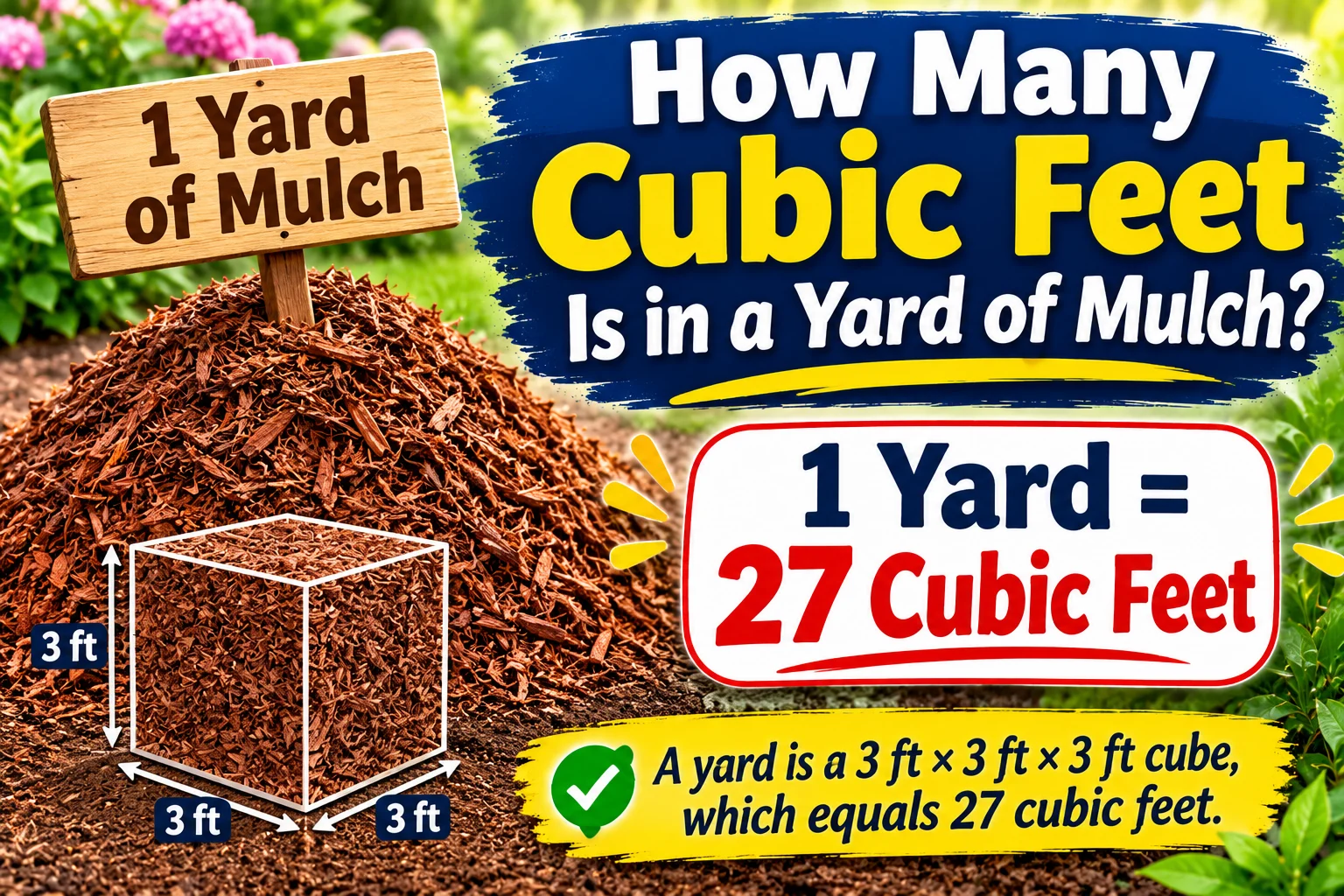
The answer is simple: one cubic yard of mulch equals 27 cubic feet.
If you’re wondering how many cubic feet is in a yard of mulch, this conversion is the key to planning your landscaping project accurately. It helps you estimate the amount of mulch you need, compare bulk and bagged prices, and avoid buying too much or too little material.
The calculation works because one yard equals three feet, and cubic measurements account for length, width, and depth. Therefore, you multiply 3 feet by 3 feet by 3 feet to get 27 cubic feet.
In this measurement guide, you’ll learn the conversion formula, see practical examples, explore useful conversion tables, and discover how to estimate mulch coverage for flower beds, trees, and other outdoor spaces.
Whether you’re a homeowner tackling a weekend project or a landscaping professional estimating materials, understanding this simple volume conversion can save you time, money, and unnecessary trips to the garden center.
1. Quick Answer: How Many Cubic Feet Is in a Yard of Mulch?
One cubic yard of mulch contains exactly 27 cubic feet.
A cubic yard measures volume, not length or surface area. It represents a space that is 3 feet long, 3 feet wide, and 3 feet high.
The conversion formula is:
1 cubic yard = 3 × 3 × 3 = 27 cubic feet
Here are the essential conversions to remember:
- 1 cubic yard = 27 cubic feet
- 2 cubic yards = 54 cubic feet
- 3 cubic yards = 81 cubic feet
- 5 cubic yards = 135 cubic feet
Quick rule: Multiply the number of cubic yards by 27 to calculate cubic feet. Divide cubic feet by 27 to convert back to cubic yards.
Keep in mind that this conversion measures volume. The actual area your mulch covers depends on how thickly you spread it.
2. Understanding Cubic Yards and Cubic Feet
Before calculating mulch quantities, it’s helpful to understand the units involved.
What Is a Cubic Foot?
A cubic foot is a unit of volume in the U.S. customary measurement system. It describes the space inside a cube measuring 1 foot on every side.
For example, a box measuring 1 foot long, 1 foot wide, and 1 foot tall holds 1 cubic foot of material.
What Is a Cubic Yard?
A cubic yard is a larger volume unit commonly used for landscaping and construction materials. It represents a cube measuring 3 feet on each side.
Because each dimension is three times larger than a cubic foot’s corresponding dimension, the volume increases by a factor of 3³, or 27.
Why Are These Units Used for Mulch?
Landscaping suppliers often sell bulk materials by the cubic yard because large quantities are easier to estimate and deliver this way.
Bagged mulch, however, is commonly labeled in cubic feet. Knowing the conversion allows you to compare prices and determine how many bags equal a bulk order.
For metric context, one cubic yard is approximately 0.7646 cubic meters, or 764.6 liters.
3. Conversion Formula: How to Calculate Cubic Feet in a Yard of Mulch
The formula for converting cubic yards to cubic feet is straightforward:
Cubic feet = Cubic yards × 27
To convert cubic feet back into cubic yards, reverse the operation:
Cubic yards = Cubic feet ÷ 27
Example 1: Convert 1 Cubic Yard to Cubic Feet
Step 1: Identify the quantity: 1 cubic yard.
Step 2: Multiply by 27.
1 × 27 = 27 cubic feet
Therefore, one cubic yard equals 27 cubic feet.
Example 2: Convert 2.5 Cubic Yards to Cubic Feet
Suppose your landscaping project requires 2.5 cubic yards of mulch.
2.5 × 27 = 67.5 cubic feet
You need 67.5 cubic feet of mulch.
Example 3: Convert 81 Cubic Feet to Cubic Yards
Suppose a supplier offers 81 cubic feet of mulch.
81 ÷ 27 = 3 cubic yards
The quantity equals exactly 3 cubic yards.
Example 4: Calculate Mulch Volume From Garden Dimensions
Imagine a rectangular garden bed that is 12 feet long and 8 feet wide. You want to spread mulch 3 inches deep.
First, convert the depth to feet:
3 ÷ 12 = 0.25 feet
Next, calculate the volume:
12 × 8 × 0.25 = 24 cubic feet
Finally, convert cubic feet to cubic yards:
24 ÷ 27 ≈ 0.89 cubic yard
You need approximately 0.89 cubic yard of mulch. In practice, you might order 1 cubic yard, depending on the supplier’s minimum order and your desired allowance for settling.
4. Cubic Yard to Cubic Feet Conversion Table
Use this conversion chart when estimating mulch quantities or checking a supplier’s quote.
| Cubic yards | Cubic feet | Approximate 2-cu-ft bags |
|---|---|---|
| 0.25 | 6.75 | 3.38 |
| 0.5 | 13.5 | 6.75 |
| 0.75 | 20.25 | 10.13 |
| 1 | 27 | 13.5 |
| 1.5 | 40.5 | 20.25 |
| 2 | 54 | 27 |
| 2.5 | 67.5 | 33.75 |
| 3 | 81 | 40.5 |
| 4 | 108 | 54 |
| 5 | 135 | 67.5 |
| 10 | 270 | 135 |
Bag counts are mathematical equivalents based on bags labeled 2 cubic feet. Round up to whole bags when purchasing.
Common Mulch Quantities at a Glance
| Mulch quantity | Cubic feet | Best use |
|---|---|---|
| 1 small bag (1 cu ft) | 1 | Small planting areas |
| 1 standard bag (2 cu ft) | 2 | Flower beds and small gardens |
| 1 bulk cubic yard | 27 | Medium-sized landscaping projects |
| 2 bulk cubic yards | 54 | Larger gardens and borders |
| 5 bulk cubic yards | 135 | Extensive landscape coverage |
These figures make it easier to compare bagged mulch with bulk deliveries. However, check the package label because bags may contain different volumes.
5. Practical Examples: How Much Mulch Do You Need?
Knowing that a cubic yard contains 27 cubic feet is useful, but most homeowners also want to know how far that mulch will go.
The answer depends on the area you need to cover and the depth of the mulch layer.
Example A: Mulching a Flower Bed
Suppose your flower bed measures 10 feet by 6 feet, and you want a 3-inch layer.
- Convert 3 inches to feet: 3 ÷ 12 = 0.25.
- Calculate the volume: 10 × 6 × 0.25 = 15 cubic feet.
- Convert to cubic yards: 15 ÷ 27 ≈ 0.56.
Result: You need about 0.56 cubic yard, before allowing for uneven ground or settling.
Example B: Covering a Large Landscape
A 20-foot-by-15-foot garden requires a 2-inch layer of mulch.
First, convert the depth:
2 ÷ 12 ≈ 0.167 feet
Calculate the volume:
20 × 15 × 0.167 ≈ 50 cubic feet
Convert to cubic yards:
50 ÷ 27 ≈ 1.85 cubic yards
Result: Approximately 1.85 cubic yards. Depending on delivery increments, ordering 2 cubic yards may be practical.
Example C: Comparing Bulk Mulch With Bags
Suppose a bulk supplier sells 1 cubic yard, while your garden center sells 2-cubic-foot bags.
27 ÷ 2 = 13.5 bags
You would need 14 bags to purchase at least the same volume as one cubic yard.
To compare costs fairly, multiply the price per bag by the number of bags required. Then compare that total with the bulk price, including delivery fees and any applicable taxes.
Example D: Estimating Coverage at Different Depths
One cubic yard contains 27 cubic feet. The area it covers is calculated by dividing the volume by the depth in feet.
| Mulch depth | Approximate coverage from 1 cubic yard |
|---|---|
| 1 inch | 324 sq ft |
| 2 inches | 162 sq ft |
| 3 inches | 108 sq ft |
| 4 inches | 81 sq ft |
| 6 inches | 54 sq ft |
These estimates assume an even layer and no material loss. For many garden beds, a depth of around 2–3 inches is a useful starting point, although the appropriate depth depends on the mulch type, plant needs, and existing soil conditions.
6. Common Conversion Mistakes to Avoid
Even a simple volume conversion can lead to ordering errors. Watch for these common problems.
- Multiplying by 3 instead of 27: Three is the linear conversion from yards to feet. Cubic measurements require multiplying all three dimensions: 3 × 3 × 3 = 27.
- Confusing square feet with cubic feet: Square feet measure area; cubic feet measure volume. Mulch estimates require both area and depth.
- Forgetting to convert inches to feet: A 3-inch layer is 0.25 feet, not 3 feet.
- Rounding too early: Keep decimal values through the calculation and round the final purchase quantity appropriately.
- Assuming every bag has the same volume: Check the label. Bags may contain 1, 1.5, 2, or more cubic feet.
- Ignoring the actual planting area: Subtract substantial paved areas or other spaces that do not need mulch.
Expert tip: Measure the length and width in feet, convert mulch depth to feet, and multiply all three values. This produces the volume in cubic feet directly.
7. Quick Mental Conversion Tips
You don’t always need a measurement calculator to work out mulch quantities.
Remember the Number 27
The easiest shortcut is to memorize:
- Cubic yards to cubic feet: multiply by 27.
- Cubic feet to cubic yards: divide by 27.
- Half a cubic yard: 13.5 cubic feet.
- Quarter of a cubic yard: 6.75 cubic feet.
Use Doubling for Common Quantities
If 1 cubic yard is 27 cubic feet, then 2 cubic yards are 54 cubic feet and 4 cubic yards are 108 cubic feet.
For 1.5 cubic yards, calculate 27 + 13.5 = 40.5 cubic feet.
Use the Dimensions to Estimate Volume
For a rectangular bed, use:
Volume = Length × Width × Depth
Keep every dimension in feet to obtain cubic feet. Divide the result by 27 if you need to order bulk mulch in cubic yards.
A calculator is helpful for irregular garden beds, multiple sections, and measurements involving several decimal places.
8. Comparison Between Cubic Feet, Cubic Yards, and Square Feet
These units describe different quantities, so choosing the correct one matters.
| Measurement | What it measures | Typical application | Key fact |
|---|---|---|---|
| Cubic foot (ft³) | Volume | Bagged mulch, soil, storage | A cube 1 ft on each side |
| Cubic yard (yd³) | Volume | Bulk mulch, gravel, soil | Equals 27 cubic feet |
| Square foot (ft²) | Area | Garden beds, lawns, flooring | Measures length × width |
| Linear foot (ft) | Length | Edging, borders, trim | Measures one-dimensional distance |
| Cubic meter (m³) | Volume | Metric construction and landscaping | About 35.315 cubic feet |
Cubic yards and cubic feet measure the same kind of quantity at different scales. Square feet measure surface area, so they cannot be converted into cubic feet without knowing the depth.
For example, a 100-square-foot garden bed does not have one fixed mulch volume. At 2 inches deep, it needs about 16.67 cubic feet; at 4 inches deep, it needs about 33.33 cubic feet.
9. Why Accurate Measurement Matters
Accurate volume calculations make landscaping and construction projects easier to plan and budget.
- Home improvement: Ordering the right amount of mulch reduces waste and avoids extra delivery charges.
- Construction: Contractors use volume conversions to estimate fill, soil, gravel, and other bulk materials.
- Engineering and manufacturing: Consistent unit conversions help teams communicate material quantities accurately.
- Education: This calculation demonstrates how linear measurements relate to three-dimensional volume.
- DIY landscaping: Knowing the required depth helps you distribute mulch evenly instead of leaving bare patches or creating unnecessarily thick layers.
A Realistic Landscaping Scenario
Suppose a homeowner estimates that a garden requires 2 cubic yards of mulch but accidentally uses a factor of 3 instead of 27. They calculate only 6 cubic feet rather than the correct 54 cubic feet.
That is a substantial shortage. The homeowner may need another order, another delivery, and additional time to finish the project.
Correctly applying the conversion factor prevents this error. Measuring the garden first and calculating volume before ordering can also help avoid paying for excess material.
The same principle applies to other materials sold by volume, including topsoil, compost, sand, and gravel.
10. Final Thoughts: Remember That One Cubic Yard Equals 27 Cubic Feet
If you’re asking how many cubic feet is in a yard of mulch, the answer is 27 cubic feet per cubic yard.
Remember these three essential rules:
- Multiply cubic yards by 27 to get cubic feet.
- Divide cubic feet by 27 to get cubic yards.
- Calculate garden area and mulch depth before deciding how much to order.
The conversion itself is exact. Your final landscaping estimate may vary because garden beds are not always perfectly rectangular, ground surfaces can be uneven, and mulch may settle after application.
Use the conversion tables and worked examples in this guide to estimate your project confidently. Before placing an order, double-check the dimensions, the desired mulch depth, the supplier’s unit of sale, and the delivery quantity.
Frequently Asked Questions
1. How many cubic feet is in a yard of mulch?
One cubic yard of mulch equals exactly 27 cubic feet. This conversion applies to volume regardless of the mulch type, whether it is shredded hardwood, bark, wood chips, or another material. To calculate the volume for multiple yards, multiply the number of cubic yards by 27.
2. How many bags of mulch equal one cubic yard?
The answer depends on the volume of each bag. If each bag contains 2 cubic feet, one cubic yard equals 13.5 bags mathematically. Because you cannot purchase half a bag, you need 14 full bags to obtain at least 27 cubic feet. Check the package label before purchasing.
3. How do I calculate cubic yards of mulch from cubic feet?
Divide the total cubic feet by 27. For example, if you have 81 cubic feet of mulch, calculate 81 ÷ 27 = 3. Therefore, 81 cubic feet equals 3 cubic yards. This reverse conversion is especially useful when comparing a bulk delivery with the quantities listed on bagged materials.
4. How much area does one cubic yard of mulch cover?
Coverage depends on the thickness of the mulch layer. One cubic yard covers approximately 108 square feet at a depth of 3 inches, or 81 square feet at 4 inches. These estimates assume an even layer. Measure your garden carefully and account for any areas that do not require mulch.
5. Is the conversion from cubic yards to cubic feet exact?
Yes. One cubic yard equals exactly 27 cubic feet under standard U.S. customary measurements. The calculation follows directly from the fact that one yard equals three feet, so 3 × 3 × 3 = 27. However, the amount of mulch you ultimately need may vary because of uneven ground, settling, or measurement errors.
6. What is the easiest formula for calculating mulch volume?
Multiply the garden’s length by its width and its mulch depth, with all measurements expressed in feet. The result is cubic feet. Divide that answer by 27 to obtain cubic yards. For example, a 10-by-10-foot bed with a 3-inch layer requires 10 × 10 × 0.25 = 25 cubic feet, or approximately 0.93 cubic yard.
7. Can I convert cubic yards to cubic feet without a calculator?
Yes. Memorize that one cubic yard equals 27 cubic feet. Double 27 to find that two yards equal 54 cubic feet, or add half of 27 to find that 1.5 yards equal 40.5 cubic feet. For more complicated measurements, a calculator helps reduce arithmetic errors.
8. Does mulch type change the cubic feet in a yard?
No. One cubic yard always represents 27 cubic feet, regardless of the material. However, different mulch products can have different weights, textures, and settling characteristics. These differences affect transportation, handling, and how the mulch performs in a garden, but they do not change the mathematical volume conversion.
Conclusion
Understanding how many cubic feet is in a yard of mulch makes landscaping projects easier to plan and budget. The essential conversion is simple: 1 cubic yard = 27 cubic feet.
Use this formula to calculate the volume you need, then consider the garden’s area, desired mulch depth, and available bag sizes before ordering.
Ready to tackle your next home improvement project? Explore more measurement conversion guides to calculate cubic yards, square feet, inches, gallons, and other everyday units with confidence.