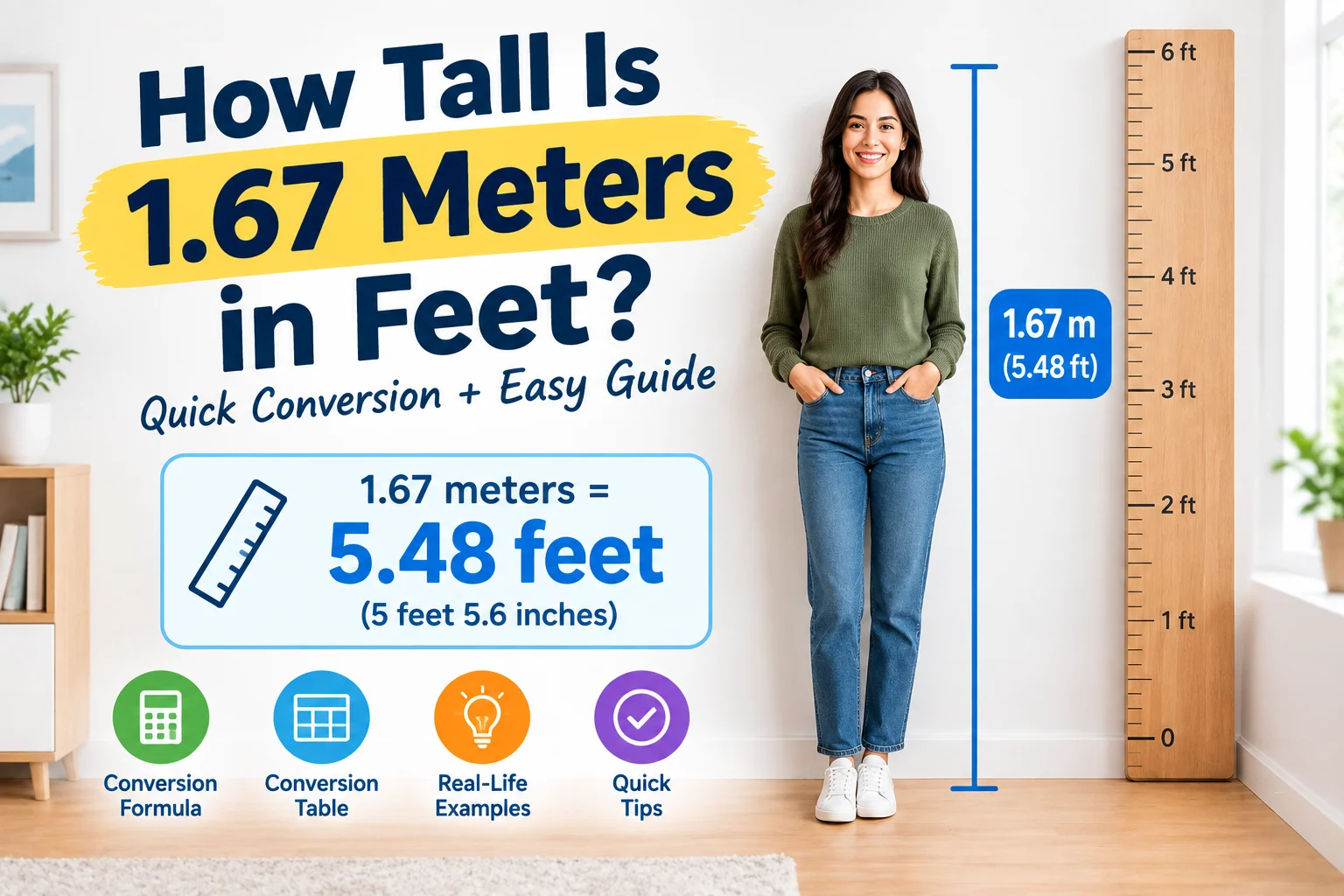
Imagine filling out a U.S. job application, comparing your height with someone who uses centimeters, or shopping for clothing on an American website. You know your height is 1.67 meters, but the form asks for feet and inches. So, how tall is 1.67 meters in feet?
The quick answer is 1.67 meters = 5.48 feet, or approximately 5 feet 5.75 inches. For everyday height descriptions, that is usually rounded to 5 feet 6 inches.
That small difference between a decimal-foot measurement and feet-and-inches notation is important. 5.48 feet does not mean 5 feet 48 inches. The decimal represents a fraction of one foot, which must be multiplied by 12 to find the remaining inches.
This guide explains exactly how the conversion works, why the numbers differ slightly when rounded, and where this measurement matters in real life. You will also find conversion tables, mental-math shortcuts, practical examples, common mistakes, and answers to frequently asked questions.
Whether you’re a student learning unit conversion, a homeowner measuring a space, or simply trying to enter your height correctly, you’ll have a reliable measurement method by the end.
1.67 meters is approximately 5.48 feet.
Expressed in the more familiar U.S. height format:
1.67 meters = 5 feet 5.75 inches ≈ 5 feet 6 inches
The calculation uses the exact relationship between meters and feet:
1 meter = 3.280839895 feet
So:
1.67 × 3.280839895 = 5.4790026 feet
Rounded to two decimal places:
1.67 meters ≈ 5.48 feet
To express the result as feet and inches, keep the whole 5 feet and convert the decimal portion:
0.4790026 × 12 = 5.748 inches
Therefore:
1.67 m = 5 ft 5.748 in
For most everyday purposes, 5 ft 6 in is the convenient rounded answer.
Understanding the Units
Before doing any measurement conversion, it helps to understand what you’re converting.
What Is a Meter?
A meter (m) is the fundamental unit of length in the International System of Units (SI), commonly called the metric system.
One meter contains:
- 100 centimeters
- 1,000 millimeters
- Approximately 39.37 inches
Therefore:
1.67 meters = 167 centimeters = 1,670 millimeters
What Is a Foot?
A foot (ft) is a U.S. customary and imperial length unit. One foot contains exactly 12 inches and equals exactly 0.3048 meters.
Useful conversion relationships include:
- 1 meter = 3.280839895 feet
- 1 foot = 0.3048 meters
- 1 foot = 12 inches
- 1 inch = 2.54 centimeters
The foot is especially common in the United States for describing people’s height, room dimensions, construction measurements, and everyday distances.
Why Height Uses Feet and Inches
In the United States, saying someone is 5 feet 6 inches tall is generally more natural than saying that person is 5.48 feet tall.
Both describe the same physical height, but feet-and-inches notation is the conventional format for personal height.
How Tall Is 1.67 Meters in Feet? Conversion Formula
The standard meters-to-feet conversion formula is:
Feet = Meters × 3.280839895
For 1.67 meters:
Step 1: Convert meters to decimal feet
1.67 × 3.280839895 = 5.4790026 feet
So:
1.67 m ≈ 5.479 feet
Step 2: Separate feet from the decimal
The whole number is 5, so we have:
5 feet + 0.4790026 feet
Step 3: Convert decimal feet to inches
Because one foot contains 12 inches:
0.4790026 × 12 = 5.748 inches
Final Result
1.67 meters = 5 feet 5.748 inches
Rounded to two decimal places:
1.67 meters = 5 ft 5.75 in
Rounded to the nearest inch:
1.67 meters ≈ 5 ft 6 in
This distinction is useful because a conversion calculator may display 5.48 feet while a height chart may display 5’6″. Neither is wrong; they are simply different ways of expressing the same measurement.
1.67 Meters Conversion Table
A nearby-value conversion chart makes it easier to estimate heights without recalculating every time.
| Meters | Feet | Feet & Inches |
|---|---|---|
| 1.60 m | 5.25 ft | 5 ft 3.0 in |
| 1.61 m | 5.28 ft | 5 ft 3.4 in |
| 1.62 m | 5.31 ft | 5 ft 3.8 in |
| 1.63 m | 5.35 ft | 5 ft 4.2 in |
| 1.64 m | 5.38 ft | 5 ft 4.6 in |
| 1.65 m | 5.41 ft | 5 ft 5.0 in |
| 1.66 m | 5.45 ft | 5 ft 5.4 in |
| 1.67 m | 5.48 ft | 5 ft 5.75 in |
| 1.68 m | 5.51 ft | 5 ft 6.1 in |
| 1.69 m | 5.54 ft | 5 ft 6.5 in |
| 1.70 m | 5.58 ft | 5 ft 6.9 in |
| 1.71 m | 5.61 ft | 5 ft 7.3 in |
| 1.72 m | 5.64 ft | 5 ft 7.7 in |
| 1.73 m | 5.68 ft | 5 ft 8.1 in |
| 1.74 m | 5.71 ft | 5 ft 8.5 in |
| 1.75 m | 5.74 ft | 5 ft 8.9 in |
Common Height Conversions
| Height in Meters | Centimeters | Feet & Inches |
|---|---|---|
| 1.50 m | 150 cm | 4 ft 11.1 in |
| 1.55 m | 155 cm | 5 ft 1.0 in |
| 1.60 m | 160 cm | 5 ft 3.0 in |
| 1.65 m | 165 cm | 5 ft 5.0 in |
| 1.67 m | 167 cm | 5 ft 5.75 in |
| 1.70 m | 170 cm | 5 ft 6.9 in |
| 1.75 m | 175 cm | 5 ft 8.9 in |
| 1.80 m | 180 cm | 5 ft 10.9 in |
| 1.85 m | 185 cm | 6 ft 0.8 in |
| 1.90 m | 190 cm | 6 ft 2.8 in |
Practical Examples
Understanding how tall is 1.67 meters in feet becomes more useful when you can apply the conversion to real situations.
Example 1: Entering Height on a U.S. Form
Suppose a form asks for height in feet and inches.
You know your height is 1.67 m.
Using the conversion:
1.67 m = 5 ft 5.75 in
If the form only accepts whole inches, enter:
5 ft 6 in
If it accepts decimal feet instead, enter approximately:
5.48 ft
Example 2: Reverse Conversion
Suppose someone tells you they are 5 feet 6 inches tall and you want to know their height in meters.
First convert feet to inches:
5 × 12 = 60 inches
Add the six inches:
60 + 6 = 66 inches
Convert inches to centimeters:
66 × 2.54 = 167.64 cm
Convert centimeters to meters:
167.64 ÷ 100 = 1.6764 m
So:
5 ft 6 in = 1.6764 m
This rounds to approximately 1.68 m.
Notice that this is slightly taller than 1.67 m. That’s because 1.67 m rounds to about 5 ft 6 in, rather than being exactly 5 ft 6 in.
Example 3: Home Improvement
A homeowner measuring a doorway might record its height as 1.67 meters.
For an American contractor or hardware specification, that becomes approximately:
5 ft 5.75 in
For precise fitting, don’t substitute the rounded 5 ft 6 in measurement. Use the original measurement whenever tolerances matter.
Example 4: Sports and Education
A teacher may give students a metric height of 1.67 m and ask them to convert it to U.S. customary units.
Students can calculate:
1.67 × 3.28084 = 5.479 ft
Then:
0.479 × 12 ≈ 5.75 in
Answer:
5 ft 5.75 in
This is a useful example because it reinforces multiplication, decimals, fractions, and unit relationships.
Common Conversion Mistakes
Even a straightforward measurement conversion can produce errors if the units are handled incorrectly.
Mistake 1: Treating 5.48 Feet as 5 Feet 48 Inches
This is the most common error.
A decimal foot is not an inch measurement.
To convert the decimal portion into inches:
0.48 × 12 ≈ 5.76 inches
So:
5.48 ft ≈ 5 ft 5.76 in
It does not mean 5 ft 48 in.
Mistake 2: Using the Wrong Conversion Factor
For meters to feet, multiply by approximately:
3.28084
For feet to meters, multiply by:
0.3048
Mixing these directions can produce a dramatically incorrect result.
Mistake 3: Rounding Too Early
If you round the intermediate result too aggressively before converting the decimal portion into inches, your final answer can shift slightly.
Keep several decimal places until the final step when precision matters.
Mistake 4: Confusing Centimeters and Meters
167 cm = 1.67 m, but 167 meters would be an enormous distance.
Always check the unit label before entering a value into a measurement calculator.
Expert tip: Keep the original measurement as long as possible. Round only when the final application tells you how much precision is needed.
Quick Mental Conversion Tips
You don’t always need a calculator to estimate a meter-to-feet conversion.
A useful approximation is:
1 meter ≈ 3.28 feet
For 1.67 meters:
1.67 × 3.28 ≈ 5.48 feet
That’s accurate enough for many everyday situations.
For height estimates, remember these reference points:
- 1.60 m ≈ 5 ft 3 in
- 1.65 m ≈ 5 ft 5 in
- 1.67 m ≈ 5 ft 6 in
- 1.70 m ≈ 5 ft 7 in
- 1.75 m ≈ 5 ft 9 in
- 1.80 m ≈ 5 ft 11 in
A Simple Professional Method
When you need a quick but reliable answer:
- Multiply meters by 3.28.
- Keep the whole number as feet.
- Multiply the decimal remainder by 12.
- Round the inches appropriately.
For example:
1.67 × 3.28 = 5.4776 ft
Then:
0.4776 × 12 = 5.7312 in
So the practical result is approximately:
5 ft 5.7 in
This shortcut is excellent for quick estimates, while the exact factor is preferable for technical work.
Comparison Between Meters, Feet, and Inches
Different measurement systems are useful in different situations.
| Unit | Unit Size | Typical Uses | Precision |
|---|---|---|---|
| Meter | 1 m | Science, engineering, international measurements | High |
| Centimeter | 0.01 m | Height, clothing, small dimensions | High |
| Foot | 0.3048 m | U.S. construction, height, room dimensions | Moderate |
| Inch | 0.0254 m | U.S. manufacturing, tools, furniture, height | Fine |
| Millimeter | 0.001 m | Engineering, manufacturing, technical work | Very high |
Metric vs. U.S. Customary Units
The metric system is based on powers of 10, which makes calculations and scaling straightforward.
U.S. customary measurements use relationships such as 12 inches per foot and 3 feet per yard.
Neither system is inherently more accurate. Accuracy depends on the measuring instrument, technique, and precision recorded, not simply on the unit system.
For example, a height recorded as 1.670 m can communicate more measurement precision than a casually rounded 5 ft 6 in.
Why Accurate Measurement Matters
A difference of a few tenths of an inch may seem insignificant when discussing someone’s height. In construction or manufacturing, however, the same difference can determine whether something fits.
Consider a homeowner replacing an interior door. A rough conversion might tell them that a measurement is about 5 ft 6 in, but ordering a component based only on that rounded value could cause problems if the actual opening is 5 ft 5.75 in.
Accurate measurements matter in:
- Construction: Doorways, walls, ceilings, lumber, and fixtures must fit specified dimensions.
- Engineering: Small measurement errors can affect tolerances and system performance.
- Manufacturing: Components often need to fit within narrow dimensional limits.
- Home renovation: Flooring, cabinetry, furniture, and appliances depend on accurate dimensions.
- Education: Students need to understand both the mathematical calculation and the meaning of units.
- DIY projects: Accurate measurements reduce material waste and prevent costly rework.
Practical Case Study
Suppose a DIY homeowner measures a space as 1.67 meters but records the result only as 5 feet 6 inches.
For a casual estimate, that rounding is perfectly reasonable. But if the space is being used to order a precisely sized component, the homeowner should retain the original 1.67 m measurement or its more precise converted equivalent.
The lesson is simple:
Measure first, convert second, round last.
This habit prevents many avoidable measurement errors.
Frequently Asked Questions
How tall is 1.67 meters in feet and inches?
1.67 meters is 5 feet 5.75 inches, or about 5 feet 6 inches when rounded to the nearest whole inch. In decimal form, it is approximately 5.48 feet. The decimal portion of the feet measurement must be multiplied by 12 to express it in inches, which is why 5.48 feet does not mean 5 feet 48 inches.
Is 1.67 meters the same as 5 feet 6 inches?
Not exactly. 1.67 meters equals approximately 5 feet 5.75 inches, while exactly 5 feet 6 inches equals approximately 1.6764 meters. However, when height is rounded to the nearest inch, 1.67 meters is normally described as 5 feet 6 inches. For precise construction, engineering, or manufacturing measurements, use the unrounded value.
What is the easiest way to convert 1.67 meters to feet?
The easiest method is to multiply the meter measurement by 3.28084. For example, 1.67 × 3.28084 = 5.479 feet. If you need feet and inches, keep the whole 5 feet and multiply the decimal portion, 0.479, by 12. That gives approximately 5.75 inches, producing 5 ft 5.75 in.
Can I convert 1.67 meters to feet without a calculator?
Yes. For a quick estimate, use 1 meter ≈ 3.28 feet. Then calculate 1.67 × 3.28 ≈ 5.48 feet. To turn the decimal portion into inches, calculate 0.48 × 12 ≈ 5.76 inches. This gives approximately 5 feet 5.8 inches, which rounds to 5 feet 6 inches. Mental conversion is useful for estimates, but use the exact factor for technical measurements.
Is the meter-to-foot conversion exact?
Yes. The relationship between meters and feet is exact because 1 foot is defined as exactly 0.3048 meter. Consequently, one meter equals exactly 3.2808398950131 feet. The apparent uncertainty comes from rounding the displayed answer, not from the underlying relationship between the units. Therefore, 1.67 meters has an exact mathematical conversion even when the result is displayed as 5.48 feet.
How many inches is 1.67 meters?
1.67 meters equals approximately 65.75 inches. Since 1.67 meters is 167 centimeters and one inch equals exactly 2.54 centimeters, the calculation is 167 ÷ 2.54 = 65.748 inches. Rounded to two decimal places, the result is 65.75 inches. In feet-and-inches notation, this is approximately 5 feet 5.75 inches.
What formula should I remember for meters to feet?
Remember:
Feet = Meters × 3.28084
For the reverse conversion:
Meters = Feet × 0.3048
If you need feet and inches, first calculate decimal feet. Then take the decimal portion and multiply it by 12 to obtain inches. This two-step process prevents the common mistake of interpreting decimal feet as though the decimal were already an inch measurement.
Why is converting 1.67 meters to feet useful?
The conversion is useful whenever metric and U.S. customary measurements meet. Examples include entering height on U.S. forms, comparing international sports statistics, buying clothing, interpreting product dimensions, working on home-improvement projects, and teaching measurement. Knowing how to convert units also helps you verify results rather than relying blindly on a conversion calculator.
Which industries use meters and feet?
Both systems appear across many industries. Construction in the United States frequently uses feet and inches, while engineering, science, manufacturing, and international specifications commonly use metric units. Sports, aviation, architecture, and manufacturing may use either system depending on the country, organization, or technical standard involved. Being able to convert between units makes specifications easier to interpret and reduces costly measurement misunderstandings.
Final Thoughts: How Tall Is 1.67 Meters in Feet?
So, how tall is 1.67 meters in feet?
The exact decimal conversion is:
1.67 meters = 5.4790026 feet
For practical use:
1.67 meters ≈ 5.48 feet
And in feet-and-inches height notation:
1.67 meters ≈ 5 feet 5.75 inches
For everyday forms and conversations, you can generally round that to 5 feet 6 inches.
The key formula to remember is:
Feet = Meters × 3.280839895
And when converting decimal feet into inches:
Inches = Decimal Feet × 12
The most important measurement lesson is not simply memorizing one answer. It is understanding the conversion process so you can calculate measurements, check a conversion chart, and move confidently between metric and U.S. customary units.
Explore More Measurement Conversions
If you regularly work with measurements, explore more guides covering length conversion, weight conversion, volume conversion, measurement calculators, and unit conversion formulas. Learning the relationships between common units makes everyday calculations faster, easier, and more accurate.
How Many Feet in 60 in? Easy Inches to Feet Conversion Guide








1 thought on “How Tall Is 1.67 Meters in Feet?”