If you’re ordering mulch for a garden, estimating concrete for a project, calculating soil for a raised bed, or checking a landscaping quote, you may suddenly wonder: how many cubic feet are in 1 yard?
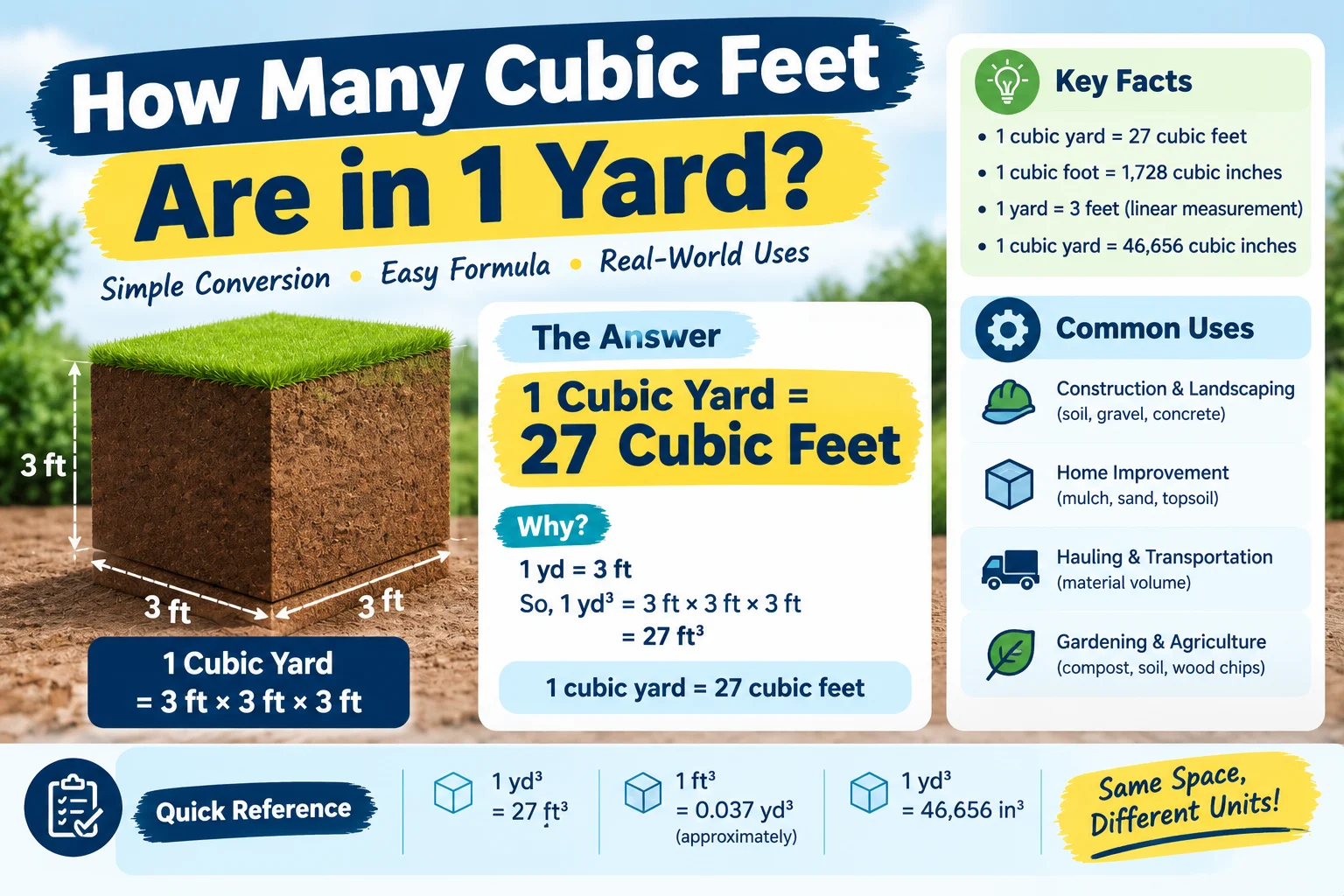
The quick answer is 27 cubic feet in 1 cubic yard.
That number is easy to remember, but there is an important detail that often causes confusion: a cubic yard measures volume, while a yard by itself usually describes length. One yard equals 3 feet, but one cubic yard is 3 feet × 3 feet × 3 feet, which gives 27 cubic feet.
This distinction matters when buying materials sold by the cubic yard. A supplier may tell you that you need 2 cubic yards of mulch, for example. To understand how much physical volume that represents, you can multiply 2 by 27 to get 54 cubic feet.
In this measurement guide, you’ll learn the conversion formula, see practical examples, explore useful conversion tables, and learn how to avoid common mistakes when working with cubic feet and cubic yards.
1 cubic yard = 27 cubic feet.
The conversion comes from the fact that:
- 1 yard = 3 feet
- A cubic yard has three dimensions: length, width, and height
- Therefore: 3 ft × 3 ft × 3 ft = 27 cubic feet
Key conversion: 1 yd³ = 27 ft³
If you’re converting cubic yards to cubic feet, multiply the number of cubic yards by 27.
Formula:
Cubic feet = cubic yards × 27
For example:
4 cubic yards × 27 = 108 cubic feet
So, 4 cubic yards is equal to 108 cubic feet.
Understanding the Units
Before calculating measurements, it helps to understand exactly what these units represent.
A yard (yd) is a unit of length in the U.S. customary system. It equals:
1 yard = 3 feet = 36 inches
A cubic foot (ft³) measures volume. Imagine a box that is 1 foot long, 1 foot wide, and 1 foot high. Its volume is 1 cubic foot.
A cubic yard (yd³) is a larger unit of volume. Imagine a cube measuring 1 yard—or 3 feet—on every side:
3 ft × 3 ft × 3 ft = 27 ft³
The U.S. customary system uses feet, yards, inches, gallons, pounds, and related units in many everyday applications. Metric units such as meters and cubic meters are more common in most of the world.
An important distinction
The phrase “1 yard” can be misleading in a question about cubic feet.
- 1 linear yard = 3 linear feet
- 1 cubic yard = 27 cubic feet
You cannot convert a single linear yard into cubic feet because volume requires three dimensions.
For example, a board that is 1 yard long could be 2 inches wide and 1 inch thick—or 12 inches wide and 12 inches thick. Both are 1 yard long, but their volumes are completely different.
How Many Cubic Feet Are in 1 Yard? Conversion Formula
The conversion formula is straightforward:
1 cubic yard = 27 cubic feet
Why 27?
Start with the basic length conversion:
1 yard = 3 feet
Because volume has three dimensions, cube the conversion factor:
1 yd³ = 3 ft × 3 ft × 3 ft
1 yd³ = 27 ft³
Therefore:
1 cubic yard = 27 cubic feet
Step-by-step calculation
Suppose you have 6 cubic yards of topsoil.
Step 1: Start with the quantity.
6 yd³
Step 2: Multiply by 27.
6 × 27 = 162
Step 3: Add the volume unit.
6 yd³ = 162 ft³
Reverse conversion
To convert cubic feet back into cubic yards, divide by 27.
Formula:
Cubic yards = cubic feet ÷ 27
For example:
81 ft³ ÷ 27 = 3 yd³
So, 81 cubic feet equals 3 cubic yards.
Cubic Yard to Cubic Feet Conversion Table
Use this conversion chart for common quantities.
| Cubic Yards | Cubic Feet |
|---|---|
| 0.25 yd³ | 6.75 ft³ |
| 0.5 yd³ | 13.5 ft³ |
| 0.75 yd³ | 20.25 ft³ |
| 1 yd³ | 27 ft³ |
| 1.5 yd³ | 40.5 ft³ |
| 2 yd³ | 54 ft³ |
| 3 yd³ | 81 ft³ |
| 4 yd³ | 108 ft³ |
| 5 yd³ | 135 ft³ |
| 10 yd³ | 270 ft³ |
This table is particularly useful when comparing a supplier’s cubic-yard price with the capacity of a truck, trailer, container, or storage area measured in cubic feet.
Practical Examples of Cubic Yard Conversions
The conversion becomes much more useful when you see how it works in real situations.
Example 1: Basic conversion
You have 2 cubic yards of mulch.
Use the conversion formula:
2 × 27 = 54
Therefore:
2 cubic yards = 54 cubic feet
Example 2: Decimal conversion
Suppose you need 1.5 cubic yards of gravel.
1.5 × 27 = 40.5
Therefore:
1.5 yd³ = 40.5 ft³
Decimals work exactly the same way as whole numbers.
Example 3: Reverse conversion
A storage container holds 108 cubic feet. How many cubic yards is that?
108 ÷ 27 = 4
Therefore:
108 ft³ = 4 yd³
Example 4: Landscaping
Imagine a landscaping bed that is 20 feet long, 6 feet wide, and 4 inches deep.
First convert 4 inches to feet:
4 ÷ 12 = 0.3333 ft
Now calculate the volume:
20 × 6 × 0.3333 ≈ 40 ft³
Convert cubic feet to cubic yards:
40 ÷ 27 ≈ 1.48 yd³
You would therefore need approximately 1.5 cubic yards of material, allowing for practical purchasing and settling considerations.
Example 5: Construction material
A concrete form has a volume of 216 cubic feet.
To find cubic yards:
216 ÷ 27 = 8
So the form has a volume of 8 cubic yards.
In real construction work, additional considerations such as waste, site conditions, reinforcement, and material specifications may affect the final quantity ordered.
Common Conversion Mistakes
Cubic measurements are simple once the dimensions are understood, but several mistakes appear repeatedly.
1. Confusing a yard with a cubic yard
This is the biggest error.
1 yard = 3 feet, but 1 cubic yard = 27 cubic feet.
The word “cubic” changes the measurement from length to volume.
2. Multiplying by 3 instead of 27
Someone may see that a yard equals 3 feet and conclude that 1 cubic yard equals 3 cubic feet.
That’s incorrect because volume has three dimensions.
The correct calculation is:
3 × 3 × 3 = 27
3. Using the wrong direction of conversion
When converting cubic yards to cubic feet, multiply by 27.
When converting cubic feet to cubic yards, divide by 27.
A useful memory rule is:
- Small unit → larger number: multiply
- Large unit → smaller number: divide
4. Mixing inches and feet
If you’re calculating the volume of a physical space, all dimensions should use the same unit before multiplying.
For example, don’t multiply feet by inches without first converting them.
5. Rounding too early
Keep decimals during intermediate calculations and round near the end. Early rounding can create noticeable differences in material estimates.
Expert tip: For material orders, distinguish between the mathematically calculated volume and the quantity you actually need to purchase. Compaction, settling, waste, and uneven surfaces can require additional material.
Quick Mental Conversion Tips
You don’t always need a calculator.
The easiest number to memorize is:
1 cubic yard = 27 cubic feet
From there, you can build other conversions mentally.
Multiply by 27
For 2 cubic yards:
27 + 27 = 54 ft³
For 3 cubic yards:
54 + 27 = 81 ft³
For 5 cubic yards:
27 × 5 = 135 ft³
Break 27 into easier numbers
For 8 cubic yards:
8 × 27 = 8 × (30 − 3)
240 − 24 = 216 ft³
Memorize the reverse relationship
Because 27 cubic feet make one cubic yard:
27 ft³ = 1 yd³
54 ft³ = 2 yd³
81 ft³ = 3 yd³
108 ft³ = 4 yd³
This makes common construction and landscaping calculations much faster.
Professional calculation method
For repeated work, use a consistent three-step process:
- Put every dimension into the same unit.
- Calculate volume using length × width × height.
- Convert the resulting volume using the appropriate conversion factor.
This method reduces errors and makes your work easy to check.
Comparison Between the Units
| Measurement | Size | What It Measures | Typical Uses | Precision |
|---|---|---|---|---|
| Inch | 1/36 yard | Length | Small dimensions, hardware, woodworking | High for small measurements |
| Foot | 1/3 yard | Length | Rooms, construction, furniture | Common everyday unit |
| Yard | 3 feet | Length | Fabric, landscaping dimensions, sports fields | Useful for larger lengths |
| Cubic foot | 1 ft × 1 ft × 1 ft | Volume | Storage, appliances, construction | Useful for moderate volumes |
| Cubic yard | 3 ft × 3 ft × 3 ft | Volume | Soil, mulch, gravel, concrete | Efficient for bulk materials |
The key point is that yard and cubic yard are not interchangeable. One measures distance; the other measures volume.
Why Accurate Measurement Matters
Accurate measurement is more than a classroom exercise. It can save money, materials, time, and labor.
Construction
Contractors frequently work with cubic feet and cubic yards when estimating concrete, aggregate, excavation, fill, and other bulk materials.
A small conversion error can become significant when quantities increase.
Engineering and manufacturing
Engineers need consistent units when calculating volume, capacity, material requirements, and specifications. Mixing measurement systems without proper conversion can produce incorrect results.
Home renovation
Homeowners may encounter cubic measurements when buying insulation, soil, gravel, mulch, storage containers, or other materials.
Knowing the conversion helps you compare quantities instead of relying solely on supplier descriptions.
Education
Students can use the relationship between cubic yards and cubic feet to understand how dimensional conversions work.
It also demonstrates an important mathematical principle: when a unit is cubed, the conversion factor must be cubed as well.
Realistic case study
Imagine a homeowner needs 3 cubic yards of mulch.
A supplier describes its delivery in cubic feet, so the homeowner needs to verify the quantity.
Using the formula:
3 yd³ × 27 = 81 ft³
The order represents 81 cubic feet of mulch.
If the homeowner accidentally multiplies by 3 instead, they would calculate only 9 cubic feet—just one-third of the correct volume.
This illustrates why understanding the underlying conversion is more reliable than simply memorizing a number without understanding it.
Common Values: Cubic Yards, Cubic Feet, and Cubic Inches
Here are several useful reference points.
| Cubic Yards | Cubic Feet | Cubic Inches |
|---|---|---|
| 0.25 | 6.75 | 11,664 |
| 0.5 | 13.5 | 23,328 |
| 1 | 27 | 46,656 |
| 2 | 54 | 93,312 |
| 3 | 81 | 139,968 |
| 5 | 135 | 233,280 |
| 10 | 270 | 466,560 |
The cubic-inch figures can look surprisingly large because one cubic foot contains 1,728 cubic inches, and a cubic yard contains 27 cubic feet.
Frequently Asked Questions
How many cubic feet are in 1 yard?
If by “yard” you mean 1 cubic yard, there are exactly 27 cubic feet. The calculation is 3 feet × 3 feet × 3 feet = 27 cubic feet. However, if you mean 1 linear yard, the answer is different: one linear yard is simply 3 feet of length and cannot be converted to cubic feet without knowing the width and height or depth.
What is the easiest way to convert cubic yards to cubic feet?
The easiest method is to multiply cubic yards by 27. The formula is cubic feet = cubic yards × 27. For example, 4 cubic yards × 27 = 108 cubic feet. For the reverse conversion, divide cubic feet by 27. Keeping these two operations straight makes most everyday volume conversions quick and reliable.
Can I convert cubic yards to cubic feet without a calculator?
Yes. The main number to remember is 27. One cubic yard equals 27 cubic feet. For common whole numbers, mental multiplication is easy: 2 yards is 54 cubic feet, 3 yards is 81 cubic feet, and 5 yards is 135 cubic feet. For awkward decimal quantities, a calculator can help avoid arithmetic or rounding mistakes.
Why is 1 cubic yard equal to 27 cubic feet?
Because one yard equals three feet, and a cubic measurement has three dimensions. You therefore multiply the conversion factor three times: 3 × 3 × 3 = 27. This is why you cannot simply multiply by 3 when converting cubic yards to cubic feet. The unit is cubed, so the length conversion factor must also be cubed.
Is the conversion from cubic yards to cubic feet exact?
Yes. 1 cubic yard is exactly 27 cubic feet. There is no rounding involved in this conversion because the relationship comes directly from the exact definition of the yard as 3 feet. Rounding only becomes relevant when you calculate a physical volume from measurements that themselves contain decimals or when estimating how much material to purchase.
What formula should I remember for cubic yard conversions?
Remember two formulas: cubic feet = cubic yards × 27, and cubic yards = cubic feet ÷ 27. If you’re starting with a physical space, first calculate its volume using length × width × height. Make sure all dimensions use the same unit before calculating, then apply the appropriate conversion formula.
Why is this conversion important for landscaping?
Landscaping materials such as mulch, soil, compost, gravel, and some aggregates are commonly sold by the cubic yard. Knowing that one cubic yard equals 27 cubic feet allows you to compare a material order with the volume of your garden bed or project area. It also helps you check supplier quantities and estimate whether a delivery is sufficient.
Can a linear yard be converted directly into cubic feet?
No. A linear yard measures length, while cubic feet measure volume. One linear yard equals 3 linear feet, but you need three dimensions to calculate volume. For example, if something is 1 yard long, 2 feet wide, and 1 foot deep, its volume is 3 × 2 × 1 = 6 cubic feet. Without width and depth, the volume cannot be determined.
Which industries commonly use cubic feet and cubic yards?
Cubic feet and cubic yards are widely used in construction, landscaping, excavation, concrete work, agriculture, manufacturing, shipping, storage, and home improvement. Cubic feet are useful for smaller volumes, while cubic yards are particularly convenient for bulk materials such as soil, mulch, gravel, sand, and concrete. The exact unit used depends on the industry and size of the project.
Final Thoughts
So, how many cubic feet are in 1 yard?
If you mean 1 cubic yard, the answer is:
1 cubic yard = 27 cubic feet
The conversion formula is simple:
Cubic feet = cubic yards × 27
And for the reverse:
Cubic yards = cubic feet ÷ 27
The most important thing to remember is the difference between a linear yard and a cubic yard. A linear yard measures distance, while a cubic yard measures volume. That distinction prevents many of the mistakes people make when estimating materials.
Whether you’re calculating mulch for a garden, checking a construction estimate, planning a renovation, or learning measurement conversions in class, understanding why the number is 27 makes the calculation much easier to remember.
Ready to calculate more measurements?
Use this conversion principle as a foundation for other U.S. customary units, including length, area, weight, and volume conversions. Once you understand how dimensional units work, even unfamiliar measurement problems become much easier to solve.
How Many Feet in 60 in? Easy Inches to Feet Conversion Guide