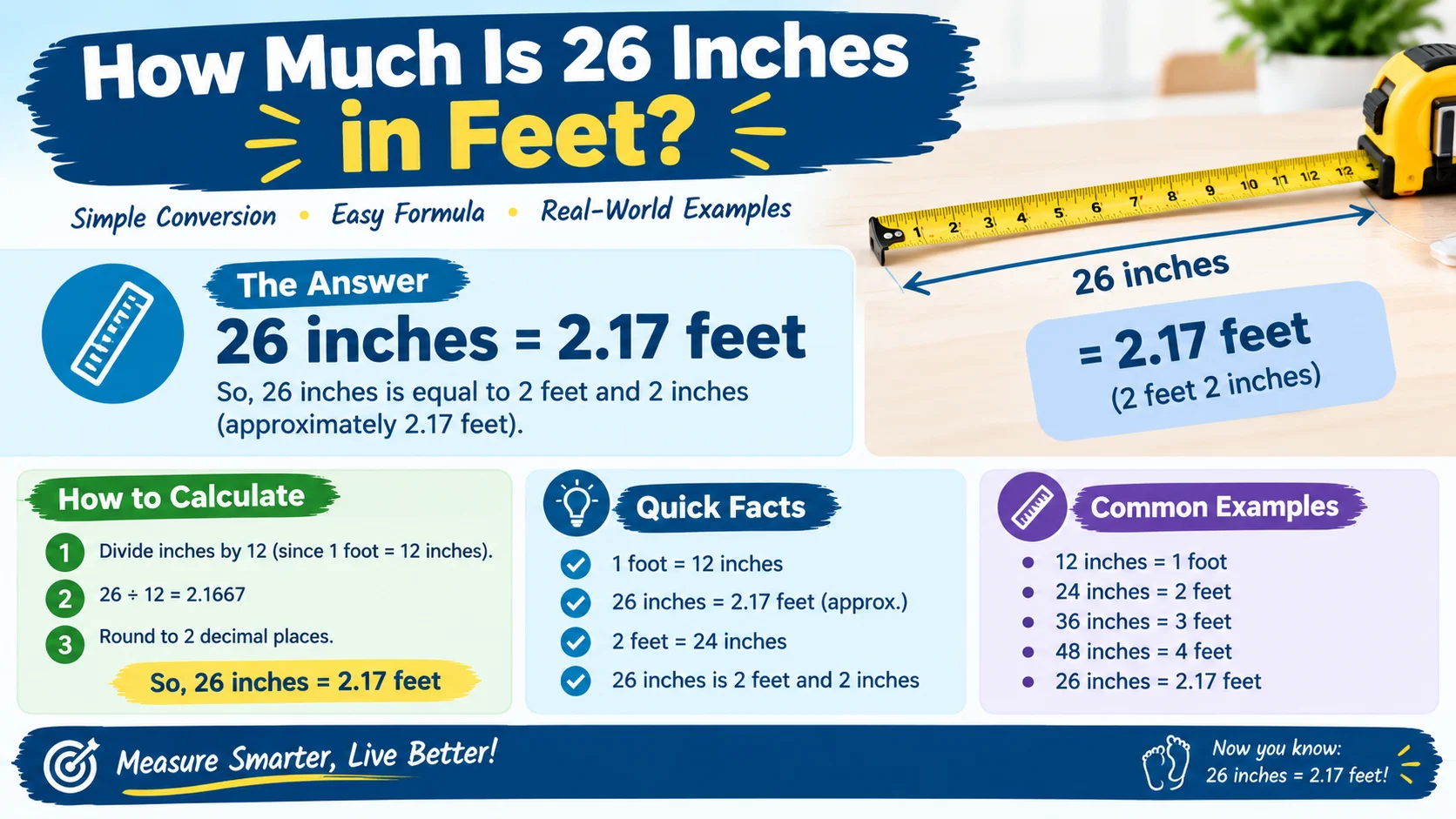
Imagine you are measuring a piece of lumber, checking whether a television will fit on a shelf, or trying to understand a product’s dimensions. The measurement says 26 inches, but your project is working in feet. So, how much is 26 inches in feet?
The quick answer is 26 inches = 2.1667 feet, or approximately 2 feet 2 inches.
This is a straightforward length conversion because there are exactly 12 inches in 1 foot. To convert inches to feet, simply divide the number of inches by 12:
26 ÷ 12 = 2.1667 feet
For everyday measurements, the mixed-unit form—2 feet 2 inches—is often easier to visualize. The decimal form, 2.1667 feet, is more convenient for calculations, construction plans, engineering, and measurement calculators.
In this guide, you’ll learn exactly how the conversion works, why the formula is correct, how to convert the answer back to inches, and where a measurement of 26 inches commonly appears in real life. You’ll also find useful conversion charts, practical examples, expert tips, and FAQs to make future unit conversions much easier.
1. Quick Answer: How Much Is 26 Inches in Feet?
26 inches is equal to 2.1667 feet.
The exact calculation is:
26 inches ÷ 12 inches per foot = 2.166666… feet
Rounded to four decimal places:
26 inches = 2.1667 feet
It can also be expressed as:
26 inches = 2 feet 2 inches
Quick conversion
| Measurement | Equivalent |
|---|---|
| 26 inches | 2.1667 feet |
| 26 inches | 2 feet 2 inches |
| 26 inches | 66.04 centimeters |
| 26 inches | 0.7222 yards |
The conversion from inches to feet is exact when written as a fraction:
26 inches = 13/6 feet
The decimal 2.1667 feet is simply the rounded version.
2. Understanding the Units Behind 26 Inches in Feet
Before performing any measurement conversion, it helps to understand the units involved.
What is an inch?
An inch (in) is a unit of length used primarily in the United States and a few other countries. It is commonly used for relatively small dimensions, such as:
- Screen sizes
- Furniture dimensions
- Building materials
- Clothing measurements
- Hardware
- Paper and packaging
- Rulers and tape measures
What is a foot?
A foot (ft) is a larger unit of length in the U.S. customary system.
One foot contains exactly:
1 foot = 12 inches
Therefore:
1 inch = 1/12 foot
This fixed relationship makes inch-to-foot conversion particularly simple.
U.S. customary units and metric units
The United States commonly uses inches, feet, yards, and miles for everyday length measurements. The metric system, meanwhile, uses millimeters, centimeters, meters, and kilometers.
For reference:
1 inch = 2.54 centimeters exactly
Therefore:
26 inches × 2.54 = 66.04 centimeters
So 26 inches is also 66.04 cm.
3. How Much Is 26 Inches in Feet? Conversion Formula
The standard conversion formula for inches to feet is:
Feet = Inches ÷ 12
Why divide by 12? Because one foot contains exactly 12 inches. Dividing a measurement expressed in inches into groups of 12 tells you how many feet it represents.
Step-by-step calculation
To calculate 26 inches in feet:
Step 1: Start with the measurement.
26 inches
Step 2: Divide by the number of inches in one foot.
26 ÷ 12
Step 3: Calculate.
26 ÷ 12 = 2.166666…
Step 4: Round if necessary.
≈ 2.1667 feet
Therefore:
26 inches = 2.1667 feet
Example: Convert 18 inches
18 ÷ 12 = 1.5 feet
So:
18 inches = 1.5 feet
Example: Convert 36 inches
36 ÷ 12 = 3 feet
So:
36 inches = 3 feet
Example: Convert 50 inches
50 ÷ 12 = 4.1667 feet
So:
50 inches ≈ 4.1667 feet
The same formula works for virtually any inch-to-foot measurement.
4. 26 Inches in Feet: Conversion Table
A small conversion chart can be faster than repeatedly performing calculations.
| Inches | Feet | Feet & Inches |
|---|---|---|
| 12 in | 1 ft | 1 ft |
| 13 in | 1.0833 ft | 1 ft 1 in |
| 18 in | 1.5000 ft | 1 ft 6 in |
| 20 in | 1.6667 ft | 1 ft 8 in |
| 24 in | 2.0000 ft | 2 ft |
| 26 in | 2.1667 ft | 2 ft 2 in |
| 30 in | 2.5000 ft | 2 ft 6 in |
| 36 in | 3.0000 ft | 3 ft |
| 48 in | 4.0000 ft | 4 ft |
| 60 in | 5.0000 ft | 5 ft |
| 72 in | 6.0000 ft | 6 ft |
For measurements that will be entered into a spreadsheet, calculator, CAD program, or mathematical equation, use 2.1667 feet when four decimal places are appropriate.
For a tape measure or everyday conversation, 2 feet 2 inches is usually more intuitive.
5. Practical Examples of 26 Inches in Feet
Knowing the formula is useful, but understanding where the conversion appears in everyday life makes it easier to remember.
Construction and home improvement
Suppose a contractor needs a board that is 26 inches long but the project specifications are written in feet.
The calculation is:
26 ÷ 12 = 2.1667 feet
The contractor can record the dimension as 2.1667 ft or, when working directly with a tape measure, simply mark 2 ft 2 in.
Interior design
A shelf may be advertised as 26 inches deep.
If a room layout uses feet, the depth is:
26 inches = 2.1667 feet
This makes it easier to compare the shelf with a space described in feet.
Education
A teacher might ask students to convert 26 inches to feet as an exercise in fractions and decimals.
The solution is:
26/12 = 13/6 = 2 1/6 feet
This demonstrates that a measurement does not have to produce a whole number of feet.
Shopping
Furniture, appliances, televisions, mirrors, and other household products may list dimensions in inches. Converting those measurements to feet can make the size easier to visualize in a room.
Manufacturing
Manufacturing drawings can use decimal feet when dimensions need to be incorporated into calculations. Converting consistently prevents errors when different documents use different units.
6. Common Conversion Mistakes
Inches-to-feet conversion is simple, but small mistakes can produce surprisingly large problems in construction and other precision work.
Mistake 1: Multiplying instead of dividing
A common error is:
26 × 12 = 312
That is not the answer to an inches-to-feet conversion.
Multiplication by 12 converts feet to inches. Conversion in the opposite direction requires division.
Inches → feet: divide by 12
Feet → inches: multiply by 12
Mistake 2: Treating 26 inches as 2.6 feet
The number of inches does not translate directly into a decimal by moving the decimal point.
26 inches ≠ 2.6 feet
The correct value is approximately 2.1667 feet.
Mistake 3: Confusing decimal feet with feet-and-inches
This is especially important in construction.
2.5 feet means 2 feet 6 inches, not 2 feet 5 inches.
A decimal portion of a foot must be multiplied by 12 to determine its equivalent in inches.
Mistake 4: Rounding too early
Using 2.17 feet instead of 2.1667 feet may be perfectly acceptable for a rough estimate, but unnecessary rounding can cause cumulative errors in detailed projects.
Expert measurement tips
- Keep the original measurement until the final calculation.
- Write the units beside your numbers.
- Use a consistent rounding rule throughout a project.
- For physical work, verify important dimensions with the actual measuring tool.
- Never assume a decimal foot equals the same number of inches after the decimal point.
7. Quick Mental Conversion Tips for 26 Inches in Feet
You don’t always need a calculator.
The most useful fact to memorize is:
12 inches = 1 foot
For 26 inches, identify the nearest complete group of 12:
24 inches = 2 feet
That leaves:
26 − 24 = 2 inches
Therefore:
26 inches = 2 feet 2 inches
To convert that into decimal feet, convert the remaining 2 inches into a fraction of a foot:
2 ÷ 12 = 0.1667
Then add it to the two complete feet:
2 + 0.1667 = 2.1667 feet
A useful shortcut
For any inch measurement:
- Divide the inches by 12.
- The whole number is the number of complete feet.
- Multiply the decimal remainder by 12 to recover the remaining inches.
For 26 inches:
26 ÷ 12 = 2.1667
The whole-number portion is 2 feet.
The remaining portion represents 2 inches.
Common values worth memorizing
| Inches | Feet |
|---|---|
| 6 in | 0.5 ft |
| 12 in | 1 ft |
| 18 in | 1.5 ft |
| 24 in | 2 ft |
| 30 in | 2.5 ft |
| 36 in | 3 ft |
| 48 in | 4 ft |
| 60 in | 5 ft |
| 72 in | 6 ft |
Remembering 12, 24, 36, 48, and 60 inches gives you useful reference points for many everyday calculations.
8. Comparing Inches and Feet
Inches and feet measure the same physical quantity—length—but they are useful at different scales.
| Feature | Inches | Feet |
|---|---|---|
| Basic relationship | 12 inches = 1 foot | 1 foot = 12 inches |
| Best for | Smaller dimensions | Larger dimensions |
| Typical symbol | in | ft |
| Common uses | Furniture, hardware, screens, small objects | Rooms, buildings, height, lumber |
| Precision | Convenient for fine measurements | Convenient for larger measurements |
| U.S. customary system | Yes | Yes |
| Metric equivalent | 1 in = 2.54 cm | 1 ft = 30.48 cm |
Neither unit is inherently more accurate than the other. Accuracy depends on the measuring instrument, the number of decimal places used, and how carefully the measurement is taken.
For example, saying 26 inches and 2 feet 2 inches describes exactly the same length.
Decimal feet vs. feet and inches
These formats are interchangeable but serve different purposes:
- 2.1667 ft — useful for calculations.
- 2 ft 2 in — useful for practical measuring.
- 26 in — useful when the original specification is in inches.
Choosing the right format can make a project easier to understand and less prone to errors.
9. Why Accurate Measurement Matters
A measurement may look small on paper, but an error can become expensive when repeated across a project.
Consider a homeowner installing a built-in shelf. The available opening is 26 inches wide. The homeowner converts that to approximately 2.17 feet for a design plan.
If the designer mistakenly interprets 2.17 feet as 2 feet 17 inches, the resulting shelf would be dramatically oversized.
This illustrates an important measurement principle:
Always distinguish between decimal measurements and mixed-unit measurements.
Accurate conversions matter in:
- Construction: Incorrect dimensions can result in improperly cut materials.
- Engineering: Unit inconsistencies can compromise calculations and specifications.
- Manufacturing: Small dimensional errors may affect whether components fit together.
- Home renovation: Flooring, cabinetry, shelving, and countertops depend on accurate dimensions.
- Education: Correct unit conversion is a foundation for more advanced mathematics and science.
- DIY projects: Consistent measurements reduce material waste and rework.
A professional approach
For important projects, use this simple workflow:
- Measure the physical object carefully.
- Record the original unit.
- Write the conversion formula.
- Perform the calculation.
- Check the result using the reverse conversion.
- Round only at the appropriate stage.
This takes very little time and can prevent costly mistakes.
10. Final Thoughts: How Much Is 26 Inches in Feet?
So, how much is 26 inches in feet?
The answer is:
26 inches = 2.1667 feet, approximately.
In everyday feet-and-inches notation:
26 inches = 2 feet 2 inches
The essential conversion formula is:
Feet = Inches ÷ 12
For 26 inches:
26 ÷ 12 = 2.1667 feet
The most important thing to remember is that 12 inches make one foot. Once that relationship is familiar, converting inches to feet becomes quick mental math rather than a complicated calculation.
Whether you’re working on a home improvement project, checking furniture dimensions, studying mathematics, or reading a technical specification, choosing the right unit—and converting it correctly—helps ensure that everyone is working from the same measurement.
Frequently Asked Questions
1. How much is 26 inches in feet exactly?
26 inches equals 13/6 feet, or 2.166666… feet. If rounded to four decimal places, the result is 2.1667 feet. In feet-and-inches notation, it is exactly 2 feet 2 inches. The fractional form is exact, while the decimal version is normally rounded for practical use.
2. What is the easiest way to convert 26 inches to feet?
The easiest method is to divide 26 by 12, because there are exactly 12 inches in one foot. The calculation is 26 ÷ 12 = 2.1667 feet. If you’re working with a physical tape measure, another easy approach is to recognize that 24 inches equals 2 feet, leaving 2 inches. Therefore, 26 inches is 2 feet 2 inches.
3. Can I convert 26 inches to feet without a calculator?
Yes. Since 24 inches equals 2 feet, subtract 24 from 26 and you have 2 inches remaining. That gives 2 feet 2 inches. To express it as decimal feet, convert the remaining 2 inches into a fraction: 2 ÷ 12 = 0.1667. Add that to 2 feet to get approximately 2.1667 feet.
4. Is the conversion from inches to feet exact?
Yes. The relationship 12 inches = 1 foot is exact in the U.S. customary system. Therefore, 26 inches is exactly 13/6 feet. The decimal 2.1667 feet is rounded, because the exact decimal continues indefinitely as 2.166666…. For practical measurements, the rounded value is usually sufficient.
5. What formula should I remember for converting inches to feet?
Remember this simple conversion formula:
Feet = Inches ÷ 12
To convert in the opposite direction:
Inches = Feet × 12
For example, 26 inches becomes 26 ÷ 12 = 2.1667 feet, while 2 feet becomes 2 × 12 = 24 inches.
6. Why is converting 26 inches to feet useful?
The conversion is useful whenever measurements are recorded in different units. Furniture, building materials, room dimensions, product specifications, and technical drawings may use inches or feet. Converting them lets you compare dimensions consistently. It is particularly helpful for homeowners, contractors, students, designers, manufacturers, and anyone who needs to calculate measurements accurately.
7. How many centimeters are in 26 inches?
There are 66.04 centimeters in 26 inches. The calculation uses the exact relationship 1 inch = 2.54 centimeters:
26 × 2.54 = 66.04 cm
This is useful when converting between U.S. customary units and metric measurements, particularly when product specifications or technical information use centimeters rather than inches.
8. Is 2.1667 feet the same as 2 feet 2 inches?
Yes, approximately. 2 feet 2 inches is exactly equal to 2.166666… feet, while 2.1667 feet is the value rounded to four decimal places. For everyday physical measurements, 2 feet 2 inches is usually easier to interpret. For mathematical calculations, engineering data, or spreadsheets, decimal feet may be more convenient.
9. What industries commonly use inch-to-foot conversions?
Inch-to-foot conversions are common in construction, engineering, manufacturing, architecture, interior design, furniture, woodworking, and education. Contractors often work with both inches and feet on plans and measuring tapes, while engineers and manufacturers may need decimal measurements for calculations and specifications.
Key Takeaways
- 26 inches = 2.1667 feet when rounded to four decimal places.
- 26 inches = 2 feet 2 inches exactly.
- The conversion formula is feet = inches ÷ 12.
- There are exactly 12 inches in 1 foot.
- For reverse conversion, multiply feet by 12.
- Decimal feet and feet-and-inches notation represent the same physical length when converted correctly.
- For important projects, always check units before calculating or cutting materials.
Ready to convert another measurement? Explore more practical length conversion, weight conversion, and volume conversion guides to make everyday unit conversion faster, easier, and more accurate.
How Many Square Feet in a Quarter of an Acre?