Imagine you’re planning a two-mile walking route, measuring the distance between two properties, or checking a construction plan. Someone gives you the distance in miles, but your tape measure, project estimate, or worksheet uses feet. Suddenly, a simple distance needs a quick measurement conversion.
So, how many feet are in 2 mi?
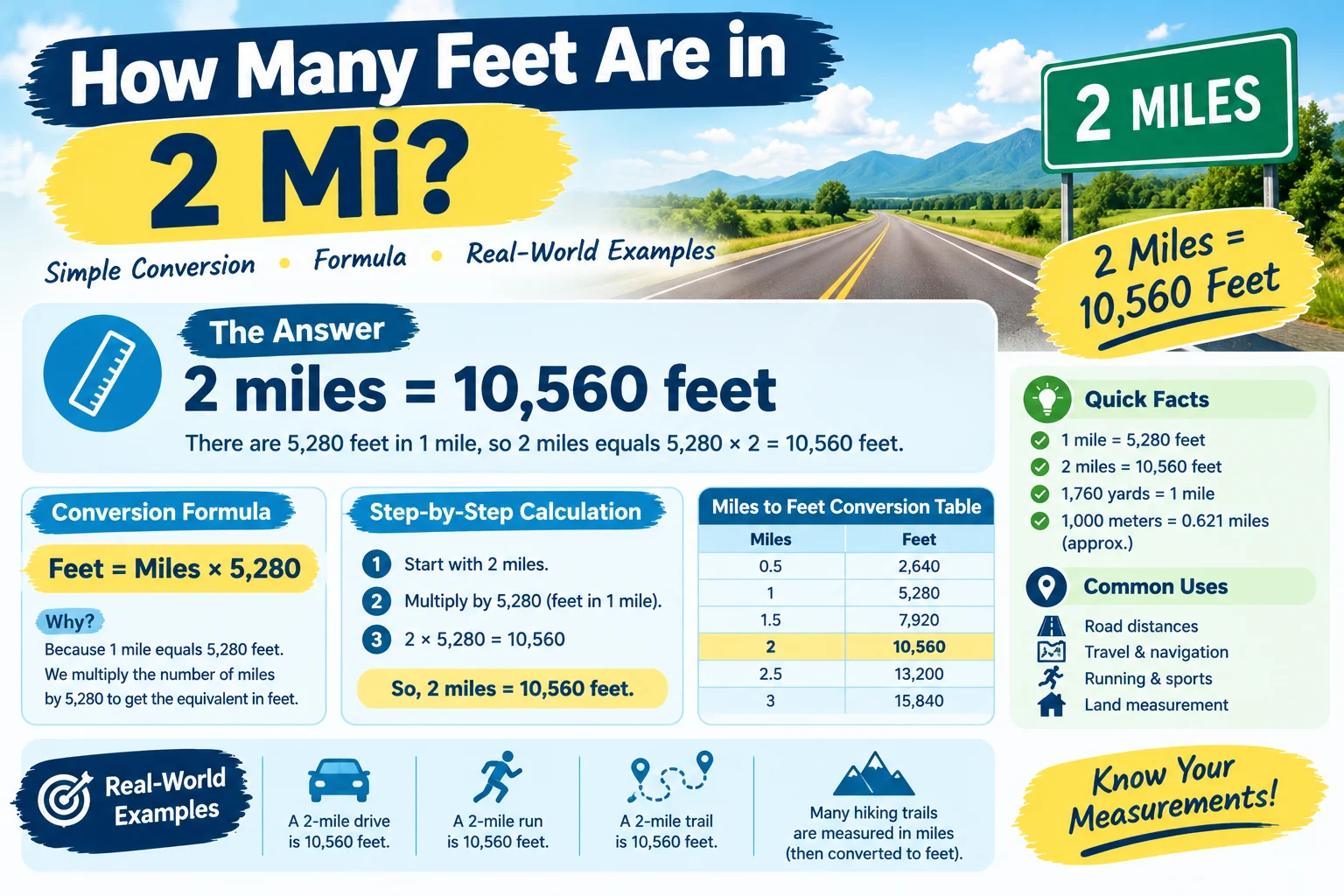
There are exactly 10,560 feet in 2 miles.
The calculation is straightforward because 1 mile equals 5,280 feet:
2 miles × 5,280 feet per mile = 10,560 feet
That means a two-mile distance contains 10,560 individual feet. Once you know the relationship between miles and feet, you can convert other distances just as easily.
This guide explains the conversion formula, shows several worked examples, provides useful conversion charts, and explains when converting miles to feet matters in everyday life. Whether you’re a student solving a math problem, a homeowner measuring property, or a professional working from plans, you’ll have a reliable method for converting units accurately.
1. Quick Answer: How Many Feet Are in 2 Mi?
2 miles = 10,560 feet.
The standard U.S. customary length conversion is:
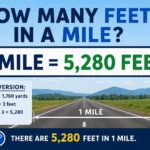
1 mile = 5,280 feet
Therefore:
2 × 5,280 = 10,560 feet
At a glance
| Measurement | Equivalent |
|---|---|
| 2 miles | 10,560 feet |
| 2 miles | 3,520 yards |
| 2 miles | 126,720 inches |
| 2 miles | 3.218688 kilometers |
| 2 miles | 3,218.688 meters |
The answer is exact, not an estimate. You don’t need to round unless the situation requires a particular level of precision.
2. Understanding Miles and Feet
A mile and a foot are both units used to measure length or distance.
A mile is a relatively large unit, commonly used for roads, travel distances, property boundaries, running routes, and geographic measurements. A foot is much smaller and is frequently used for buildings, room dimensions, construction, landscaping, and everyday measurements.
Both belong to the U.S. customary system used in the United States. The foot and mile are also part of the broader traditional English measurement system, although the modern U.S. and international definitions should not be confused with every historical version of those systems.
The relationship is fixed:
- 1 mile = 5,280 feet
- 1 foot = 12 inches
- 1 mile = 1,760 yards
- 1 yard = 3 feet
The number 5,280 may look unusual, but it is simply the established relationship between these units.
What about metric units?
The metric system uses kilometers and meters instead. One international mile equals exactly 1.609344 kilometers.
So:
2 miles = 3.218688 kilometers
This is useful when comparing U.S. customary units with metric measurements used internationally.
3. Conversion Formula: How Many Feet Are in 2 Mi?
The basic conversion formula is:
Feet = Miles × 5,280
For the specific question of how many feet are in 2 mi:
Step 1: Start with the distance
2 miles
Step 2: Use the conversion factor
1 mile = 5,280 feet
Step 3: Multiply
2 × 5,280 = 10,560
Step 4: State the result
2 miles = 10,560 feet
That’s all the calculation requires.
Why do we multiply?
You’re starting with two groups of 5,280 feet. Each mile contains 5,280 feet, so two miles contain:
5,280 + 5,280 = 10,560 feet
Multiplication is simply the faster way to express that repeated addition.
Worked decimal example
Suppose you need to convert 2.5 miles to feet:
2.5 × 5,280 = 13,200 feet
So, 2.5 miles = 13,200 feet.
Reverse conversion
If you know the distance in feet and want miles, divide by 5,280:
Miles = Feet ÷ 5,280
For example:
10,560 ÷ 5,280 = 2 miles
This reverse calculation is especially useful when reading construction plans or converting measurements recorded in feet.
4. Conversion Table for Miles to Feet
A small conversion table makes it easier to estimate nearby distances without repeating the calculation.
| Miles | Feet |
|---|---|
| 0.25 mi | 1,320 ft |
| 0.5 mi | 2,640 ft |
| 0.75 mi | 3,960 ft |
| 1 mi | 5,280 ft |
| 2 mi | 10,560 ft |
| 2.5 mi | 13,200 ft |
| 3 mi | 15,840 ft |
| 4 mi | 21,120 ft |
| 5 mi | 26,400 ft |
| 10 mi | 52,800 ft |
For quick reference, remember that every additional mile adds another 5,280 feet.
Common values in other units
| Distance | Feet | Yards | Inches |
|---|---|---|---|
| 1 mile | 5,280 | 1,760 | 63,360 |
| 2 miles | 10,560 | 3,520 | 126,720 |
| 3 miles | 15,840 | 5,280 | 190,080 |
| 4 miles | 21,120 | 7,040 | 253,440 |
| 5 miles | 26,400 | 8,800 | 316,800 |
These values can serve as a handy reference when you need to calculate measurements quickly.
5. Practical Examples: When This Conversion Matters
Knowing how many feet are in 2 mi isn’t just a classroom exercise. Distance conversions appear in many practical situations.
Construction and land measurement
A contractor or surveyor might receive a project specification in miles but need to express a distance in feet for a site plan.
For example:
2 miles × 5,280 = 10,560 feet
That gives the team a precise linear distance to use in calculations.
Home improvement
A homeowner planning a long driveway, fence line, private road, or property boundary may encounter distances measured in both feet and miles.
If a property boundary is approximately 2 miles long, its length is:
10,560 feet
Of course, actual property boundaries can contain curves and angles, so this conversion describes the straight-line length represented by the stated distance.
Sports and fitness
Running and walking routes are often described in miles, while a track or training facility may provide dimensions in feet.
A two-mile run covers:
10,560 feet
This doesn’t mean a runner travels that distance in one straight line; it is the total distance represented by the route.
Education
Teachers often use mile-to-foot problems to demonstrate multiplication, unit conversion, dimensional analysis, and proportional reasoning.
The key idea is not memorizing a mysterious number. It’s understanding that every mile contains 5,280 feet.
Travel and mapping
Road signs and navigation tools commonly express distances in miles in the United States. Detailed planning documents may use feet for shorter segments.
Being able to move between the two units helps prevent confusion when comparing measurements.
6. Common Conversion Mistakes
Most errors with this calculation aren’t caused by difficult mathematics. They’re caused by using the wrong operation or conversion factor.
Mistake 1: Dividing instead of multiplying
To convert miles to feet, multiply by 5,280.
Correct:
2 × 5,280 = 10,560 feet
Dividing by 5,280 converts feet to miles, which is the reverse direction.
Mistake 2: Using 5,280 incorrectly
A common error is to remember that a mile contains 5,280 feet but accidentally add or subtract the number.
For a direct conversion, use:
Miles × 5,280 = Feet
Mistake 3: Confusing yards and feet
One mile contains 1,760 yards, not 5,280 yards.
Because one yard contains three feet:
1,760 × 3 = 5,280 feet
Mistake 4: Mixing metric and customary units
Don’t assume that a mile equals 1.6 feet or that a foot equals 1.6 meters. Those relationships involve different units.
For example:
1 mile = 1.609344 kilometers
while:
1 foot = 0.3048 meter
Mistake 5: Rounding too early
If you are converting miles to feet, there’s no reason to round the result for ordinary calculations. The conversion factor is exact.
Expert tip: Write the units beside your numbers. Seeing “miles × feet per mile” makes it much easier to catch an incorrect calculation before it becomes a larger measurement error.
7. Quick Mental Conversion Tips
You don’t always need a conversion calculator.
The easiest number to remember is:
1 mile = 5,280 feet
From there, simple mental calculations become possible.
For 2 miles
Double 5,280:
5,280 × 2 = 10,560
For 3 miles
Add another 5,280:
10,560 + 5,280 = 15,840
For half a mile
Divide 5,280 by 2:
2,640 feet
For a quarter mile
Divide 5,280 by 4:
1,320 feet
A useful mental-math pattern
| Miles | Quick calculation | Feet |
|---|---|---|
| 0.25 | 5,280 ÷ 4 | 1,320 |
| 0.5 | 5,280 ÷ 2 | 2,640 |
| 1 | 5,280 × 1 | 5,280 |
| 2 | 5,280 × 2 | 10,560 |
| 4 | 5,280 × 4 | 21,120 |
For larger values, multiplication is still usually faster and safer than trying to memorize every answer.
8. Comparison Between Miles and Feet
Miles and feet measure the same physical quantity—length—but they’re designed for different scales.
| Feature | Mile | Foot |
|---|---|---|
| Relative size | Large distance unit | Smaller length unit |
| Exact relationship | 1 mile = 5,280 feet | 1 foot = 1/5,280 mile |
| Common uses | Roads, travel, running | Construction, rooms, objects |
| Precision for short distances | Less convenient | More convenient |
| Main advantage | Easy for long distances | Practical for detailed measurements |
| U.S. customary use | Very common | Very common |
Neither unit is inherently more accurate. Accuracy depends on how precisely the measurement is taken and recorded.
For example, saying a road is 2 miles long is perfectly useful for navigation. Saying a wall is 10,560 feet long would be mathematically correct but unnecessarily cumbersome.
Choosing the right unit
Use miles when:
- Measuring roads or travel routes
- Describing long running or walking distances
- Discussing geographic distances
- Giving directions over several thousand feet
Use feet when:
- Measuring rooms
- Reading construction plans
- Estimating fence or wall dimensions
- Measuring building components
- Working with architectural dimensions
The best unit is usually the one that makes the measurement easiest to understand and apply.
9. Why Accurate Measurement Matters
Accurate unit conversion matters because a small misunderstanding can become a significant practical error.
Imagine a contractor receives a specification for a 2-mile utility route but mistakenly treats 2 miles as 2,000 feet. The difference is enormous:
10,560 feet − 2,000 feet = 8,560 feet
That is more than 1.6 miles of missing distance.
In construction, engineering, and manufacturing, errors of this type can affect material quantities, labor estimates, schedules, and project costs.
A realistic scenario
Suppose a landscaping company needs to estimate edging for a long recreational trail measuring 2 miles.
The trail length is:
2 × 5,280 = 10,560 feet
If edging is required on both sides, the total linear requirement becomes:
10,560 × 2 = 21,120 feet
That second calculation illustrates an important professional habit: convert first, then apply the measurement to the project requirement.
The same principle applies to engineering drawings, manufacturing specifications, educational exercises, and DIY projects.
Whether you’re performing a length conversion, weight conversion, or volume conversion, using the correct conversion factor is fundamental.
10. FAQ: How Many Feet Are in 2 Mi?
How many feet are in 2 mi?
There are 10,560 feet in 2 miles. The calculation is 2 × 5,280 because one mile contains exactly 5,280 feet. Therefore, doubling one mile gives 10,560 feet. This is an exact U.S. customary length conversion, so no rounding is required.
What is the easiest way to convert 2 miles to feet?
The easiest method is to multiply the number of miles by 5,280. For 2 miles, calculate 2 × 5,280 = 10,560 feet. If you only need the answer for this specific measurement, remembering that 1 mile equals 5,280 feet lets you solve it mentally by simply doubling 5,280.
Can I convert miles to feet without a calculator?
Yes. For 2 miles, you can double 5,280: 5,280 + 5,280 = 10,560 feet. For other whole-mile distances, repeated addition or basic multiplication works well. A calculator becomes more useful when you’re working with many decimal places or a large set of measurements.
Is the conversion from miles to feet exact?
Yes. 1 international mile equals exactly 5,280 international feet, so 2 miles equals exactly 10,560 feet. Unlike some conversions involving rounded decimal factors, this relationship does not require approximation. You can therefore use 10,560 feet confidently in calculations where exact unit conversion is required.
What formula should I remember for miles to feet?
Remember this simple conversion formula:
Feet = Miles × 5,280
To reverse the calculation, use:
Miles = Feet ÷ 5,280
These two formulas cover ordinary mile-to-foot and foot-to-mile conversions and are useful for schoolwork, construction, mapping, and other measurement tasks.
How many yards are in 2 miles?
There are 3,520 yards in 2 miles. One mile equals 1,760 yards, so 2 × 1,760 = 3,520 yards. Because one yard equals three feet, multiplying 3,520 by 3 also gives 10,560 feet. This provides another way to verify the main conversion.
How many kilometers are in 2 miles?
Two miles equals exactly 3.218688 kilometers. The conversion uses 1 mile = 1.609344 kilometers, so 2 × 1.609344 = 3.218688. In everyday conversation, this might be rounded to approximately 3.22 kilometers, but the unrounded value is preferable when precision matters.
Why is knowing how many feet are in 2 mi useful?
Knowing the conversion helps when measurements are expressed in different units. Construction plans, property measurements, sports routes, maps, engineering specifications, and educational problems may use either miles or feet. Converting them correctly lets you compare measurements and perform calculations without mixing incompatible units.
Which industries commonly use miles and feet?
Both units appear across construction, engineering, transportation, surveying, sports, real estate, landscaping, and education. Miles are generally convenient for longer distances, while feet are better suited to detailed dimensions. Professionals often convert between the units depending on the scale and purpose of the measurement.
Final Thoughts
The answer to how many feet are in 2 mi is simple:
2 miles = 10,560 feet
The essential conversion factor is 1 mile = 5,280 feet. To convert miles to feet, multiply by 5,280. To convert feet back to miles, divide by 5,280.
The most useful formula to remember is:
Feet = Miles × 5,280
Once that relationship is familiar, you can quickly convert whole numbers, decimals, and reverse measurements without relying on a specialized measurement calculator.
Accurate conversions are more than a math exercise. They help students solve problems correctly, help homeowners plan projects, and help professionals avoid costly measurement errors.
Ready to make your next measurement easier? Explore more measurement conversion guides for miles, feet, inches, yards, centimeters, meters, and other everyday units.
How Many Square Feet in a Quarter of an Acre?